
World taz
Liechtenstein visits India: 100 billion US dollars for India
The European Free Trade Association was faster than the EU in free trade with India. Liechtenstein's hereditary prince is now visiting Delhi. What is the balance? more...
Deutsch (original) ·Auto-translated to English
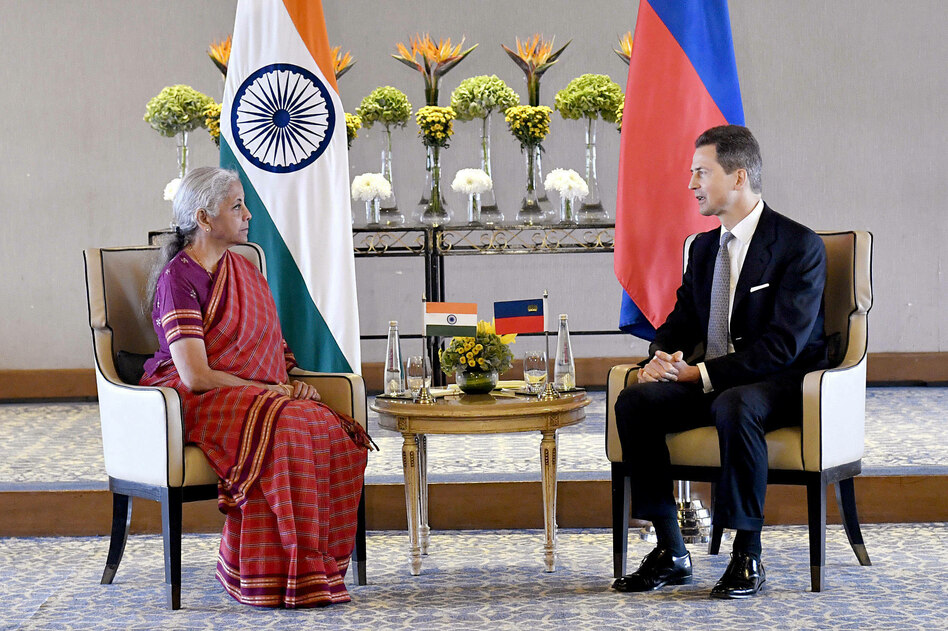
At the beginning of the week, Delhi rolled out the red carpet for the royal visit. Hereditary Prince Alois of Liechtenstein arrived in India for the Principality's first state visit. "The Trade and Economic Partnership Agreement was an important milestone. We want to build on this momentum and further deepen our ties," he said in a meeting with Prime Minister Narendra Modi on Tuesday.
Delhi is once again moving into the European spotlight. At the beginning of October, Swiss Federal President Guy Parmelin visited. The hereditary prince and Parmelin were in the Indian capital for the AI summit back in February. The visits show how important India has become for the states of the European Free Trade Association (EFTA).
Meanwhile, Modi met Poland's Prime Minister Donald Tusk. He tried to use India's close relations with Russia to persuade Moscow to make peace in Ukraine. While Russia's war against Ukraine is putting a strain on Europe's security, the Iran war is endangering India's energy supply.
Meanwhile, Delhi is expanding its economic relations: in the past six years, the country has signed nine trade agreements. The EFTA is ahead of the EU here. Their agreement, or Tepa for short, came into force in October 2025. The EU hopes to complete its free trade agreement by mid-December.
But what did the lead bring? “The results so far are manageable,” says Saon Ray, visiting professor at the Indian Council for Research on International Economic Relations in Delhi. In the 2025/26 financial year, India's exports to the Efta countries fell by 10.8 percent to $1.75 billion. In the first quarter of the current financial year, they fell by 22.7 percent year-on-year. However, excluding gold, they remained almost stable.
The Efta countries Switzerland, Norway, Iceland and Liechtenstein plan to invest $100 billion in India within 15 years and create one million jobs. India relies on pharmaceuticals, biotechnology, mechanical engineering and renewable energies, explains Ray. Swiss companies are planning investments of 29 billion US dollars by 2030 and expect this to create around 400,000 jobs.
Whether the goals are achieved also depends on the geopolitical situation, which can slow down investments, warns Ray. However, India remains the fastest growing major economy in the world. “When uncertainty subsides, it might make sense to invest in India,” she says. It is still too early to evaluate Tepa. However, the agreement holds great potential.
Tepa came into force around ten months before the planned EU agreement. Both contracts differ in important ways, says Ray. India and the EU have also agreed on an investment protection agreement. More than 6,000 EU companies are already active in India. The smaller Efta is also represented on the Indian market with companies such as Nestlé, Novartis and UBS.
For Liechtenstein it is about diversifying its economic relationships. And: “Our export-oriented industries need market access,” says Sabine Monauni, Liechtenstein’s deputy head of government in Delhi. The time advantage over the EU is an advantage. At the same time, Liechtenstein must meet its investment obligations. “Since 2024, we have invested more than $107 million in India and created over 1,000 jobs and additional training positions,” she says. Tepa gave companies additional motivation to invest in India.
Supply chains would increasingly shift to India. In view of geopolitical uncertainties, Liechtenstein companies are diversifying their production. The tool manufacturer Hilti, for example, also produces in India and exports from there all over the world. “India offers more security because of the Tepa,” says Monauni.
The companies are not just concerned with cheap production. “They want to invest sustainably in the workforce,” she says. Like other German-speaking countries, Liechtenstein companies have experience in vocational training. In India there is also a young, large workforce that is not available to Liechtenstein in this form.
Liechtenstein is seeking a double taxation agreement with India, which Germany has had since 1995. Whether Efta's lead will pay off will be seen in the coming months.