
World taz
LGBTIQ in Turkey: With Pride against Erdoğan
First Zoe Lila lost her job as a teacher, then she ended up in the men's wing of a police station. How Turkey puts queer people under pressure. more...
Deutsch (original) ·Auto-translated to English
About 15 men are sitting in the cell where the police put Zoe Lila. She is the only woman. But for the officers, it's not their appearance that counts, but rather what it says on their ID card: "Erkek", i.e. male. Zoe is a trans woman and has already had gender reassignment surgery. However, your gender entry has not yet been changed. To do this, she still has to go through a lot of administrative procedures and doctor's visits, she says a few weeks after her arrest in a café in Istanbul's Osmanbey district.
“With such actions they want to spread fear and tell us: We will wipe you out.” Zoe Lila's lips are painted red and her fingernails are painted the same color. She smiles as she sits down, orders a chamomile tea and takes a deep breath. She seems calm.
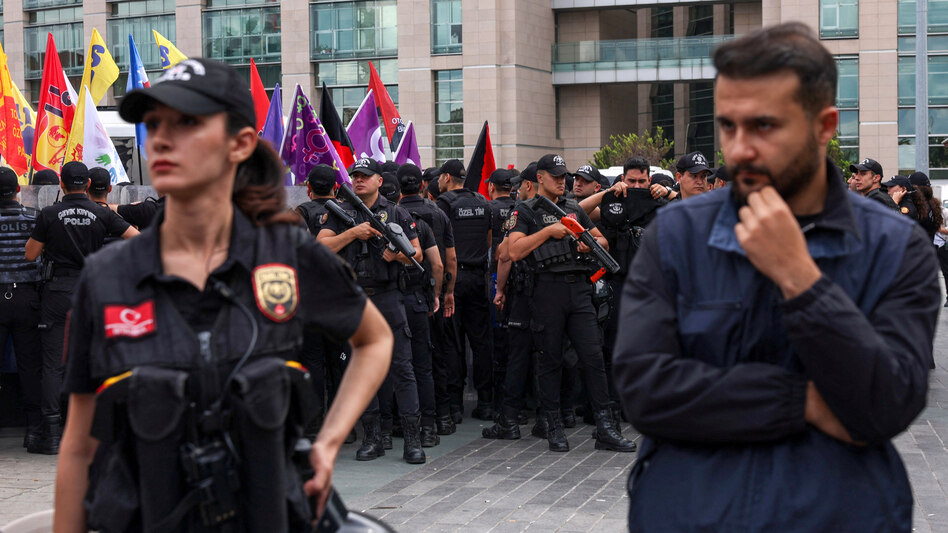
Zoe was among more than 100 people arrested on September 15 during a protest against police crackdowns on the queer community. She spent 32 hours in police custody before being released. She reports insults, violence and intimidation.
A few days before her arrest, the police searched places where queer people gather: club rooms, bars, nightclubs and apartments. “Ailem Güvende,” the authorities called the police operation: “My family is safe.” The public prosecutor's offices in Istanbul, Ankara, İzmir, Aydın and Mersin coordinated the operations, which covered 15 provinces. According to the Ministry of Justice, 162 people, 9 clubs and 13 companies are being investigated.
The investigations also affect those who support queer people in everyday life: by providing advice, defending their rights or supporting people with HIV. In Ankara, the police arrested members of the board and supervisory board of Kaos GL. In Istanbul, she took action against members and those responsible for Lambdaistanbul, HEVİ LGBTİ+ and SPoD, among others, as well as against the HIV aid organization Pozitif-İz.
The authorities cite, among other things, “obscenity”, violations of the association law as well as prostitution and drug offenses as reasons for the arrests. An investigation is also underway in Istanbul on suspicion of forming a criminal organization. Justice Minister Akın Gürlek said the operations served to protect children, families and social order. He placed it in the context of the “Decade of Family and Population” from 2026 to 2035 proclaimed by President Recep Tayyip Erdoğan.
Homosexuality is not punishable in Turkey, nor is gender reassignment treatment. But according to Human Rights Watch, authorities are using existing criminal statutes to criminalize queer people and organizations. An example from Ankara shows how quickly accusations of “obscenity” are made: The evidence against Kaos GL includes two photos of kissing men that were published on social media.
Zoe thinks the very name of the operation “My Family is Safe” is cynical. “Are you sure?” she asks, rummaging through her cloth bag. She pulls out a cigarette filter, a turquoise pack with Arabic writing and a piece of paper. “No one is safe in this country.” Neither at home, nor on the street, not even children at school. As she rolls her cigarette, she talks about how clubs helped her change her name and gave her legal and psychological support.
But how long these contact points will continue to exist is uncertain. The Istanbul association SPoD fears that the previous arrests will not continue. In a statement from September he warned of the threat of club closures. Test reports and applications from the public prosecutor's office indicated this. Legal advice and the documentation of discrimination are already being criminalized. But without contact points like SPoD, queer people lose places where they can seek help, share experiences and defend themselves.
“These clubs are vital for us,” says Zoe. The government wants to create an internal enemy to distract from the problems in the country - the high cost of living, femicides, violence against children, often in the domestic context.
Queer people have to take the blame now. Zoe's tobacco pouch reads "Buradayım Aşkım" - "I am here, my darling" in rainbow-colored letters. The answer to the cry of “Where are you, my darling?” that people shouted to each other at Istanbul Pride 2013, two years before the authorities first banned the march. The change call became the identifying symbol of the queer movement. Zoe lights her cigarette, takes a drag and places it in the ashtray.
“The streets belong to us,” says Zoe. To protest against the raids, she took to the streets on September 15th together with human rights activists, feminists and lawyers. They gathered in front of the Istanbul Palace of Justice in Çağlayan. But the police surrounded the demonstrators and arrested 106 people. Also Zoe.
After her arrest, Zoe was taken to the Büyükçekmece police station with about 30 other women. Three plainclothes police officers picked them up there that night, she says. Why were they in civilian clothes? She doesn't know that. With handcuffs behind her back, she had to get into a car alone with them. They said they would take her to another police station, Zoe remembers. There was no more precise explanation.
The journey took about two hours and at times led through a forest area. Why did they take this route? “Just harassment and to show how powerful the state is,” Zoe thinks looking back.
At the next station, a male police officer wanted to search her. “I said I was a woman and didn’t want to be searched by a man,” Zoe says. The answer: her ID says “male”.
Her lawyer put it in writing that the police would be responsible if anything happened to Zoe. Only then did the officers move her to a small cell with two other trans women. They stayed in the men's wing. Zoe was not allowed to return to the women with whom she was initially arrested.
Already in the summer she lost her job as an English teacher at the private Sarıyer Açı Ortaokulu in Istanbul. She taught there for five years and has been working as a teacher for a total of ten years. She loves her job, says Zoe. When she began her gender reassignment treatment about three years ago, she worried about one thing above all else: would she be allowed to continue teaching?
She confided in her principal, who involved the school's founder. They both supported her. “They told me it was a human right and they would stand behind me until the end,” Zoe remembers. The school even gave her an interest-free loan for the operation. For Zoe, it looked like she could stay and continue doing what she loves: teaching.
In June, Zoe finally informed her students, their parents and the staff. She prepared this step together with school psychology. Four days later, her former name, photos and personal information appeared in pro-government media. A colleague passed on the information, she says. Suddenly, what she entrusted to her school community is being read and seen on television across the country. “I couldn’t leave my apartment for a while, my face was everywhere,” she says. She received hate messages and death threats - including from her uncle in Cyprus.
A few days later, Zoe was scheduled for surgery. She had been preparing for this procedure for years. But the day before the operation, the school informed her that her contract would not be renewed. The decision was apparently made days before - without being informed about it. Quite the opposite: her superiors assured her that they would have her back. “You lied to me,” Zoe says calmly.
Instead of being able to concentrate on the procedure and her recovery, she now had to defend herself legally. The school was under pressure from the Ministry of Education. “You said the ministry was demanding a head.” The guidance counselor who had supported Zoe during her transition also lost her job. The school did not respond to a query from the taz about the allegations.
Zoe doesn't want to just accept this. She worked there for five years without a single negative review. During an attempt at mediation, she was offered money so that she would remain silent. “They wanted to cover up their violations of the law,” she says. She refused. There are also other queer people at the school, says Zoe: students, parents, teachers. But no one speaks openly about it out of fear. "The only visible trans person was me. And that's why I was targeted."
The Ministry of Education accused Zoe of teaching without a valid license and imposed two disciplinary reprimands and a fine. After changing its name, the school would have had to have its teaching license renewed, explains Zoe. She submitted the necessary documents. But now she is being punished.
Zoe has remained in contact with her former students. They write to her again and again, she says. A ten-year-old child sent her a long text: "You are still very valuable to us. Nothing has changed at all." She also receives messages from former students who now live abroad. Some have formed a solidarity group. Two confided in her that they were trans themselves and that they wanted a teacher like her when they were at school. Zoe now gives some people private lessons. This way she earns a little money and can continue to do what she loves, at least in a small way.
In Kadıköy, on the Asian side of Istanbul, Tusidi is preparing for her performance. She repeatedly pulls the comb through her blonde wig, adjusting individual strands. “My own hair hasn’t been washed,” she says without looking up and laughs. Then she points to her head. “Look, they’re just greasy.” And anyway: blonde hair suits her well, she thinks.
Homosexuality is not punishable in Turkey. Gender reassignment treatments and changing the gender entry are possible under legal requirements. Nevertheless, authorities prosecute queer people and organizations with different regulations: for example, for “obscenity” or alleged violations of association law. Human rights organizations criticize this as targeted criminalization.
The government describes extensive legal changes, including in criminal law, as justice packages. A draft of the 11th package that became known in October 2025 envisaged up to three years in prison for behavior that contradicted “biological sex” and “public morality” – as well as for public support for it. In addition, gender reassignment treatments should be made significantly more difficult. Among other things, the plan was to raise the minimum age to 25 years.
Queer organizations, human rights groups and medical associations mobilized against the plans. When the 11th Justice Package came to parliament in November 2025, the anti-queer provisions were missing. This was a success of public pressure.
Pride marches took place annually in Istanbul from 2003 to 2014, with tens of thousands taking part. The authorities banned the march for the first time in 2015; The police used tear gas and water cannons against participants. Since then, bans and police operations have prevented the big parade from taking place. Activists still organize protests and small marches – with the risk of being arrested.
Tusidi actually means something different. She doesn't want to read her real name in the newspaper, nor the name of the nightclub where she works as a dancer. The risk of coming onto the government's radar is too high for that. A staircase leads down to a kind of cellar. Such places are known in the scene, but they should remain secret to the outside world.
She often wears a hoodie, cap and sunglasses outside. “Especially with my deep voice, people look twice,” she says. She has had her gender reassignment surgery and her gender has also been changed. But that doesn't protect her from stares and attacks on the street. She tells how she was spat on, pushed and beaten. “What kind of man are you?” people would have shouted after her. "I'm not a man at all. I'm a woman. You can see that!" she says and laughs.
Since the raids in September, she has become even more worried. Friends who hung rainbow flags in solidarity were arrested. “Now I have even more friends in prison to worry about,” says Tusidi.
Dancing is part of her life here at the club. She can decide about her body herself. That gives her strength. It is all the more important that such spaces remain. “We saw what happened during the raids in September,” she says seriously. She fears that someone could betray the club.
Tusidi hopes for a life in which she doesn't always have to worry about ending up in prison like her friends. Until then, she wants to continue dancing and filling the places where she can move freely with life. This is also a kind of resistance: “The show must go on”. This applies to their performances in the club as well as to the protests on the streets. She won't stop.
Back at the café in Osmanbey, Zoe's chamomile tea has long since gone cold. When she talks about her plans for the evening, it turns back to her former students. She has arranged to have dinner with some of them and their parents. A reunion that she is looking forward to. They stick by her, even if she is no longer allowed to stand in front of her class.
Zoe wants to prove in court that the school fired her because of her gender identity. She also cares about those who come after her. She hopes for a ruling that other trans people can rely on if they lose their jobs because of their gender identity. “They shouldn’t be able to just target trans women and dismiss them,” she says.
She sees what happened to her at school and in police custody as part of a whole. "They don't want to accept our existence. On the contrary: they want to make us invisible by putting us in prison, making us unemployed and depriving us of any security."
Next month, she hopes that her gender entry on her identity card will finally be changed: from “Erkek”, male, to “Kadın”, female. However, it remains to be seen when she will be able to stand in front of a school class again. “I don’t want to spend the next 10 or 15 years of my life fighting for my rights,” she says. After all, she has to live and pay her bills.
But when Zoe speaks of rights, she doesn't just mean her own. She speaks of women, of children, of the Kurdish minority in the country. She sees the attacks on queer people as part of a development that also affects others. “Today it starts with LGBTQ, tomorrow it’s about women’s rights,” she says. You have to defend yourself before you are affected yourself. “I don’t have to be a Kurd to defend the rights of Kurds.” Then she smiles and shouts through the café: “No one is free until everyone is free.” No one is free until everyone is free.