
Germany · taz · · 4h
Reading Writing Black Berlin: Completely different stories in your luggage
Deutsch (original) · Auto-translated to English
East Berlin, goodness! It has long been bitterly cold in Germany. If you're feeling cold now, you've probably spent the last few years in hibernation.
When you maneuver through public spaces as a black person, you know only too well how stubborn the frost is in this country. In trains or cafés you are subjected to white full-body scans, you try to escape or cheekily scan back. Maybe you spot the only other black person in the corner of the room, maybe you give her a quick nod. Or you feel like you're being put on the wrong side of ice and don't know how to behave appropriately.
In the Berlin Brotfabrik on Friday evening, thinking out loud about black realities, individual dreams and collective dissonances works surprisingly well. Bread factory board member and literary agent Alexander Graeff has invited people to “Writing Black Berlin”. The restaurant in the former inn on Caligariplatz hums and clinks, but you don't feel pressured.
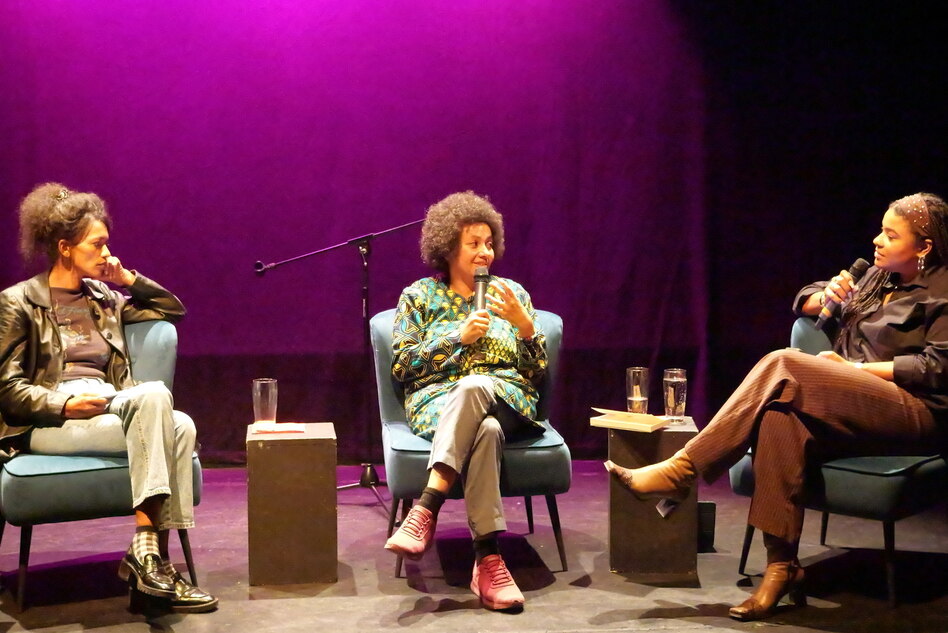
After a quick scurry through the cozy hustle and bustle to the event hall, it starts. Yama Tessa Hart, Elisa Aseva and Jenaba Samura sat on blue velvet armchairs. The three walk between cultural forms, writing diary-like texts here, queer poems there, or researching postcolonialism, all from a black perspective.
Moderator Jenaba Samura opens the conversation with a quote from the Berlin author and activist May Ayim: “Germany in autumn/I dread winter”. Germany's most famous Afro-German poet had exposed German racism in her texts for years and threw herself from a high-rise building to commit suicide in August 1996. She called German reunification “sh-unity,” as moderator Samura reminded us that evening before German Unity Day.
It continues with Yama reciting her poem “Excluded” to Tessa Hart. In this situation, those around you tell you that it is your own fault for being excluded. A safe space is also prohibited. Hypocrisy. In Hart's short story "Overboard," good old German virtue comes to the fore. In it, wings sprout from the head of the narrative self, which initially floats around between different ships, which help to catalog the ships from the air as illusions and social constructs.
Elisa Aseva draws attention to the perfidious deceptions of the dominant society, which degrades those affected by racism as black snowflakes. She reads kaleidoscopic short messages from “Over Hours” and reflects on her time living behind the Kotti and the black community. “You come together over lived experiences of discrimination, but you have completely different stories in your luggage,” says Aseva, explaining that there were phases in which the literary world couldn’t get enough of black stories of suffering. “Great, it’s all in there,” agents and publishers certainly wouldn’t say to white authors.
Just a few weeks ago, the authors Tupoka Ogette and Don Pablo Mulemba discussed something similar at the Berlin Literature Festival. Writing a sci-fi story as a black person? Why not! The white dominant society finds it difficult to tolerate dualities. At least some of them reach for the book table at the end of “Writing Black Berlin”.
Read the full story at the source
Source: taz