
Germany taz
Agricultural soils: Hopefully the worm is in there!
Lots of earthworms, that’s what every farmer wants. An organic farmer from Saxony observes: The animals help the soil even in extreme weather. more...
Deutsch (original) ·Auto-translated to English
The ground in front of the barn is bare and dense; a few days ago there was still heavy building material stored here. Nevertheless, the first globules of earth can be seen on the surface and small holes in the dense earth. Kai Pönitz, slim, tall, in his mid-fifties, kneels on the ground and pulls a blade of grass from one of these corridors.
“The earthworms immediately started working, grabbing the stalks to digest them.” Here in Seifersdorf near Freiberg in Saxony, at the foot of the Ore Mountains, Pönitz keeps a herd of Galloway cattle - sought-after meat for star chefs in the region. Over the summer, he also takes in other farmers' animals as a summer retreat. And he is investigating the extent to which climate change affects the earthworms in his soil.
Pönitz's passion for the inhabitants of the underworld began in 2018, when he was still regularly plowing his fields. The neighbor, a successor to the former LPG cooperative, did not do this, instead he mulched. With mulch sowing, the crops are covered with a protective layer - usually with straw, leaves or plant residues.
The aim is to protect the soil, retain moisture and suppress weeds. Ideal for earthworms. A plowed organic field here, a conventionally managed and mulched field there – that piqued Pönitz’s interest. “I wanted to know if there were more worms there than in my organic soil that had been plowed.”
So Pönitz dug up square meters of earth in four different places in both fields. In addition to his work as a farmer, he teaches at the Freiberg-Zug technical school center. The helpers come from there and work with him to count and compare earthworms. In order to get to the specimens that live deep in the ground, an irritant is poured into the ground.
“The worms find the brew disgusting and escape to the surface.” The volunteers counted an average of 220 earthworms per square meter on the organic soil, while there were only around 100 on the conventionally mulched area.
Earthworms are an indicator of soil quality, i.e. fertility. Agricultural scientist and earthworm expert Stefanie Krück prepares reports on soil function using earthworms, among other things. She says: “The rule of thumb is: Where there are lots of earthworms, the soil is healthy.” “A lot” means different things depending on the nature of the soil: in sandy soil, 50 earthworms per square meter is a lot, in clay soil it would have to be more like 200.
Pönitz could have left it at his first count. But the result actually raised new questions: What does it look like on a field that is farmed and plowed conventionally? And how does this compare to grassland, i.e. the soil that is no longer cultivated?
The following year, the farmer expanded his experiment: As expected, the largest earthworm population was found in the grassland - up to 500 specimens per square meter. In order to examine the influences of management and climate change on the earthworm population in more detail, Pönitz has since carried out his worm count twice a year: in spring and autumn.
In October 2026, the farmer, binoculars around his neck to look for animals, trudges across his fields and pastures in rubber boots. On the first field, almost 5 hectares in size, Pönitz grows an alfalfa-clover grass mixture into which he sprinkles other forage herbs “because this makes the feed more palatable for the cattle.” The alfalfa has roots several meters deep and therefore penetrates the soil very well, providing an ideal environment for earthworms.
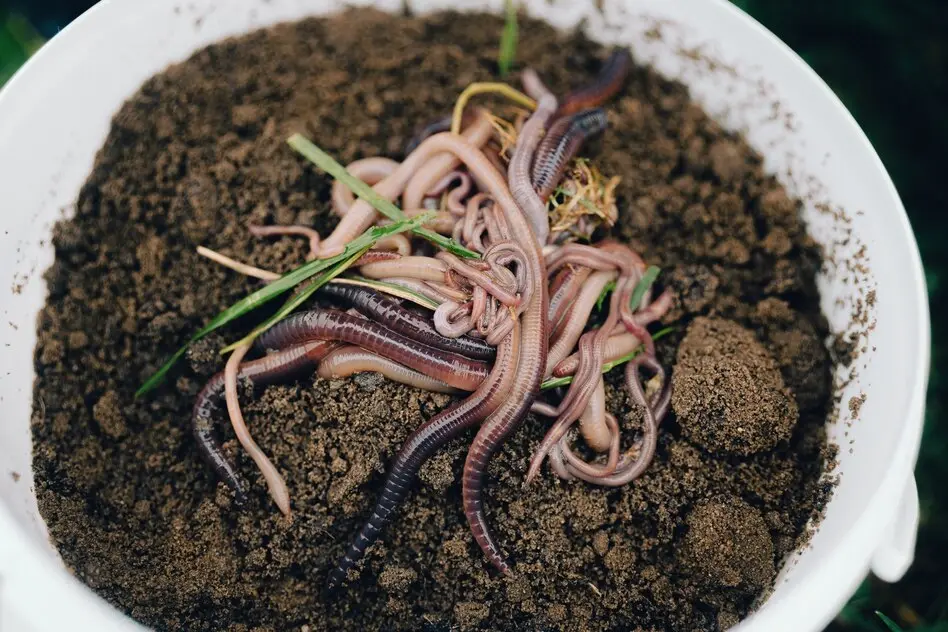
Lumbricus terrestris, for example, the common earthworm, digs its burrows up to 3 meters deep into the earth, usually horizontally. The farmer kneels down to push the clover and alfalfa a little to the side with his hands. Yellow plant remains appear under the dense canopy of leaves. “This is ideal food for the earthworm: it pulls the biomass into the soil and digests it there.” What remains are small black balls of soil, the so-called worm solution - biomass that is ideal as garden soil.
“We divide earthworms into three different groups,” explains Pönitz: “The deep burrowers, shallow burrowers and litter-dwellers.” The latter, also called epigeic species, can be found, for example, in the forest floor. Endogeic, shallow-burrowing earthworms are rarely seen on the surface; they live at depths of up to 1 meter and mainly dig horizontal burrows - the pink meadowworm, for example, or the fieldworm.
Shallow diggers have few pigments that can protect them from UV radiation. "In the case of deep diggers, the anectic species, half of the body is pigmented," says Pönitz, "they can easily get out of the earth with this part of their body, for example to select the best plant residue. Earthworms can convert 40 to 100 tons of biomass on one hectare in a year - if they are doing well."
The soil expert Stefanie Krück has written a “picture atlas for earthworm identification”. She knows: Earthworms have eight bristles, and you can tell which species they are based on their arrangement, the position of the belt or the color of the earthworm's body. There are 52 different species in Germany, “but with a strong north-south divide,” says Krück. In the German northeast there are only 20, which is due to the ice age: “Earthworms could not survive under the frozen glacier.”
That was almost 12,000 years ago. But earthworms need time until they conquer new habitats. It's a question of adaptation. “Some species cope better with drought,” says Krück. Aporrectodea caliginosa, for example, the small meadow worm that lives in the topsoil.
“Other species react very sensitively to drought; after the dry years of 2018 to 2020, they were greatly reduced,” adds the expert. In 2023 and 2024 it rained an unusually high amount in Germany and the stocks recovered. Perhaps the fact that earthworms are hermaphrodites also helped. “When two sexually mature conspecifics meet, they exchange sperm.”
Heat waves caused by the climate crisis are not just a problem for earthworms. “More and more farms no longer have enough feed for their livestock in the summer,” says Kai Pönitz. He doesn't have this problem himself - more feed grows on his land than his own herd needs.
This is due to the alfalfa-clover mixture. The advantage is: “Once you’ve sown the seeds, you don’t have to do anything anymore,” says Pönitz. No plowing, no agricultural chemicals, the farmer doesn't even have to go into the field to harvest: "The herd graze little by little, then clover and alfalfa grow back again. Not least thanks to the many earthworms."
“Thanks to the earthworm channels, my soil can absorb such amounts of water – but my neighbor’s soil cannot.” Pönitz points to a depression in the area where the grass is lush: it grows on the precious topsoil that the rain brought here from the neighbor's field. The conventional farmer, who has fewer earthworms in the soil, is now missing them.
The galloping climate change is not only bringing heavy rain but also drought to the foot of the Ore Mountains. Earthworms have developed their own strategy for surviving dry phases. “If the worms notice that drought is imminent, they build a cave that they line with their mucus,” explains Pönitz. The animals then reduce their metabolism extremely and the liquid in their exhaled air is sufficient to protect the cave from drying out.
It's a very dry October, and so are farmer Pönitz's fields. “If I were to plow now,” he says, “the earthworm population would of course collapse.” The plowshares would destroy the burrows and the worms would dry up.
However, Pönitz also has to plow his fields from time to time, for example when he changes the crop rotation. This has a massive impact on the earthworm population, “the population has literally collapsed”. How long does recovery take? “Really, really long,” says Pönitz. Earthworms are mobile, but only travel a maximum of 10 meters per year.
The Pönitz alfalfa field is 50 meters wide. Earthworms have an average life expectancy of three to nine years. May they be well and get as far as possible until the next time he has to plow.