
Politics · taz · · 3h
New state parliament building in Saxony: ostentatious buildings on the banks of the Elbe
Deutsch (original) · Auto-translated to English
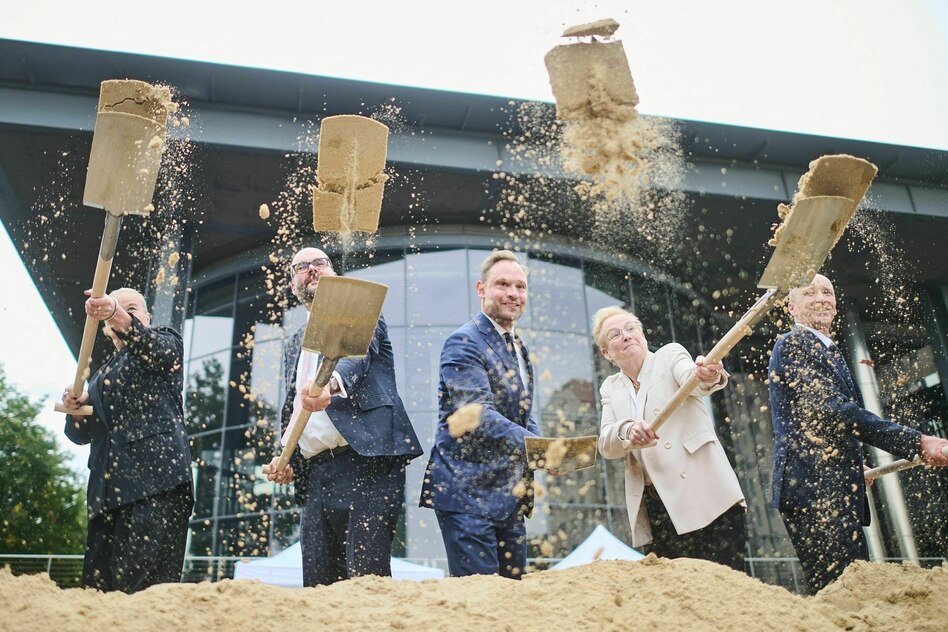
Democracy is a construction site, as we have known at least since the Saxony-Anhalt election. Next door in Saxony, where elections won't be held until 2029, it's a particularly expensive one. On Wednesday last week, political celebrities from the Free State picked up a spade on the state parliament forecourt and celebrated democracy with the start of construction on another of their temples. A cube in the inner courtyard of the state parliament and an attached block are intended to relieve the existing building on the banks of the Elbe not far from the Semperoper so that it can be completely renovated from 2030. By 2037, costs of 450 million euros are estimated, including a reserve of 130 million for increasing construction costs.
The old state parliament building with administration, parliamentary offices and canteen was built around a hundred years ago as a tax office. In the GDR, the Dresden city and district leadership of the SED state party sat here. After 1990, the state parliament met temporarily in the Epiphany Church before finally moving to this building in 1994. For this purpose, it was supplemented by a much-noticed and award-winning extension with a plenary hall by the architect Peter Kulka, which actually exudes the appearance of a “Hall of the People”.
It's not just the state parliament administration that claims there is a need for renovation. Even critics do not fundamentally deny it. Media and communication lines are worn out, there are water leaks, accessibility is limited, and the air conditioning leaves a lot to be desired. The number of visitors has increased and the state parliament has grown to six parliamentary groups. According to State Parliament President Alexander Dierks (CDU), two thirds of the administrative staff now have to rent external space of 4,000 square meters. He therefore speaks of a “complex operation on the working heart of democracy”.
The decision for a comprehensive renovation with two new buildings was not made by state parliament committees or a plenary session in 2022, but rather unanimously by the state parliament presidium, in which all parliamentary groups were represented. In addition to the Kenya coalition made up of the CDU, SPD and the Greens, there is also the AfD and the Left. However, a year after the decision, the state's project failed in the building committee of the state capital Dresden. The architect Peter Kulka, who died in 2024, was once again entrusted with the design for the two new buildings. Aesthetic criticism has not stopped since then, however. The cube in the inner courtyard disrupts its character as a place of rest and celebration, and the 84 meter long block on the bank of the Elbe next door disrupts the vaunted visual effect of the plenary hall and the view of the former Erlwein city warehouse, now the Maritim Hotel.
The effort and scale of the new building are also criticized. In times of crisis, Saxony's Finance Minister Christian Piwarz (CDU) actually announced the principle "No new construction of buildings, renovation comes before new construction". At the beginning of September he introduced the record double budget for 2027/28 into the state parliament, for which the proud Saxony vow of debt freedom must be broken for the first time and 1.5 billion euros in loans must be taken out. The state parliament must always decide again on the funds required for the new state parliament building. But savings are also being made there, as the Sächsische Zeitung found out. There is no money for the file holders in the toilets requested by MPs and employees.
The Taxpayers Association of Saxony still speaks of “gigantism”. “The fact that politicians are seizing a monumental special right in their own parliamentary seat is a fatal signal to the population,” criticizes President Dirk Mohr. The otherwise announced principle of moving closer together apparently does not apply there. The ADFC cycling club is also outraged. “For that money you can build over a thousand kilometers of cycle paths,” says state chairman Konrad Krause. The draft budget cuts the funding for this by 85 percent.
The groundbreaking ceremony nevertheless took place quietly and without protests. Unless you consider the state police orchestra's contribution to be satire. In keeping with the project, it intoned the melody of the cult television series about the alien Alf.
Read the full story at the source
Source: taz