
Germany · taz · 38m
Landscape after the opencast mining: The lake is at rest
Deutsch (original) · Auto-translated to English
The sand under your feet moves towards the lake shore. That's the first thing you notice. It feels like you're standing on a huge carpet and being pulled into the water with it. It happens so quickly and with so much force that you can't run in the opposite direction fast enough to save yourself. Together with the sand you slide into the water, which is still relatively shallow close to the shore. But after ten or twenty meters it suddenly goes downhill. The lake floor slopes away like a steep slope, which it actually once was.
Anyone caught in such a slide will be caught in masses of sand and water weighing tons. Underwater, the swirling mass takes away any orientation; The wet sand can hold the body in place, block the mouth and nose, or constrict the chest to such an extent that breathing is no longer possible. Even good swimmers hardly have a chance: anyone who gets caught in such a whirlpool can be pulled into the depths and buried under the slipping sand. The surface of the water could even appear quite calm while a death struggle is taking place under the water. Anyone caught in such a whirlpool will most likely be dragged into a cool grave on the lake floor.
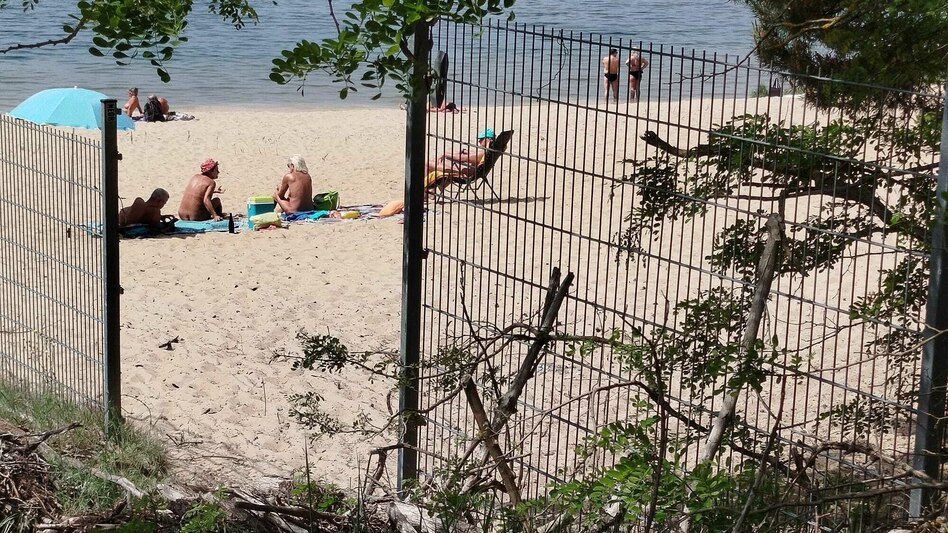
If you look at Lake Helene on a sunny weekday at the end of August, you would hardly believe how dangerous a swim there can be. The sandy beach appears solid. A few dozen bathers are spread out over several hundred meters of beach: a few naturists of retirement age who are working on their hazelnut tan. Two teenage couples are busy with a box of Little Cowards. Some residents of the asylum seekers' home in the former semiconductor factory in Frankfurt (Oder) are there, and a family with small children has spread out next to a half-dilapidated wooden platform with a parasol and swimming toys and is sucking ice cream in the shade.
A bathing fun where brown coal used to be mined: With this promise, former mines in the East German mining areas were flooded, and in some cases real lake landscapes were created.
Geotechnical risks still exist in many of these post-mining lakes today. Lake Helene is not an isolated case. Loosely tipped, water-saturated sands can lose their strength, and rising groundwater or changes in the water level can further destabilize embankments. In 2009, part of the embankment at Lake Concordia in Saxony-Anhalt slipped and took houses with it, killing three people. Major subsidence flow occurred at Knappensee near Hoyerswerda in Saxony in 2021, even though renovation work had been underway there for years.
On behalf of the federal and state governments, the Lausitz and Central German Mining Management Company (LMBV) is rehabilitating the legacy of the GDR lignite mining and continues to secure tipping areas and banks through compaction, flattening and monitoring.
If the embankment were to slip now, some of these people would probably disappear under water forever within a few minutes. “But nothing has happened here for five years,” says André, 72, his last name is irrelevant. He sits on a towel wearing only a straw hat, squinting at the sun and doesn't even think about giving up his seat because the beach is officially closed.
But something happened five years ago. On March 9, 2021, on the eastern north shore of Lake Helene - not far from where André is sitting on his towel today - the sandy subsoil separated over a length of 27 meters. At least 500 cubic meters of sand slid down into the former opencast mine and tore a fence with it. What remained was a dark cauldron on the beach.
Luckily no one was harmed - because no one is at the lake in March. On May 21st, the entire north and west banks were closed due to the risk of further “slide events” – as they are called in technical terms. The remaining banks were already closed beforehand. And since then, Frankfurt (Oder) no longer has a swimming lake. For more than half a decade.
A kilometer-long construction fence has been standing along the central beach and bathing access to Lake Helene for a long time now. Through its wire mesh you can see how the blue water shimmers in the sun on beautiful summer days. But at regular intervals there are signs hanging on the fence that say: "Restricted area. No entry allowed. Danger to life." Anyone who bathes here knows what they are doing.
This text first appeared in wochentaz, our weekly newspaper from the left!
Every week, wochentaz is about the world as it is – and as it could be. A left-wing weekly newspaper with a voice, attitude and the special taz view of the world. New every Saturday at the kiosk and of course by subscription.
But someone in the area must have a wrench to loosen the fence's connecting clamps. The fence is closed every morning, but at some point during the day there is a gap between two grid elements through which a few dozen bathers sneak onto the beach every day in summer. There are more on weekends. Then the tenant's security men show up and explain that swimming is dangerous and forbidden.
“The lake is at rest,” jokes André Benedict Prusa, the head of the building department in Frankfurt (Oder). Lake Helene is part of his area of responsibility, and it is certainly not a pleasant task: Who wants to be responsible for depriving the almost 60,000 residents of their city of the only swimming lake in the area for years?
And Prusa also knows that "the beautiful Helene", as some people call the lake, is not just another place to swim: "Most Frankfurters associate the lake with a piece of their own life story. During the GDR era, many people came here for their summer vacation through their companies or with their parents. There they learned to swim, experienced romantic sunsets or got their first kiss."
Like many other bathing lakes in the new federal states, Lake Helene was once an opencast mine in which the brown coal was mined, which the entire GDR smelled of. After coal mining in the Brieskow-Finkenheerd district was completely stopped at the end of the 1950s, the Helenegrube and the nearby Katjagrube were allowed to fill with groundwater.
On March 28, 1958, the last coal wagon left the opencast mine. The pumps were then turned off and the groundwater returned and filled the remaining hole. The Frankfurt conservationist Wilhelm Neumann recognized early on what it could become: a local recreation area and the largest bathing lake in the area. The “dark beauty” was supposed to become a “small Baltic Sea”.
In 1960 the area was declared a landscape protection area. In April 1964, rising groundwater reached the approximately one kilometer long breakthrough between the two former pits. Since then, Lake Helene and Lake Katja have been connected by a narrow canal, which the people of Frankfurt call “Congo” for some unknown reason. In 1966 Lake Helene reached its current water level. Beaches, bungalows, campsites, restaurants, sports facilities and a promenade were now built. At that time, no one thought about the geological protection of the lake. And it worked well for decades.
The holiday huts on Lake Helene belonged to state-owned companies. The state forestry company built bungalows and Finn huts in the Dachsberge; The Ironworks Combine East (EKO) owned a holiday resort on the eastern beach, which is still called the EKO settlement today. Employees at the semiconductor plant in Frankfurt also received vacation places. The “working people” applied to the company holiday commission for a place and were allowed to move in with their families for one or two weeks, after which the next holiday cycle began. There was a separate bus station and a train station in the pine forest. Lake Helene became a massively used holiday and bathing area. In 1968 there were already 140,000 visitors, ten years later almost 900,000.
“During the day our parents hardly saw us except at mealtimes,” remembers Daniel Grabow, the current tenant of Lake Helene. “We had our kid cliques and were out on the beach and off-road all day.” From the beginning of May to the end of September, the family came to the lake every weekend. In the spring the tent was put up and left there for the season. “The campsite was like a second home.”
When Daniel Grabow talks about the bathing days and the Neptune festivals of his youth, you can still see his enthusiasm for Lake Helene. The lake hasn't brought him any luck as an entrepreneur: since the closure, he's lost a lot of money on his business, so much that it's threatening his existence.
With the freedom to travel, Lake Helene lost a large part of its audience after the fall of the Wall; the annual number of visitors fell from around 100,000 to 50,000. At the same time, the old system of company holiday places collapsed. The state-owned companies withdrew, sold their huts or simply went bankrupt. Now a private investor should lead the holiday park into the market economy.
The city chose Helmuth Penz, a West Berlin construction and hotel entrepreneur who founded several companies in East Germany. In Frankfurt he planned a 160 million mark shopping arcade and hotel on the site of the demolished “Stadt Frankfurt” hotel. What initially remained was a large excavation pit, which was derided as a “Penzloch”.
At Lake Helene, Penz promised investments of 7 million marks in three years; a sports hotel and a holiday park were planned. Some sanitary facilities were renovated and bungalows were built, but the sports hotel never came. Instead, years of disputes followed over lease agreements, land and the rights of cabin owners and long-term campers at Lake Helene. What also aroused suspicion was that Penz and the head of the economic department in charge already knew each other from the swampy West Berlin construction industry. In 1999, Penz withdrew from Frankfurt and received compensation from the city.
At the end of 2000, the city tried a local solution. Several Frankfurt entrepreneurs founded Helenesee AG. This model also failed.
Then Daniel Grabow took over the business in 2012 and has been operating the holiday park on Lake Helene on a long-term lease ever since. Under him, more guests came again, increasingly from Berlin. While there were previously 25,000 bathers throughout the season, before Corona there were at least 125,000 and there were 60,000 overnight stays. On beautiful summer weekends, thousands camped on the beach, paid admission, ate and drank, took diving lessons and rented surfboards.
The event manager Grabow, who runs a discotheque in Frankfurt, wanted to cross-finance the immense maintenance costs of the facilities at Lake Helene through music festivals and other events. He brought festivals such as the Bay of Dreamers to Lake Helene, a yoga retreat and a vintage car weekend.
But then Corona came in 2020. Visitors stayed at home or had to sit on the beach in a checkerboard pattern with sufficient distance. And then in March 2021 the beach collapsed. Grabow was left with a resort without its most important attraction: the lake.
A Saturday morning in May at the Aloha beach bar on Lake Helene. The sun is shining, poplar seeds sail through the air like snowflakes. Around 50 tenants and campers showed up to hear from Daniel Grabow about the latest developments at Lake Helene. And as he has every year for half a decade, Grabow has to ask his audience, who are listening in lounge chairs, to be patient.
The investigations into the lake have been going on for five years. Lake Helene has now been examined more thoroughly than ever before - but unfortunately with depressing results: 28 deep drillings, 48 soundings and 1,450 soil samples have confirmed that there is loose sand beneath the beaches that tends to liquefy.
The problem is exacerbated by the falling water level, which - as with all lakes in Brandenburg - is contributed to by climate change. The further the crystal clear water of Lake Helene recedes, the less pressure there is on the steep embankments. The banks lose their grip and can slip more easily. So far, no construction plan has emerged from the investigations. Data is again missing for two sections of the embankment; the renovation plans should not be available until the end of 2026. Decades-old failures to secure the opencast mine are now met with jurisdictional disputes, failed tenders and planning that progresses from report to report.
At the same time, the facilities at Lake Helene are increasingly turning into a lost place. Roots are pushing through the waterfront, potholes are getting bigger, lanterns are failing. Year after year, another tenant tries his luck in the restaurant, sometimes with schnitzel, sometimes with Asian fried rice, and most recently a pizza delivery service. Most of the businesses close before the end of the season, and the failed attempt at pizza is still remembered by yellowed advertising displays left all over the site. The lake where tens of thousands once enjoyed the summer has become a quiet, melancholic place.
Sebastian Fritze, President of the Brandenburg State Office for Mining, Geology and Raw Materials (LBGR) in Cottbus, assumes that no construction work will be put out to tender before 2029. The measures to secure the shore could then drag on until 2032: “Opening the lake before then would simply be too risky.”
Daniel Grabow, on the other hand, wants to show his tenants a different future perspective. Next year, a pontoon jetty with a bathing platform will be built on the main beach between the rescue tower and the former boat rental. Like Prusa, the head of the building department in Frankfurt (Oder), Grabow hopes that the beach can be reopened to bathers in sections in the coming years after it has been renovated and inspected piecemeal.
A small part of the eastern beach is even open again, as the RBB reported a few weeks ago. But it's only a few hundred meters, most of which are full of reeds.
It is currently difficult to predict when thousands of bathers will once again be able to spend a day at the beach at Lake Helene. Anyone who ventures onto the beach through a hole in the fence must expect confrontations with security men until further notice. Or, in the worst case, sinks into Lake Helene along with a piece of beach.
If you want to go into the water in the area, you have to go swimming in the indoor swimming pool in Frankfurt (Oder). The outdoor swimming pool in Słubice on the other side of the Oder in Poland is also closed until further notice.
Read the full story at the source →
Source: taz