
Germany taz
Land use and rental prices: Federal government advisor calls for more land use
A report warns that the lack of living space is endangering economic growth. However, dangers caused by heat and lack of water are ignored. more...
Deutsch (original) ·Auto-translated to English
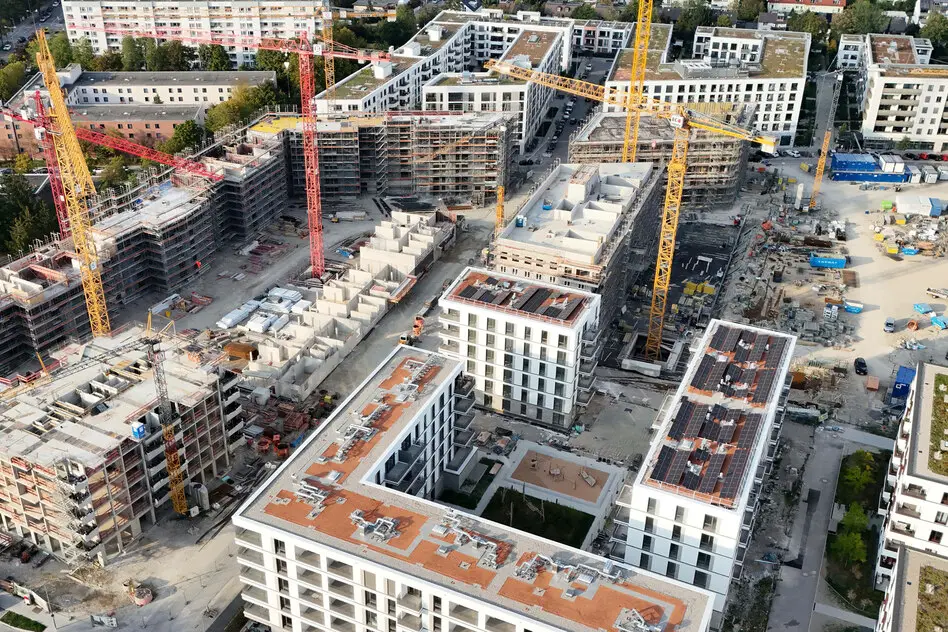
Municipalities should designate more building land, owners of building land should contribute more to the costs of infrastructure and make it easier to densify inner cities - for example, adding buildings without permission. This is what an advisory committee of the Federal Ministry of Economics suggests in order to combat the lack of housing in Germany. This is necessary because high housing costs are increasingly expanding from a social issue “to an overall economic problem,” writes the Scientific Advisory Board at the Federal Ministry of Economics in its current report.
Households in Germany spend an average of a third of their income on housing, while poorer households spend almost half, said the lead author of the report, Christian Bayer, economics professor at the University of Bonn, when presenting the report on Monday. High housing costs “particularly in growth regions hinder the mobility of workers, make it more difficult to move into productive regions and thus reduce overall economic growth and productivity,” it says.
Because apartments and houses in cities with strong economies - for example Stuttgart, Munich or Münster - are too expensive, employees do not move there, even though they can find well-paid work there. This means that they are missing as workers and not only earn a lower income themselves, but the economy as a whole suffers as a result. In addition, commuter flows into the metropolitan areas would arise with high economic, social and ecological costs.
The report therefore criticizes the goal formulated in the National Sustainability Strategy of reducing land consumption for settlement areas to less than 30 hectares per day by 2030 and to 0 by 2050. “This goal has shaped the political debate about building land designations ever since,” said Bayer. This goal must be “reconsidered” and adapted regionally. In centers with little growth and influx, different requirements could apply than in metropolitan areas.
The German Tenants' Association supports the statement of the report in principle. “More building land can make an important contribution to increasing the supply of housing and thus reducing the pressure on the housing markets,” says the Federal Director of the German Tenants’ Association, Florian Becker. It is important that “when the building land is allocated, what is to be built on the land is taken into account”.
It is crucial that sufficient affordable housing is created and remains affordable in the long term. “We need a land, housing construction and rent policy that focuses on the needs of tenants and not on the return expectations of real estate investors,” says Becker. In its “Rent Report”, the association also calls for a nationwide rent cap, better protection against dismissal for tenants and a stronger orientation of housing towards the common good.
Possible ecological effects of land use - such as greater heating due to denser development in cities or faster water drainage from the landscape due to greater sealing - were not taken into account in the advisory board's macroeconomic calculations, according to Bayer. In recent months, various calculations have shown the connection between heat and water shortages and economic growth.
The Scientific Advisory Board for Global Environmental Change (WGBU), for example, has emphasized the reduction of land use to protect natural resources - water, biodiversity, climate stability - in several reports. Recently, climate and nature conservation have fallen behind the goal of increased settlement construction, says Sabine Schlacke, professor of public and environmental law at the University of Greifswald and member of the WGBU.
In recent months, the federal government has launched a number of initiatives for more and cheaper housing construction. For example, states and associations can currently comment on a draft law after parties to a construction project can agree on a slimmed-down building variant in which apartments have fewer sockets. The so-called construction turbo has been in effect for around a year. The law privileges the construction of apartments over environmental and monument protection issues.
“Of course it would make sense if the scientific advisory councils of the federal government and the various ministries looked after each other,” says environmental lawyer Schlacke. In practice, this doesn't happen enough. However, on November 4th, various members of scientific advisory boards will meet for an “advisory board dialogue”. This could also be a place for an exchange about the conflicting goals of higher land consumption, says Schlacke.