
World taz
Label portrait Fortuna Records: The musical revitalization of the Levant
The Tel Aviv label Fortuna Records has made forgotten music from Israel and throughout the Middle East accessible again. Now it's on hold. more...
Deutsch (original) ·Auto-translated to English
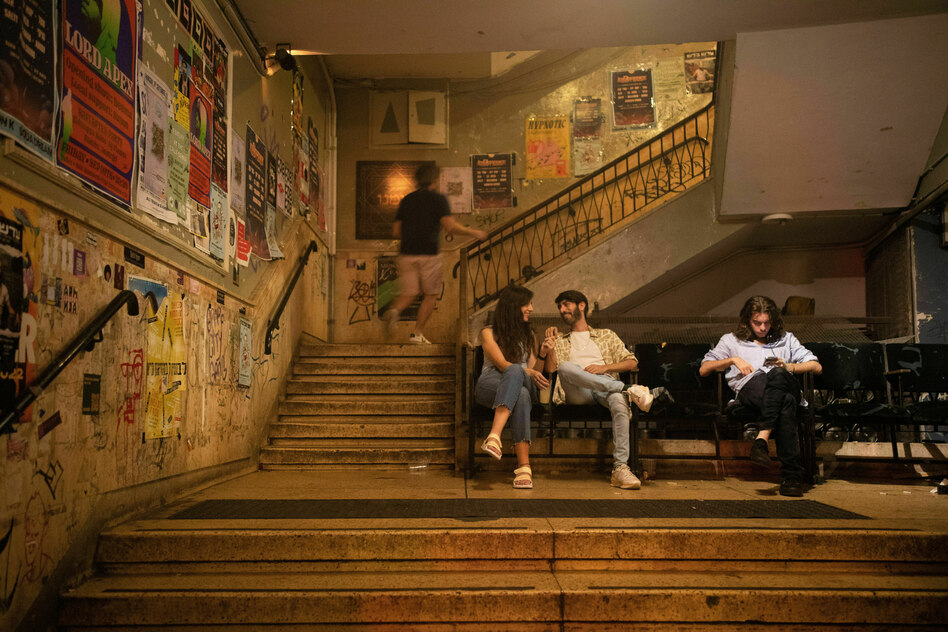
It all started with Tsvia Abarbanel. When the four Tel Aviv DJ friends Maor Anava, Tzach Bar, Ariel Tagar and Yoav Magarizo were once again scouring the city's second-hand record stores in 2012, they came across a rare album by the Yemeni-born Israeli singer. “Wings of Love”, released in 1970, brings together Yemeni melodies with jazz and funk in an idiosyncratic way. When it was first released, the artist had only moderate success with her music and then fell into oblivion. But Anava, Bar, Tagar and Magarizo were immediately fascinated. The accidental discovery was a kind of awakening experience. It marked the beginning of the independent record label, store and DJ collective Fortuna Records and sparked a “crazy obsession” in them, as the four describe their passion for pulling old things out of obscurity when asked about it.
From then on, they set out on a mission to track down and re-release forgotten music: albums that had only been released in small editions, had fallen through the cracks of commercial success and unreleased recordings by artists who had long since withdrawn from the music industry. The four DJs, long-time enthusiastic collectors of lost musical treasures, are well-known in the Israeli music scene. In 2010 they helped found Teder.fm, a Tel Aviv-based radio station.
Teder.fm began as a nomadic project, but later collaborated with celebrity chef Eyal Shani and opened a bar in Beit Romano, an old international-style commercial center in Tel Aviv that, thanks in no small part to Teder finding a home there, became a hub of nightlife in the city.
As record collectors, Anava, Bar, Tagar and Magarizo were also influenced by the diverse cultural ideas that intellectually influenced the Israeli music scene of the 1950s, 60s and 70s. She was also concerned with the question of why this music originally interested hardly anyone and was ultimately forgotten. “The general public in those decades largely still had European – Hungarian, Polish – or North African roots,” the group explained in an interview about Israel’s musical and social horizons at that time. At that time they also had the idea of starting a re-issue label.
“Popular Israeli music between 1950 and 1980 also had a European or North African influence, and anything that deviated even slightly from this line in the mainstream fell through the cracks.” From the outset, the Fortuna makers emphasized their role as “music archaeologists” who not only dig deep for artifacts, but also make the stories behind them clear – as in the case of Abarbanel.
The Yemeni singer immigrated to Israel with her family at the age of nine and later moved to Los Angeles to study art. There she came into contact with US jazz, soul and funk in the 1960s. After returning to Israel, she turned to saxophonist and producer Albert Piamenta, one of the pioneers of Israeli jazz, with a request to rearrange the Yemeni songs she had grown up with. The result can be heard on the album “Wings of Love”.
Albert Piamenta also appears again on another Fortuna release: Mezare Israel Yekabtzenu ("He who scattered Israel will gather us again" - a title based on a verse from the book of Jeremiah). The album was originally recorded in 1971 by the quartet The Jazz Workshop, which included Piamenta, pianist Danny Gottfried, bassist Teddy Kling and drummer Jerry Gravel.
The album is considered the first instrumental jazz album recorded in Israel. It is a groundbreaking attempt to create an independent Israeli sound - a combination of US jazz elements with oriental melodies. The experiment was not a huge success in the early 1970s, but in the 2010s contemporary Israeli jazz musicians such as Omer Avital and Omri Mor began to follow the same musical mold. The re-release on Fortuna Records introduced other artists and jazz fans to “Mezare Israel”.
The four from Fortuna describe The Jazz Workshop as the most obscure work they have republished to date. "It was the first real jazz album ever released in Israel and it has this super exciting combination of Arabic melodies and jazz. So it was once again met with a lot of incomprehension and ignored." Listening to The Jazz Workshop today will definitely give you a feel for the diverse and eclectic music scene that developed in Israel in the early 1970s.
The next Fortuna release was a real gem, the only album by Grazia, a popular wedding singer in the mid-1970s who sang in Turkish and Greek. Their album “Grazia” (1978) highlights a different aspect of Israeli culture, and this music was popular at family gatherings both in Israel and abroad when it was first released.
At that time, disco fever was rampant and the artist Grazia, who was only 16 years old at the time, was audibly influenced by it. “She integrated disco elements and synthesizer sounds into her traditional Turkish music as a matter of course, but this mix flopped commercially,” Bar said in an interview with Haaretz. “For disco fans, their approach was too oriental and for Turkish music lovers, Grazia was too disco.” While she fell into obscurity, her solo album achieved the status of an extremely valuable disc on the rarities market in the 1990s.
Around 2015, Fortuna came across the work of the Lebanese composer and keyboardist Ihsan Al-Munzer, an experienced studio musician who also played with superstar Fairuz and recorded a handful of instrumentals in the late 1970s, quite by chance. In an attempt to revive the musical Levant, which had languished due to the conflicts in the Middle East, Fortuna Records managed to track down Al-Munzer's works and contacted his manager to officially obtain the publishing rights.
After re-releasing two pieces by Al-Munzer as 12inch, Fortuna also began working on a work called “Voix de L'Oriente”. To do this, they enlisted the support of ten Lebanese artists who were convinced that this distinctive Middle Eastern groove deserved a new life. Fortuna remastered Al-Munzer's album and prepared it for release - until the project attracted attention in Lebanon and triggered a wave of shitstorms. Al-Munzer was accused of collaborating with Israelis. In order to protect the elderly musician from serious consequences, Fortuna put the album project on hold.
Publishing music – like anything cultural – is a highly politicized affair in the Middle East. The members of Fortuna learned this the painful way, especially after the Hamas attack on Israel on October 7, 2023 and the subsequent war in Gaza. For six years, Fortuna's DJs regularly broadcast a monthly program hour on British internet radio NTS and maintained a friendly relationship with those responsible in London. However, immediately after October 7, 2023, this relationship was abruptly ended and its broadcast was canceled without replacement.
After years of artistic success and attention around the world, the Fortuna journey almost came to a standstill due to the drastic polarization around the world. Since 2023, Fortuna has not released a new album with music from the Middle East and the creators are focusing on DJ performances at local parties in Tel Aviv. “The whole thing was mainly supposed to be fun and give us a romantic kick, Fortuna was in no way intended to make big money,” the DJs explained in an interview with Haaretz. "We thought it would be better to hold off for a while until the storm passed, but that doesn't seem to be happening." It's a shame.