
Migration taz
Cuts in the 2027 budget: Independent asylum advice is threatened with clear-cutting
In the future, it is not civil society organizations, but the Bamf itself that should advise refugees. The Greens are demanding money for sea rescuers. more...
Deutsch (original) ·Auto-translated to English
For weeks, associations have been heavily criticizing the federal government's plan to cut down on independent advice for asylum seekers. And yet, before the adjustment meeting in the Budget Committee on Thursday, everything indicates that Black and Red are sticking to the plan and cutting the funding for consultation by around 80 percent.
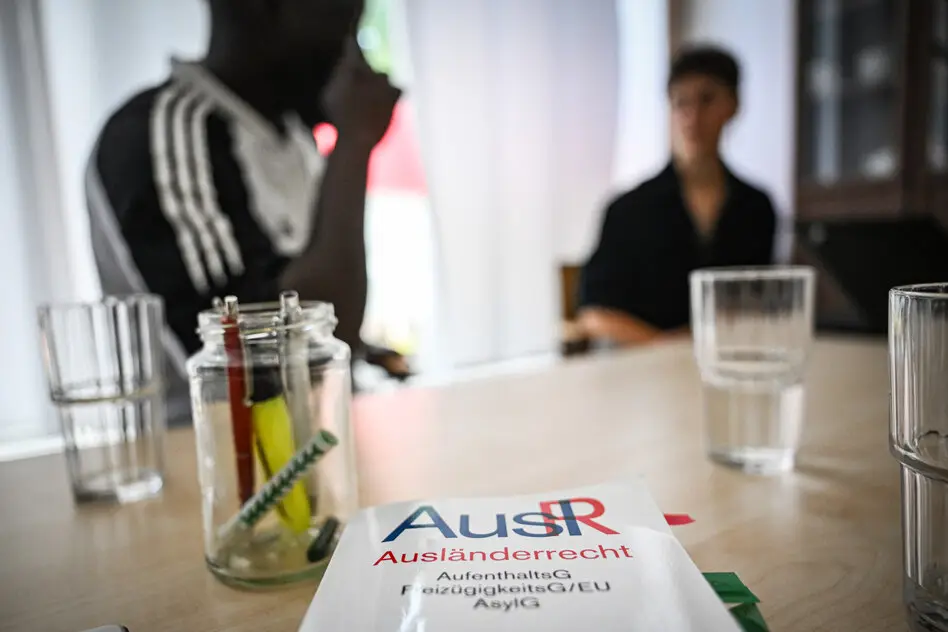
The austerity plans would mean deep cuts locally, says Manfred Asel from the Friends of Asylum in Karlsruhe. He is sitting with employees and two clients in the counseling center in downtown Karlsruhe. The small organization with almost 30 positions has been doing refugee work locally since 1987 under the umbrella of the Paritätischer Wohlfahrtsverband in Baden and the Southern Palatinate.
The individual and independent advice for refugees in the asylum procedure advice (AVB), which is currently provided by three positions in the state initial reception center (LEA), would have to be stopped completely, says Asel. This advice, which was only introduced in 2023, helps refugees gain trust in the process. According to the social associations, it makes it transparent and fair – and also more efficient. All of this is also confirmed by an evaluation commissioned by the Federal Office for Migration and Refugees itself.
In the future, this work is to be replaced by the Bamf's “auRA” program, which will then only provide individual advice to so-called “vulnerable groups” among refugees. Then the same authority that decides on residency rights would also be responsible for providing individual advice. The associations consider this to be legally problematic and possibly even unconstitutional.
The second area in which the planned savings in the federal budget would leave a deep gap: migration advice for adult migrants who have left the initial reception or have never been there. The helpers act as guides through the thicket of authorities and provide advice on applications and language support.
Here too, the federal budget is to be cut by 4 million euros. And: A new funding guideline shortens the entitlement of migrants from five to three years after arrival.
Nasteho Abdirahman Aden, who fled Somalia, reports what this means in concrete terms. Her son jumps around the sober meeting room. Aden is taking a German course, but the woman in the dark blue dress and headscarf doesn't have enough language skills to apply for child allowance and housing benefit.
Ejazulhaq Omarkhail also confirms that without a contact point like the Asylum Friends' Circle, one cannot manage correspondence with the authorities. You can't get very far in German authorities with English. The man from Afghanistan is in his mid-thirties. He came to Germany to study and has just completed his master's degree in IT security. Omarkhail, with a well-groomed beard, glasses and a fashionable windbreaker, would like to work in a German company. The employees of the Friends of Asylum help him with the applications.
Reducing bureaucracy could make some things easier, especially for refugees, say the helpers. The consequence of the planned cuts would be that refugees would retreat more into parallel societies and look for advice there.
As a study by the Arbeiterwohlfahrt (AWO) from last week shows, the advice not only helps the refugees themselves - it also saves the state millions in costs. Because without advice, the asylum procedures take significantly longer: Anyone who knows in advance what awaits him or her in the hearings needs fewer appointments, presents the correct documents straight away and thus reduces the work and time required for the authorities. If those affected can understand the work of the authorities, they are also less likely to sue against asylum decisions made, which also relieves the burden on authorities and the judiciary.
Faster asylum decisions also mean that refugees integrate into German society more quickly and take up work. So far, the advice has also reduced the costs of social benefits paid by the state. In total, the AWO experts come to a sum of around 72 million euros per year, which the advice has saved the state so far - and which would be added as additional costs in the future if the cuts are decided as previously planned.
This means that the costs would exceed the savings by around three times. "The new calculations expose the reduction in asylum procedure advice as an ineffective smokescreen. At best, what is being saved here is humanity," says AWO President Kathrin Sonnenholzner.
The Green parliamentary group in the Bundestag is against the cuts - and is even calling for more money for refugees. Specifically, the group wants to submit a motion on Thursday to resume support for private sea rescue in the Mediterranean. Until last year, Germany had paid around two million euros annually to organizations like Sea Watch, which rescue refugees in the Mediterranean. The black-red coalition stopped funding in mid-2025. The Greens are now even demanding 10 million euros annually. But they probably don't have any realistic prospects of success.
The chairwoman of the Green parliamentary group in the budget committee, Jamila Schäfer, told the taz on Wednesday: “It is shameful that we do not use a cent in the federal budget to support sea rescue in the Mediterranean.” And the domestic policy spokesman for the Green parliamentary group, Marcel Emmerich, said: “It is a declaration of moral bankruptcy that this federal government is unable to take a clear stance against militias, warlords and smugglers” and “at the same time does not even financially support sea rescue.”
In fact, the Union and SPD factions also want to extend the mandate for the controversial Bundeswehr mission “Irini” in the Mediterranean on Thursday. This was previously intended to monitor the UN arms embargo against Libya, which recently expired without replacement. Instead, the German navy, together with European allies, should now prevent illegal oil exports, monitor the Russian shadow fleet - and take action against smugglers.
In practice, the latter could mean support for the so-called Libyan Coast Guard, which is little more than an armed militia and has been accused of numerous human rights violations. The black-red coalition removed a ban on cooperation with the alleged coast guard from the “Irini” mandate text last year.
Luise Amtberg, Green MP on the Foreign Affairs Committee, told the taz: “Instead of enforcing the UN arms embargo and helping to secure peace in Libya, the mission is increasingly becoming an instrument for deterring migration.” This is not only reprehensible in terms of human rights. The federal government is also making itself dependent on the Libyan militias, which could use migration movements as a means of pressure against Europe.
And Marie Michel from the sea rescue organization SOS Humanity told the taz that the new Irini mandate meets the “worst expectations”. In the future, the Bundeswehr could “train militias that are responsible for serious crimes.”