
Germany · taz · · 3h
Cuts in Colombia's peace justice system: Red pen meets reappraisal
Deutsch (original) · Auto-translated to English
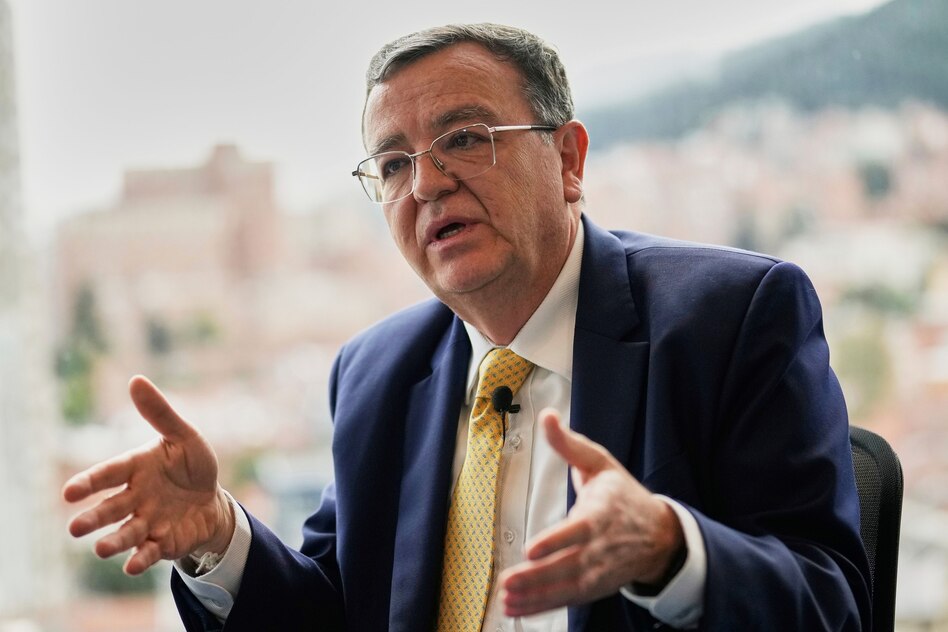
Alejandro Ramelli is visibly angry as he steps up to the podium at the Universidad del Externado in Bogotá. The president of the Special Justice for Peace (JEP) says he worked on the press release until one in the morning. A massive budget cut, plus having all verdicts against security forces reviewed by a military court - the two proposals from the governing parties are "the most serious attack that the Colombian transitional justice system has suffered on its independence and judicial autonomy," says Ramelli.
The bomb exploded the day before the special judiciary was to be publicly held accountable. Senator Enrique Gómez Martínez (Salvación Nacional) proposed cutting the JEP's budget by the equivalent of around 27.58 million euros. These should be transferred to the Supreme Judicial Council in order to increase judge positions and offices in the country. "This is an urgent need. At a cost of four trillion for the JEP, its outcome indicators are catastrophically deplorable. It is a jurisdiction of impunity," the senator said. He immediately received support via X from the ultra-right President Abelardo de la Espriella. In addition, a constitutional reform is currently being discussed in the Senate: The aim is to introduce an automatic, judicial review of the JEP's judgments against members of the security forces by the military criminal justice system. Parliament is currently in the middle of the budget debate.
Colombia's new president, Abelardo de la Espriella, is an opponent of the peace agreement between FARC guerrillas and the Colombian state - and of the special court for peace. The historic 2016 agreement marked the end of the continent's largest guerrillas after around 50 years of armed conflict. Around 14,000 men and women laid down their weapons - the vast majority have remained in civilian life to this day.
The agreement includes obligations for both sides - and created the Comprehensive System for Truth, Justice, Reparation and Non-recurrence. It is intended to investigate and punish the crimes committed by state security forces and FARC. The focus, however, is on the victims and their right to know the truth and reparation. Part of the system is the Special Court for Peace. Anyone who contributes to finding the truth and making reparations will receive reduced sentences.
In the JEP trials, the victims had the opportunity, often for the first time in decades, to ask the perpetrators directly to get rid of their anger and sadness. The perpetrators, who have often carried their guilt for decades and waited for legal clarification, can come clean. The live-streamed hearings often featured moving scenes: perpetrators asking for forgiveness, victims forgiving.
Both sides receive psychological support, transport costs are covered, the hearings are sometimes held in remote areas of the country, and personal protection is paid for everyone involved who is in danger. All of this costs money – as does implementing the penalties. They carry up to 20 years in prison, but can also mean direct reparation according to the victims' wishes: building memorials, removing landmines, building roads.
All of this is now at stake, said court president Ramelli. The budget cut would practically bring the already underfunded JEP to a standstill. “This would leave thousands of people without protection, whose rights, safety and lives are protected by the courts,” Judge Ramelli said.
In its work, the special judiciary brought to light crimes committed by the FARC and the security forces that many in Colombia would prefer to sweep under the carpet. For the FARC, this includes the forced recruitment of children, sexual crimes and the persecution of indigenous ethnic groups. In the case of the state security forces, there are details about the extrajudicial executions that they carried out on innocent people and passed them off as killed guerrillas in order to fulfill quotas and collect bonuses. Live hearings in which former soldiers and generals describe this system are still available on YouTube today. The version of the individual “bad apples” in the system has been refuted.
As for the alleged lack of efficiency: the court inherited 40,000 files from the Colombian legal system - and to this day around a hundred cases are added every month. Even the International Criminal Court had only made four verdicts in all these years.
In addition to its establishment and investigations, the first few years consisted of weeding out cases over which the court does not have jurisdiction. More than 1,000 people now have legal clarity - the majority of them are state security forces, some of whom had waited decades for their procedures to be clarified. Some who were innocently imprisoned were released. Around 9,000 people are still waiting. According to the mandate, there are still six and a half years left for this.
Ramelli appealed to the international community to stop the austerity initiative. The JEP will inform numerous international institutions, including the UN Security Council, the UN Human Rights Office and the International Criminal Court.
In addition to the special judiciary, the government also wants to drastically cut the budget for the unit for the search for disappeared persons, another body that is part of the peace agreement. To date, 137,000 people are believed to have disappeared. In purely mathematical terms, the search costs the equivalent of around 383 euros per person per year - impossible.
During the accountability hearing on Friday, Lady Johanna Rosas Morena was the last to take the microphone again. She is still looking for her brother to this day. She asked those present to speak out against both cuts. "We victims are very worried and sad. This would severely restrict our participation." Thanks to statements made to the JEP, there are now more indications of where those who were forcibly disappeared were buried.
Read the full story at the source
Source: taz