
Germany taz
Criticism from the Greens and environmentalists: Huge surcharges for LEAG and RWE
New gas power plants are intended to provide electricity when wind and sun weaken. The old coal companies rejoice at the first tender. more...
Deutsch (original) ·Auto-translated to English
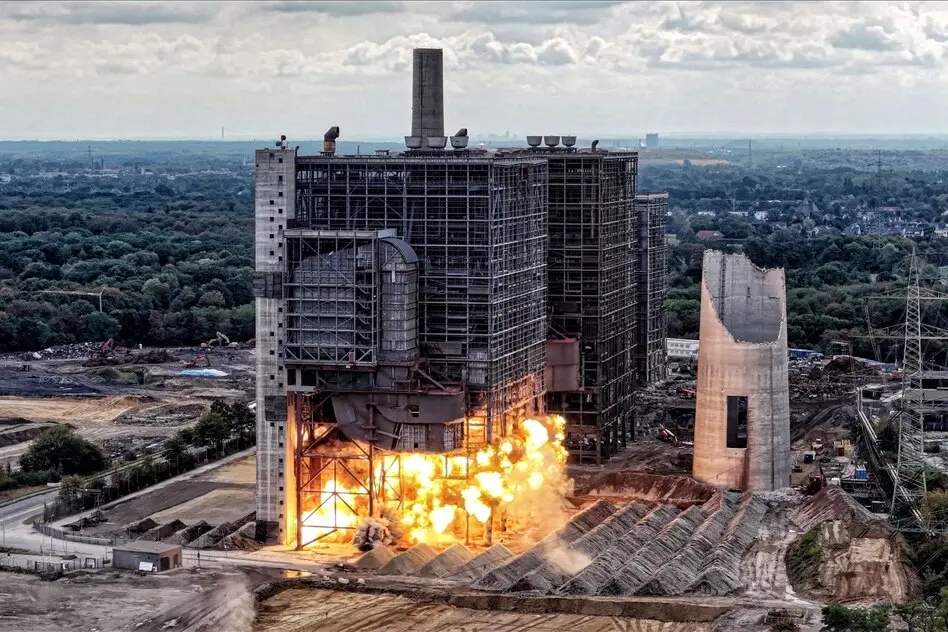
This is where the electricity will come from in the future when wind and solar systems cannot deliver much due to weather conditions: In the first tender for power plant capacities to secure electricity supply, the Federal Network Agency awarded eleven contracts on Tuesday - exclusively for gas power plants. Electricity storage systems, which could be filled with green electricity in times of a lot of sun and wind and tapped into in times of shortage, were not used.
LEAG received six contracts in Brandenburg and Saxony, three contracts went to RWE in North Rhine-Westphalia, one each to Bavaria (Leipheim gas power plant) and Baden-Württemberg (Karlsruhe municipal utilities). The German Association for the Environment and Nature Conservation (BUND) spoke of a “fossil subsidy program for climate-damaging gas power plants owned by large energy companies”.
The Federal Network Agency tendered 4,500 megawatts of secured power plant capacity as part of the Electricity Supply Security and Capacity Act and received 41 bids. 5,160 megawatts of so-called long-term capacities have now been awarded. The power plants must be able to reliably supply electricity on demand from November 2031 to October 2046. The operators then receive money in return, and electricity customers have to pay.
“Over 12 billion euros will be distributed over 15 years and financed from a levy on the price of electricity,” complains the BUND. It is particularly absurd that several awards went to old lignite-fired power plants that are to be converted into gas-fired power plants. “These old power plants are less flexible and more inefficient than new gas power plants and are therefore even more harmful to the climate,” complain the environmentalists.
Systems that are technically capable of providing at least 80 percent of the installed capacity for ten consecutive hours without interruption were eligible to take part in the auction. They have to be able to do this again after three hours at the latest, which is a high hurdle for storage. Accordingly, only gas power plants were used in this round. According to network agency boss Klaus Müller, electricity storage facilities also took part.
While Federal Economics Minister Katherina Reiche described the tender as a “great success”, Green Bundestag member Katrin Uhlig criticized the lack of diversity of actors: “We are making ourselves dependent on individual companies again when it comes to security of supply.” This structure “actually broke up” the energy transition.
The background to the tender for secured power plant capacity is the massive increase in electricity demand in the industrial, heat and mobility sectors while at the same time phasing out coal. The German Energy Agency (dena) had repeatedly pointed out that an “expansion of hydrogen-capable gas power plants to cover peak loads” was necessary. The consulting company Enervis also emphasizes that “timely investments” in at least hydrogen-capable gas power plants are “a central component in enabling the complete decarbonization of the electricity and district heating system.” At least for the time being, the energy industry is relying on climate-damaging natural gas due to a lack of hydrogen.
Regional network operators are increasingly feeling the fact that the electrification of the economy, as desired by climate policy, can hardly succeed without additional, planned electricity generation. The network operator Hamburger Energienetze, for example, only announced on Monday that new connections of more than 1.5 megawatts were currently no longer possible in the Hanseatic city due to the “skyrocketing increase in connection requests”.
Even smaller cities are sometimes at their limits. The Mittelbaden power station recently sounded the alarm: Large companies could no longer get new network connections at the moment. The company has also had to turn down an operator who wanted to build a megawatt charging park for trucks because bottlenecks in the upstream high-voltage network mean that not enough electricity is reliably arriving in the region. Therefore, E-Werk Mittelbaden also took part in the tender with a planned gas power plant, but came away empty-handed in the first round of tendering. The next bidding date is scheduled for December 29th.