
Germany · taz · · 1h
Municipalities in agriculture: They don't want to do it alone
Deutsch (original) · Auto-translated to English
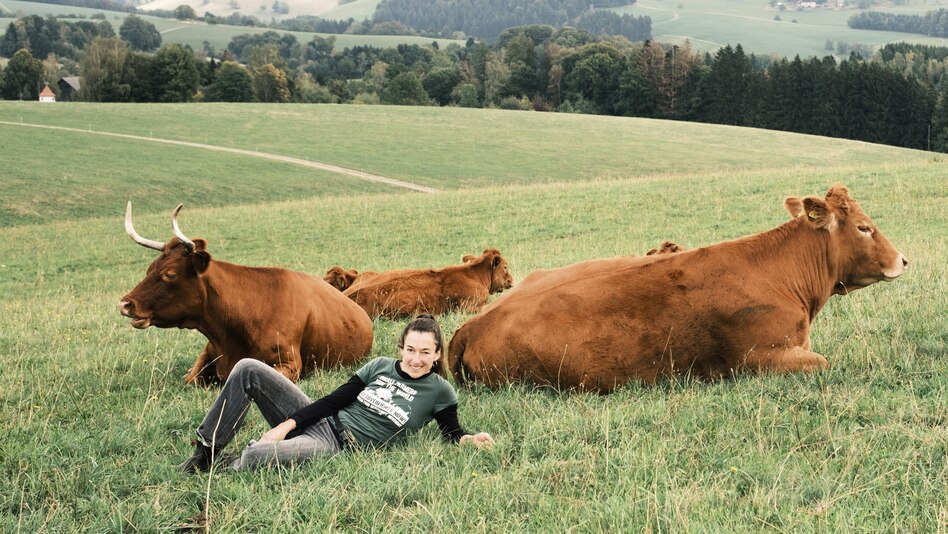
T amara Gremmelspacher looks from a small hill at what could be her property: the “Schafhof” is located at around 800 meters on a slope in the southern Black Forest, half an hour's drive east of Freiburg. Pastures stretch out on rolling hills around the residential and stable buildings. Around 70 red-brown cattle and 14 sheep graze between fruit trees and small natural ponds; The forest begins behind the open areas. The farm's holiday home is a bit off to the side. Even a small chapel from 1907 is part of the 90 hectare property.
Gremmelspacher could inherit all of this; the farm is worth around two million euros. It still belongs to her 71-year-old father Urban. Tamara Gremmelspacher is the only one of his four children who wants to work in agriculture, but she doesn't want to inherit the farm. Instead, the 35-year-old agricultural engineer arranged for the subsidiary of a cooperative to buy the land. This in turn leases the space to a municipality, which, in addition to Gremmelspacher, includes four other adults. “We are deprivatizing the farm,” she says.
Why did the farmer decide to take this step after the business had been in her family for more than 500 years? And could their model be a solution to the fact that so many farms have to give up because no one wants to continue running them?
The shortage of young people in agriculture is massive: according to a 2020 survey by the Federal Statistical Office, the farm succession was unclear for 63 percent of agricultural companies that were owned by a single person at least 55 years old. The lack of successors is one reason for the “farm death”. More and more agricultural companies are giving up and their land usually goes to larger companies. Centuries-old traditions are breaking down so easily, and property is being distributed more and more unequally. And: Large agricultural businesses often cultivate larger contiguous areas. However, studies show that larger fields are often associated with lower biodiversity.
One day in August, Tamara Gremmelspacher gets into a tractor, starts the diesel engine and drives a plastic tank with 1,000 liters of water to one of the pastures. She wears a green T-shirt with the inscription “Small farmers feed the world” and delicate tattoos adorn her left arm.
A row of young fruit trees runs through the middle of the dry, yellowish-brown grass. The trunks are still thin and the crowns are small. The plants are each tied to three wooden posts that support them and protect them from the cattle. The farmer's wife jumps down, drags a yellow hose to a quince tree and turns on the tap for several minutes. She planted the trees in the fall. It will take years for them to bear fruit. If it doesn't rain, water the trees every two weeks.
For Gremmelspacher, the new fruit trees are also a contribution to maintaining the sheep farm in the long term. This is a “huge obligation” for her, she says, as the water runs onto the dry earth around the young tree. “I grew up here and have a great connection to the place and a sense of responsibility.” Even more so when she notices that other farms in the Black Forest are constantly giving up. “Nationwide, seven shut down every day,” says Gremmelspacher. “It is often the case that the children still live on the farm, but lease the area, and the area is sold by the second or third generation at the latest.”
This leads to a “crass structural change in agriculture – more industrialized food production, dying rural areas”. Whenever a generation hands over the farm, there is a risk “that no successors will be found and that the farm will die.” This motivates them to look for another form of ownership in order to preserve the sheep farm.
Couldn't she have continued the business as a traditional young farmer and with a partner? “Yes, I could have done it, but I didn’t feel like it because I also want vacations and weekends,” she says and laughs.
In some years her father only took a two-week vacation, in other years not even that. Gremmelspacher's footsteps crunch on a sandy path through the farm's pastures. Crickets chirp in the grass. The fact that many farm owners hardly have any vacation is more normal than an isolated case. Studies show that the work pressure is often so high that, together with the better earning opportunities outside of agriculture, it deters many potential successors from taking over the business from their parents.
“I don’t see myself running the privately owned farm as a farm manager in a small family model,” says Tamara Gremmelspacher, sitting behind the wheel of the tractor again. “On the one hand, this contradicts very much how I want my life to be.” Mother, father, child(ren), who then all help on the farm, a mostly traditional distribution of roles? Please don't. “I don’t want to get married or have children.”
On the other hand, she says: “Land has no place in private property, just like living space.” The natural foundations of life and the resources that cover basic needs should not be privatized, but rather managed collectively. Also to minimize the risk that the land will be exploited at the expense of the public and to maximize profits.
The farmer protests have shown “that many farmers feel completely alone, with this extreme workload, with the really underground prices,” says Gremmelspacher. That’s why farmers and the rest of society need to move closer together again.
The Communards want to achieve these goals together with the Kulturland cooperative, which acquires arable land, meadows, pastures and biotopes nationwide for regionally integrated organic farms and, according to its own statements, has no interest in returns.
In a brochure from the cooperative, Gremmelspacher shows an organizational chart with circles and arrows. It represents the complicated legal structure of the Schafhof: A limited partnership of the cooperative acquired the land, in return it pays pensions to old farmer Urban and his ex-partner, and Urban Gremmelspacher also has the right to live in the house for life. The company leases the land to the municipality's agricultural collective on a very long-term basis. Like the cooperative, this can fundamentally prevent the areas from being leased or sold to someone else at some point through a contractually secured right of veto. At least as long as it adheres to the agreed conditions - in particular that it farms organically, for example without often harmful chemical-synthetic pesticides and artificial fertilizers.
Tamara Gremmelspacher continues to the farm chapel. There are wooden signs nailed to the fence posts there. “Equal rights for all” is written on one. Members of the community are active in the “No Border” movement against state borders, she says. Others fought in the climate movement. How much free time does the municipal model provide for such political engagement and vacation? “Oh, I have a lot this year,” she says and laughs. “I’ve already been away for two months.” Not all Communards wanted to go away for such a long time, but everyone would have at least three weeks of vacation.
Andreas Fröhle moved to the municipality from Berlin-Neukölln in March with his partner and their two and a half year old child. The 38-year-old with dark curls, a slightly rough voice and an earring sits on a beer bench in front of the house with a coffee. “We wanted to live in a community and break up this small family structure a bit,” he says. Your child should have more caregivers. “And we can live values like solidarity and social justice in everyday life here more than in Berlin.”
For example, the community economy model compensates for wage differences. “We throw all our money together and live on it together.” All expenses over 150 euros should be discussed with the group. “You do all the expenses below as you feel like it.” He gets along well with that. “I still have the feeling that I am quite free,” says Fröhle.
He is one of three community members who also earn money outside of agriculture. He has a 30 percent job as a teacher of German as a foreign language, another communard works as a circus teacher, another as a scientist. A few years ago there was even enough money for Tamara Gremmelspacher to vacation in Thailand. What wasn't entirely uncontroversial in the community. “I think it's really crappy that you're flying, that you're wasting money in such a repressive crappy monarchy, but do it,” is what she had to listen to. The attitude that dominates in the community is: “We don’t want to ban anything, but we do want to criticize other people’s consumer behavior and invite them to behave differently.”
The community explicitly describes itself as “political”. For her, in addition to organic farming, activism outside the sheep farm and the community economy, this also means that she makes decisions that affect coexistence by consensus. “We want to make unequal gender relations and patriarchal power structures visible by constantly questioning who is doing the dishes or looking after the children and who is out in the forest with a chainsaw,” it says on the municipality’s website. Summer camps for left-wing groups often take place on the farm. “We need a lot more places that bring left-wing culture and life to the countryside,” says Gremmelspacher.
Only one person on the farm is not completely convinced by the new ideas: Tamara's father Urban Gremmelspacher. When the taz reporter talks to Gremmelspacher and Fröhle about the cooperative and community model, he walks past almost without saying hello. He later said on the phone that he didn't know whether the model with the municipality and the cooperative would work in the long term. The old family business model – that has proven itself. "We ran the farm with my family for 30 years. It worked, we didn't go bankrupt or have any debts." That's why he wanted a classic court succession.
How did it feel for him to hand over the sheep farm to a cooperative after hundreds of years of family ownership? "It's not easy. But ultimately you're forced to find a solution." In other words: His daughter gave him no other option.
“I could have sold the farm and then had a lot of money,” says Urban Gremmelspacher. But it's about his life's work. He planted trees here that shaped the landscape for decades. “Perhaps we are the Black Foresters and are more attached to it.” He therefore wants the farm to continue to exist – “if possible in the family or with family involvement”.
He would not put his hand in the fire to ensure that the cooperative model guaranteed this continued existence. However, Gremmelspacher realizes that even with normal inheritance it cannot be ruled out that the following generations will sell the farm. But if the cultural land cooperative were to get into financial difficulties, the land would be sold off. However, the cooperative's statutes and management guidelines stipulate that it must first offer the land to the managers, i.e. currently the municipality, at a favorable book value. If they do not want to buy, the land must be offered to other community-oriented land owners. Only if they don't take advantage could the properties end up on the normal land market.
The agricultural master is about twice as old as his daughter; he speaks with a strong dialect, she doesn't. He speaks somewhat reservedly “about such left-wing ideas,” but his daughter clearly sees herself within this political spectrum.
Such contrasts could explain that Urban does not understand why Tamara Gremmelspacher has a problem with private ownership of land. "That's a left-wing attitude and so on. I see it a little differently." He was the owner, as was his father, and it worked well. “I don’t see any serious disadvantages.” The property now also enables him to provide for his retirement. "They have to build something up first. And that's not so easy these days."
Urban Gremmelspacher says you can't make that much money with agriculture. “You have to enjoy doing it and it also takes work.” Does the model work with a lot of free time? “I don’t really know.” Because if more people shared the work, more costs such as housing, insurance and food would have to be paid.
And then of course there is the interpersonal aspect. "That's often the problem. How do you get along with each other in the long term? That's always a challenge with several people." The fluctuation shows that it is not that easy.
But one thing is certain: the commune has already survived seven years. Most adults not only incur costs, but also bring in additional income that they earn outside the farm. Only two worked mainly on the sheep farm, says Tamara Gremmelspacher. “Overall, from an economic point of view, it now functions in a very similar way to how it once did as a family business.”
There is some evidence to suggest that alternative forms of ownership and organization such as those on the sheep farm can be transferred to other agricultural businesses. The cultural land cooperative was founded twelve years ago and now provides around 800 hectares of land to more than 50 companies.
According to its own information, the BioBoden Cooperative has secured over 5,000 hectares of soil for 90 partner farms since 2015. As early as 2022, such community-oriented land organizations (GBOs), which also include foundations, owned around 33,000 hectares, according to a federally funded study by the University of Halle-Wittenberg. This is only a small part of the agricultural area in all of Germany, but the number shows that such communal forms of land ownership have long been more than individual experiments: they are stable organizations. The managers and organizations share common goals, and surveys of partner companies indicate a “high durability” of shared land ownership.
How durable communities or other farm communities are in agriculture has hardly been systematically examined. But there are some businesses that have not been run by a family but by a group for decades: for example, the Heggelbach farm community in Baden-Württemberg for more than 30 years. Hof Klostersee in Schleswig-Holstein is about the same age. The Niederkaufungen municipality in Hesse has existed since 1986. Around 40 communities from Germany take part in the Kommuja network of political municipalities alone.
But no one will get rich with these projects. Nor the comrades who give Kulturland money to buy the sheep farm, for example. Do they get a return? “Yes,” says Tamara Gremmelspacher. Also financial? “No,” she says and laughs. “The return is the certainty that the money works in a way that one can find justifiable, i.e. it secures land and enables ecological, small-scale farming that is also suitable for grandchildren and sustainable.”
The farmer looks again at the meadows and hills of the sheep farm. It is not their property - but still their farm.
Read the full story at the source
Source: taz