
Germany taz
Local elections in South Africa: Cape of false hope
South Africa’s “rainbow nation” should offer a place for everyone. But nationalists have been agitating against migrants again for months, including now before the local elections. Insights from Cape Town. more...
Deutsch (original) ·Auto-translated to English
L inda Muwalo's eyes dart left and right under her camouflage hat. Then the market woman leans forward a little. She speaks quietly, almost in a whisper: "I can't go home. I have four children, we need the money."
Muwalo is a foreigner. Ten years ago she came from desperately poor Malawi to South Africa, to Bellville, a suburb of Cape Town. Here the 37-year-old sells tomatoes, oranges, okra and African medicinal herbs to people with little money. A humble business that an entire family depends on.
Linda Muwalo stood for a long time with her goods in the good places at the entrance to the market. Then the hostilities began. “Concerned citizens” chased Muwalo and other traders away. Now the East African woman spreads her bags of vegetables and greens a little ways away on the sidewalk. Above her stands a stained pavilion. Below, she seeks shelter from the October sun with shop assistant friends from Malawi and Somalia. “Go home!” Muwalo says women hear this sentence several times a day. It is enough to be recognized as a foreigner. “If only they could stop it.”
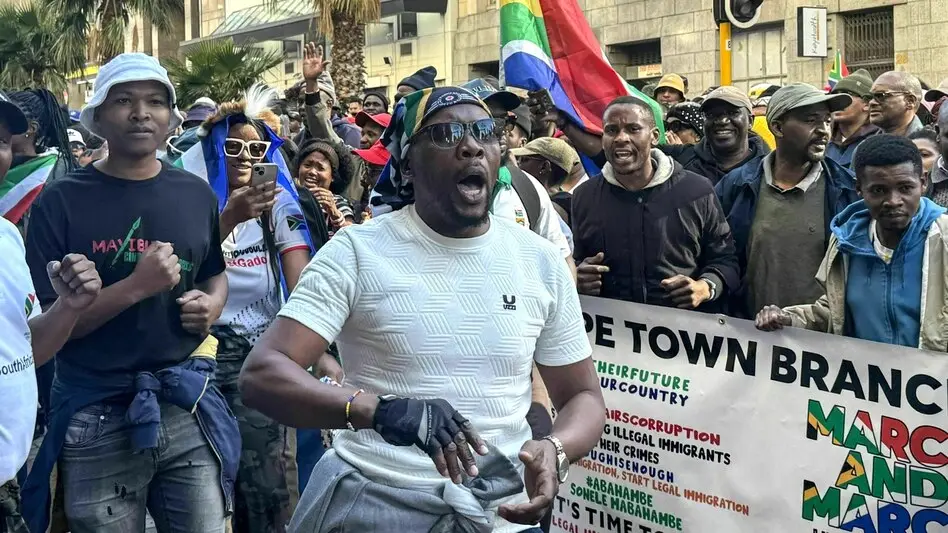
Xenophobic protests began in Bellville in the spring. Around 300 South Africans marched through the neighborhood singing, baseball bats and sticks in their hands. Their T-shirts bore the name of their movement: “March and March.” On the one hand, it takes up the Zulu nationalism of former President Jacob Zuma. On the other hand, it is compatible with an organization of right-wing, white Afrikaners.
Jacinta Ngobese-Zuma, radio presenter and leader of the protests, marched at the front. “Yes, we are dividing,” she told a television crew at the time. “We are separating ourselves from people who should have left the country long ago.”
Shortly before, it had been claimed on social media that a recent landmark ruling by the Constitutional Court automatically guaranteed residency for asylum seekers - fake news that spread like wildfire.
Whether someone like Linda Muwalo lives completely legally in South Africa doesn't seem to matter to March and March. For Ngobese-Zuma, her movement and the radical parties riding this wave of protest, belonging has nothing to do with the law. And not so much with reality. According to official figures, only 2.4 to 3.3 million migrants live in South Africa. That's 4 to 5 percent of the population. And they are important for the economy, say experts.
In June, the people of March and March stood in front of the shops owned by Somalis, Pakistanis and Zimbabweans. They wanted to force the business people to close their shops. They threw fruit crates at informal traders like Linda Muwalo to drive them away from their usual places. Then in August, blood spilled onto the pavement of Bellville Market.
The sticks, a symbol of the nationalism of the Zulu, South Africa's largest ethnic group, no longer remained just a threatening gesture. They became weapons. The protesters attacked the foreign traders, kicked people and looted shops. “I was so scared,” says Linda Muwalo, who was at least physically unharmed. The police found it difficult to control the violence, says Muwalo. Despite tear gas and stun grenades. There were very similar scenes in September and October, here and elsewhere in the country. March and March wanted to build pressure ahead of South Africa's local elections on November 4th.
The republic at Africa's southern tip is familiar with such riots. More than 60 people died in xenophobic attacks in 2008. Tens of thousands were displaced. After that, the protests flared up again and again. What is new about the latest wave is its level of organization and its geographical reach. The hatred is no longer just erupting in the Gauteng province around Johannesburg. It covers the entire country. And it is having an impact.
Since June, more than 160,000 foreigners have left South Africa. Many volunteered to be deported on government-organized buses. Zimbabwe, Nigeria and Ghana ultimately initiated measures themselves to bring their citizens back. Muwalo's husband also made his way back to Malawi. He covered 3,000 kilometers with his four children. Linda Muwalo stayed. The family needs the few rands they earn here at the market.
Not everyone made it away in time. In the summer, Nigeria blamed South African authorities for the deaths of two of its citizens. At the end of October, around 50 rioters beat a foreigner to death in the east coast city of Durban.
The protests in Cape Town are smaller than in Johannesburg and Durban. But even here in the south the violence can end in death. Bashiru Isak, a Ghanaian and father of three, was shot dead here during the summer protests. Here of all places. In a city whose political leadership never tires of distancing itself from the rest of the country.
On Voortrekker Road, just a few steps away from the market in Bellville, is house number 177: an ocher-colored clinker brick building from the 1990s, the branch of the South African Ministry of the Interior. Around 50 people are waiting in line in front of the entrance. White pensioners collecting their passports, Indian South Africans, coloreds and blacks who need birth or marriage certificates. And foreigners who want to renew their residence papers.
Dorel Clansia is 22 years old and comes from Congo. “A country that attracts foreigners is blessed,” he says. In 2016 he came to South Africa to study, actually. Then his father died and the money from the Congo stopped. The studies were no longer payable. Clansia began mending car tires. Today he earns enough to support his girlfriend, a colored South African, and to care for their little daughter.
“There are enough men who abandon their children,” says Clansia. He won't go. He will take care of his daughter. After all, she is a “real” South African.
Clansia is tall and wears shorts and a gray T-shirt. His English has a slight French accent. “We are not criminals, we work, we pay taxes,” he says. “We are all Africans.” The South Africans who lived in the Congo would not be treated so badly.
He believes it is no coincidence that March and March is mobilizing against people like him, while white German, Dutch and other foreigners in South Africa remain largely unmolested. Clansia believes that the movement will not affect white people. Why? "Because they have money and bring it into the country. What they don't see: Black people are also investing here."
The queue in front of the office is slowly moving forward. Clansia is waiting to have his residence permit extended. A plastic card that helps decide whether he can stay where he has built a life. “The government is like our father,” says Clansia. “It determines who has to go and who doesn’t.” But with this power comes responsibility. Clansia's voice becomes firmer. He won't let a mob drive him away. “The government needs to intervene much more decisively,” he says.
But now, just before the elections, politicians are noticeably holding back. The candidates and representatives hardly dare to put March and March in their place. Public gestures of solidarity with foreigners who are attacked, threatened and driven from their jobs are even rarer. The fear of going against what the parties assume to be the “will of the people” seems too great.
These local elections are about more than seats in local councils and town halls or issues such as functioning infrastructure. It's about the character of South African society - and the future of a still young democracy.
The 2021 local elections were already a key moment for a free South Africa. The dominance of the African National Congress (ANC), once a liberation movement against apartheid and Nelson Mandela's party, waned significantly for the first time. Coalitions became necessary in South Africa's 257 municipalities, and finally at the national level in 2024.
The new political competition could help the ANC get to grips with corruption and chaos within its own ranks. The fact that the white, economically liberal Democratic Alliance (DA) could win the upcoming local elections in six of the eight metropolitan regions, and even in the ANC stronghold of Johannesburg, increases the political pressure enormously. And then there are the protests.
The DA has been in power in Cape Town for 20 years and prides itself on its infrastructure projects. “Cape Town works” – Cape Town works is the motto in this election campaign. As if the Cape metropolis could be separated from the rest of the country. As if what is happening beyond the luxurious villas on the sunny side of Table Mountain is not part of Cape Town. For example, the wave of violence against taxi drivers in the townships of Delft, Gugulethu, Khayelitsha and Bonteheuwel. Three dead and six injured in the days before the election alone. And then the xenophobic violence in Bellville and elsewhere in the city.
Between the huge corrugated iron settlements and the beaches of the rich and famous in upscale Clifton lies the Bokaap district with its colorful houses, mosques and gay bars - and of course Cape Town's shady old town. African market stalls are squeezed between colonial buildings and Gothic churches. Craftsmen, hipsters and old Cape Malay women roam the streets, the latter with headscarves and no shoes. Cleaning crews, all in yellow, march with brooms in hand. Private security companies monitor the shopping streets on behalf of the city. Cape Town works.
From the eighth floor of a high-rise on Church Street, Cape Town lies at Paula Assubuji's feet. From up here, above the roofs of the city, the economist looks at a country in which the political fronts are being rearranged. Assubuji heads the foreign office of the green-friendly Heinrich Böll Foundation in Cape Town. The petite woman with curly hair observes how hatred of African immigrants has developed into a political force.
“Before these elections, the Afrophobic movement really took off,” she says. The fact that March and March and other groups are so well organized suggests financial support. Where the money comes from is unclear. It is possible that foreign governments have an interest in destabilizing South Africa. Many in the country are speculating whether US President Donald Trump, who despises South Africa's government, might have a hand in it. He had repeatedly claimed that a “genocide” of white South Africans was taking place in South Africa and that they were being robbed of their land without compensation. Some also suspect Israel to be a background player because South Africa has sued the country before the International Court of Justice for committing genocide in Gaza. There is no evidence for any of this.
Domestically, Assubuji sees connections to the political environment of former President Jacob Zuma's uMkhonto weSizwe, or MK, party. Zuma always politically favored the Zulu, his own ethnic group; March and March follows on from that. Afriforum, a right-wing organization that primarily represents white Afrikaners, is also seeking proximity to the movement.
The protests can become a stage for political outsiders: those who mobilize against foreigners make it into the news - and hope to gain votes in the local elections. White and black nationalists can profitably agitate against foreigners. And the Coloreds, whose family trees include Europeans, Cape slaves and indigenous Khoi-San, also have a xenophobic small party here in the Western Cape province: the Patriotic Alliance.
“This is nothing less than a direct attack on the 1996 South African constitution,” says Paula Assubuji. After the end of apartheid, this was intended to be the alternative to a state that sorted people according to their skin color: a democratic order in which different population groups live together on equal terms.
But it was the “government of national unity” under ANC President Cyril Ramaphosa that gave space to the Afrophobic protests, says Paula Assubuji. Ramaphosa did condemn the violence. At the same time, however, his government allowed itself to be driven by the mood on the street.
On Wednesday, November 4th, local councils will be re-elected in South Africa. 10,526 seats are up for election in 4,488 constituencies, from the mayoral positions of megacities to village councils.
In the last local elections in 2021, the former liberation movement ANC (African National Congress), which has ruled South Africa since 1994, slipped below 50 percent for the first time and ended up at around 45 percent. Since then, it has only governed four of the eight metropolitan areas and has lost numerous municipalities. The 2024 general election confirmed the ANC's downward trend. The big question this year is whether the ANC voter base will continue to erode.
This is particularly clear at the Ministry of the Interior, says Assubuji. "It's actually a chaotic institution. But at the moment when it came to deportations, it worked." When Ramaphosa received representatives of March and March in Pretoria for talks, he added additional value to them. A movement that intimidates people has also become a conversation partner for the government.
The Democratic Alliance is more moderate. At least at first glance. The party, which co-governs Pretoria and Cape Town, likes to present itself as a color-blind advocate of efficient administration. It tries not to be lumped in with openly xenophobic groups. But she also wants to demonstrate toughness, says Assubuji – especially towards wealthy foreigners.
During the election campaign, Cape Town's DA mayor Geordin Hill-Lewis was filmed stopping West Africans in expensive cars in middle-class neighborhoods and checking their documents. The staging was aimed at a suspicion: According to the embassy, anyone who can afford such cars must have earned their money illegally. Another DA candidate went further. For his social media, he independently organized a nighttime raid on black men who were sleeping in a poor shack. “Do you speak Afrikaans?” he shouted at her. The question was apparently intended to clarify whether the men were South Africans. Poverty is only legitimate if it affects the right people.
Assubuji raises both hands in resignation. “The DA sings the same Afrophobic song as the other parties,” she says. “It’s just different in the key.” South Africa is faced with tasks that cannot be solved with blatant videos and xenophobia.
The ANC needs to fundamentally renew itself, says Assubuji. The reference to one's own role in the liberation struggle has worn off. “To say, ‘I was a freedom fighter during apartheid,’ is no longer enough.” For people, today's elections are primarily about concrete things: about electricity that flows reliably, about clean drinking water, about roads that are maintained. About tax money that must not be embezzled.
But even the DA, which wants to transfer its Cape Town successes on these issues to the other metropolises in the country, cannot rely solely on functioning infrastructure, says Green Party member Paula Assubuji. An analysis by the South Africa office of the conservative Konrad Adenauer Foundation also states that behind the tourist trails and clean streets in Cape Town there is a city that is characterized “by extreme inequality, a lack of housing, gang violence, spatial apartheid and increasingly bitter disputes about who benefits from its success.”
As the competition for living space and income becomes increasingly fierce, foreigners are quickly made into scapegoats, says sociologist and activist Vainola Makan from Bellville. With her association Ubuntu, Makan campaigns for social cohesion in her neighborhood - and also for foreigners. “We non-whites internalized a lot of the misanthropy during the apartheid era,” says Makan, “African foreigners are now feeling that.”
And they are not allowed to take part in local elections. You can't defend yourself. Or maybe it is?
Graffiti artists designed the house walls around the market in Bellville, on the edge of which Malawian Linda Muwalo and her Somali friends sell tomatoes and oranges. A herd of elephants, small and large, in purple, red, orange, yellow, green and blue walk on a wall. The image is intended to symbolize the rainbow nation that the Republic of South Africa declared itself to be after the end of apartheid.
“One day we will have to confront the vaunted constitution and consider how to protect ourselves from its devastating effects,” Afrophobic leader Jacinta Ngobese-Zuma recently complained on her Facebook account. The reason: The Association of Somalis in South Africa, together with South African lawyers from the Legal Resources Center, filed a lawsuit on behalf of 20 informal traders from Bellville. Against Ngobese-Zuma's xenophobic vigilante group - and against the city of Cape Town.
The traders want the Western Cape Provincial High Court to declare the failure of the city and police to take effective security measures unconstitutional. The authorities should present a “detailed, coordinated plan” to protect traders. There is no verdict yet, but the city has already responded by promising to closely monitor the situation in Bellville and expand security measures if necessary. And police spokesman Ndakhe Gwala said his agency had “an emergency plan with additional operations in place to prevent such violence from occurring again.”
In Durban, the police have now taken themselves to court to get a ban on demonstrations around election day. During the election and the counting of votes, march-and-march protests are only permitted there between 9 a.m. and 3 p.m. - and only without weapons and gestures of intimidation.
“We don’t have any special requests,” says Linda Muwalo in Cape Town. You and the other foreign traders at the Bellville market simply want to feel safe again. You have valid sales licenses. And trust in a constitution whose preamble states: “We believe that South Africa belongs to all those who live in it – united in our diversity.”