
Germany taz
Local elections in South Africa: ANC dominance is over
Almost all metropolitan regions are lost to South Africa's ruling party. The winners are very diverse – can they pull themselves together now? more...
Deutsch (original) ·Auto-translated to English
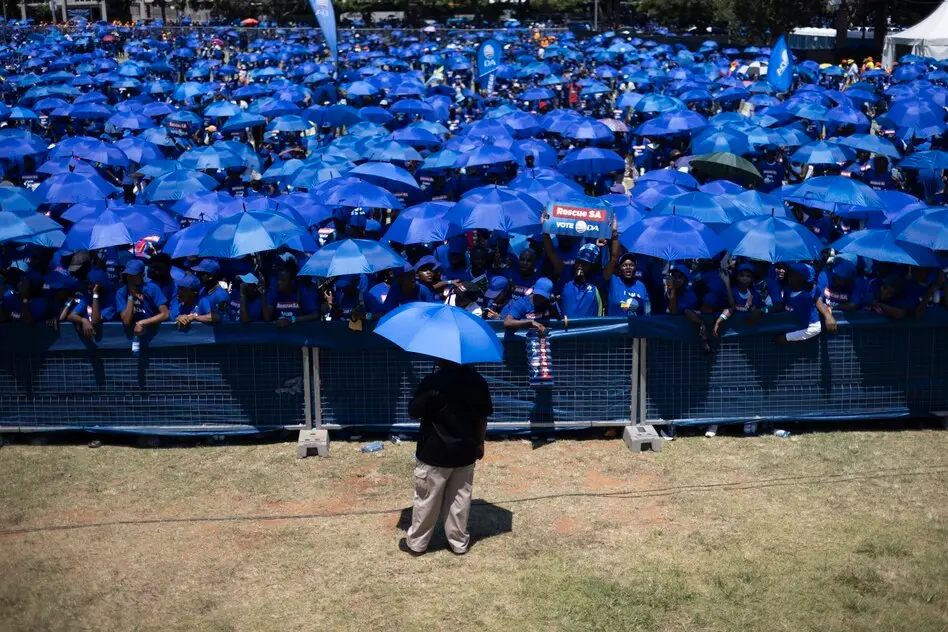
The dominance of the ANC (African National Congress) in South African politics is finally over. In the local elections on November 3rd, the former liberation movement only received just under 30.8 percent of the votes nationwide, according to the final results distributed by the electoral commission on Monday - only three of the 23,696 electoral districts were still missing in the afternoon.
The ANC's downward trend is clear and accelerating. After democratization in 1994, the party then led by Nelson Mandela had consistently received over 50 percent of the vote for decades. In the 2021 local elections, their vote share fell below this mark for the first time at 45.6 percent, followed by 40.2 percent in the 2024 parliamentary elections. This was considered a historic turning point - it forced the ANC to form a coalition government for the first time after thirty years of sole rule.
Now the debacle continues even more dramatically at the local level, especially in the big cities. Not only does the ANC not win an absolute majority in any of the eight metropolitan areas, in six of them it is no longer even the strongest party.
In the most populous city region of Johannesburg, the ANC only achieves around 20 percent, after 34 percent five years ago and 45 percent in 2016. In the capital region of Tshwane (Pretoria), the ANC only comes in third place with also 20 percent, as well as in eThekwini (Durban) with 16 percent and in Cape Town with 14 percent. The ANC only retained first place in Buffalo City around the port of East London with its Daimler car factories and in Mangaung around the historic Boer settler town of Bloemfontein in the central Free State.
Only in the last few years has the ANC had to form coalitions with smaller parties in order to be able to govern in South Africa - now it is the smaller party in many places and may go into opposition in some places, something that was previously unthinkable.
The shining winners are to the right of the ANC. The liberal-white dominated DA (Democratic Alliance), which emerged from the merger of the former liberal opposition with the former white apartheid party, increased from 21.8 to 24.6 percent - not particularly much in itself, but the gap to the ANC narrowed from 18 to 6 percentage points. DA now leads in five of the eight metropolitan areas, including Johannesburg and Tshwane. With over 56 percent in Cape Town and 44 percent in Nelson Mandela Bay around the port of Port Elizabeth, DA achieved historic victories.
The DA spin-off “Action SA” of the former DA mayor of Johannesburg, Herman Mashaba, achieved respectable results: 16.3 percent in Johannesburg, 18.5 percent in neighboring Ekurhuleni, where, among other things, the Johannesburg international airport is located, and even 22.1 percent in Tshwane. In all of these three city regions, Action SA and DA would now hold the majority together - majorities for a liberal economic policy that breaks with the state dirigisme of the ANC, its welfare systems, which are criticized as inefficient, and its preference for party-affiliated black companies, which is decried as a source of corruption and nepotism.
The three regions together form the heart of South Africa's largest state, Gauteng, and their mining is the engine of the South African economy. The unions and the gigantic townships of Gauteng were one of the two most important roots of the ANC resistance struggle - disempowering him here would have a completely different meaning than the existing DA administration in Cape Town, a local peculiarity in the only part of the country without a black majority.
The ANC's other historical root, the rural black population, whose traditional chiefs reliably provide voters to the ruling party, survived these local elections relatively unscathed. The ANC therefore remains the strongest force in six of the nine states. Limpopo, on the border with Zimbabwe, still votes ANC at 54 percent - but it is the only state where the ANC still surpasses the 50 percent mark.
In KwaZulu-Natal, which includes South Africa's third largest city, Durban, the ANC is collapsing in both rural and urban areas. The ANC split MK (Umkhonto weSizwe), which South Africa's former president Jacob Zuma founded three years ago under the name of the former armed wing of the ANC, is now asserting itself here. MK dominates the cities, with 38 percent in the eThekwini metropolitan region (Durban). In the countryside, the IFP (Inkatha Freedom Party), the ANC's historic Zulu rival during apartheid, dominates.
The ANC's hope is now that, despite everything, it is still the strongest force. He can still govern alone in 53 cities, against 12 for DA, 5 for IFP and 3 for MK. And his opponents are too fragmented in many places to actually bring about a change in power everywhere. In Kwazulu-Natal, the MK and IFP together hold a majority everywhere, but they can't stand each other. In Johannesburg, Herman Mashaba and his ActionSA absolutely do not want to work with DA top candidate Helen Zille - the two hate each other from their DA days together, during the election campaign Mashaba called Zille a "liar" and "racist", and she contradicted it by saying that she had completely ignored him during the election campaign.
Nevertheless, the fall of the ANC is traumatic for a former liberation movement that, according to its own identity, represents the entire black majority of the population in South Africa. On Monday, the party leadership had to deny rumors that President Cyril Ramaphosa had offered to resign.