
Germany · taz · · 3h
Local elections in Lower Saxony: Greens remain stable
Deutsch (original) · Auto-translated to English
There are election evenings when triumph and disillusionment are close together. September 13, 2026 is such an evening for the Lower Saxony Greens.
At the district level, according to the preliminary results published on Monday morning, the Greens received 14.1 percent of the vote. That's a good result. They have only been better twice: in 2011 with 14.3 percent. And in 2021 with 15.9 percent, the best result since it first took office in 1981, with the momentum of the climate movement.
Bitter for the Greens: Since Sunday they have only been the fourth force in Lower Saxony. Because this time it is the AfD that gets 15.9 percent.
The Green Party state chairman Maximilian Strautmann summarizes the situation on election evening for the taz as follows: “Nationwide, the Greens performed strongly and reached many runoff elections, such as in the university towns of Göttingen, Lüneburg, Oldenburg or in Rotenburg, Bevensen and Elbtalaue.”
Belit Onay, Hanover's Green mayor, who stood for re-election, "achieved a sensational result of 45 percent against all odds" and is going into the runoff "as the clear favorite." That is “outstanding”. What's piquant: Axel von der Ohe (SPD), Onay's competitor, with almost 22 percent but less than half as strong, is head of the finance department and first city councilor in Hanover, as well as Onay's deputy.
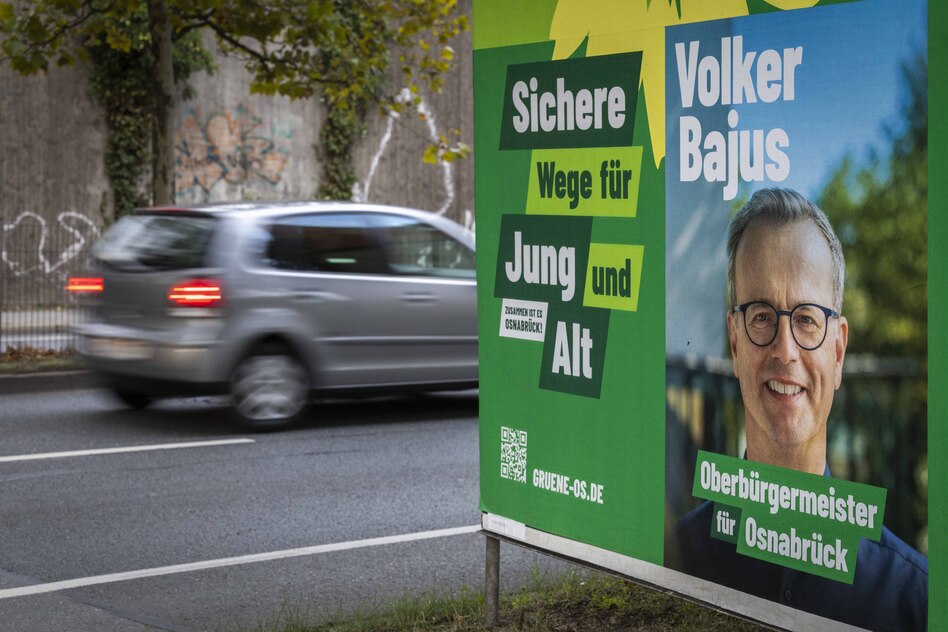
Volker Bajus, parliamentary manager and vice-chairman of the Green parliamentary group, has run as mayoral candidate in Osnabrück. He got 22.3 percent of the vote. “Our goal was to get into the runoff election against the incumbent,” Bajus told the taz on election evening. "We have achieved that. Now the cards are being reshuffled and we will do everything we can to mobilize people with our issues of affordable housing, transport transition and climate protection." However, Katharina Pötter, CDU, with 42.2 percent, almost twice as strong as Bajus, is the clear favorite.
In the Osnabrück city council, the Greens are once again the strongest force with 24.7 percent of the votes, but a little below the 29.2 percent in 2021.
Anna Kebschull, who became Germany's first Green district administrator in the Osnabrück district in 2019, also relegated a CDU candidate to second place in her second candidacy with 33.8 percent of the vote - in a district that has been dominated by the CDU for decades.
In the state capital Hanover, the Greens became the strongest force with 28.4 percent of the vote. Likewise in the city councils of Göttingen with 28.6 percent, Lüneburg with 29.3 percent and Oldenburg with 24.9 percent.
In Lüneburg, Claudia Kalisch, one of the few Green mayors in Lower Saxony, achieved 36.1 percent when she ran again - she ran without a party. There is now a runoff election here.
In Göttingen, Onyeka Oshionwu, the Green candidate for the mayoral election, got a confident 41.4 percent - her runoff competitor from the CDU is almost 14 percent behind.
In Oldenburg, the green mayoral candidate Jascha Rohr got 30.5 percent - and also made it into the runoff against his only slightly stronger SPD competitor.
In the district election in the Osterholz district, the Green Kim Fürwentsches came in first place with 28.5 percent.
Overall, it is clear that the Greens are not only strong in metropolitan areas, their classic urban strongholds. They also achieved solid results in the area, in the more conservative country.
The districts of Oldenburg, Ammerland, Osterholz, Harburg and Lüneburg are examples of this; The Greens are above their national average here, in some cases significantly. However, there is also the opposite: in districts such as Vechta, Cloppenburg, Emsland, Aurich and Wittmund, the Greens perform well below the national average, in some cases below 7 percent.
The runoff elections are scheduled for September 27th. Then it will be decided what the Greens’ final balance looks like.
Read the full story at the source
Source: taz