
Germany · taz · · 2h
Artificial intelligence and images of nature: Something is wrong with these valleys
Deutsch (original) · Auto-translated to English
A machine describes images of nature and families. The other creates new pictures based on this description. The result: mostly vaguely familiar. Often interchangeable and formulaic. And sometimes really scary.
For her video “It seems to capture the beauty and majesty of nature” (2023), the artist Ornella Fieres had photos from a family album from the 19th century described by an artificial intelligence. And these descriptions are then used as prompts for new image compositions by another artificial intelligence.
And because artificial intelligence isn't that intelligent, suddenly there's a family standing in the branches of a tree. And the clouds above the mountains look like the mountains below them. And because the AI couldn't generate such perfect, photorealistic videos as it does today three years ago, when the work was created, the figures don't have faces. Their hats melt into their skulls. And the landscape around them is an uncanny valley.
"On Landscape. Between escapism and disenchantment": until January 3rd, Haus am Lützowplatz, Berlin
The roboticist Masahiro Mori originally used the term “Uncanny Valley” to describe the effect that occurs when an artificial figure looks very similar to a human, but not similar enough to be completely convincing. In the exhibition “On Landscape” it is the valleys, mountains, meadows and forests that are not convincing upon closer inspection. Many of the works derive their impact precisely from the shift between recognition and strangeness.
Because here nature is not a simple image of an existing reality, but often the statistically generated distillate of countless landscape images. In “Drill Baby Drill”, a video by the London collective Troika, whose images were generated entirely by AI generators, it at least initially looks like a Windows XP desktop background. But then there is a desert dune rising from an icy lake. And at some point icebergs burn.
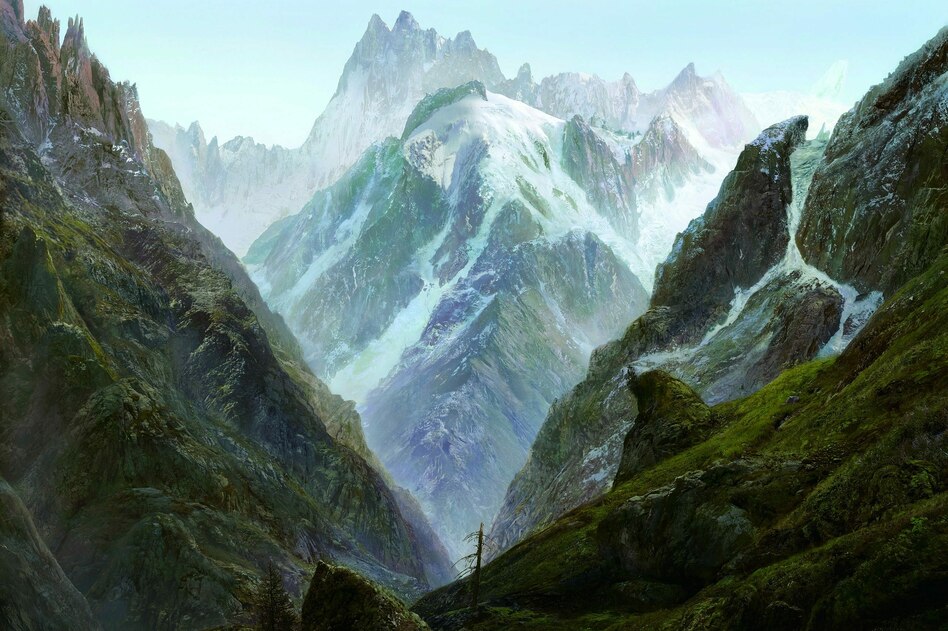
Hiroyuki Masuyama has digitally reconstructed the painting “High Mountains” by Caspar David Friedrich, which once belonged to the collection of the Berlin National Gallery but was burned in an air raid in 1945, from archive recordings of the lost picture and his own photos. And Sven Drühl used geodata from the Zugspitze and other Alpine peaks to create chunky three-dimensional steles using a 3D printer.
The exhibition brings together fourteen positions that revisit the genre of landscape painting in the area of tension between the merciless reshaping of the planet in the Anthropocene and the growing power of the digital, which, along with AI, is also reorganizing image production. And initially without cultural pessimism. Because the landscape was never a neutral image in art, but always a construct and projection surface, an expression of inner moods and human interventions.
However, the exhibition only shows a hint of what kind of “landscapes” emerge when the hunger for energy and computing power is given free rein. “Resistance, Flood, Fire, Resistance” (2022/2026) by Beate Gütschow is a work that documents the consequences of climate change and forest fires on a landscape near Treuenbrietzen in Brandenburg. The factors that promote such catastrophes may also include the GPU clusters that were used to create many of the images in the exhibition.
However, artists like Ivar Veermäe have created relevant artistic documentation of this form of post-industrial landscape destruction, which could have provided a counterweight to the handsome, large-format works in the exhibition.
Amazingly, these buildings - and the destruction of the landscape that go with them - are currently doing something in the USA that many other impositions of the second Trump administration were unable to do: motivating parts of the population to become politically active. Resistance is forming against the construction of ever new data centers, which are the material prerequisite for digital images from landscape paintings to AI slop; New construction has already been banned by law in some states.
But you don't have to go to the USA to see what landscapes AI creates in physical space: a trip to the Vantage Data Center in Ludwigsfelde is enough to see what material devastation the supposedly immaterial data processing can cause. Whether you want to sacrifice real landscapes to create artificial ones - you can think about it again after visiting this stimulating exhibition.
Read the full story at the source
Source: taz