
Climate taz
Climate change and Islamism in Nigeria: Boko Haram tills the field
Climate change threatens the livelihoods of many farmers in Nigeria. The terrorist militia Boko Haram is using its distress to recruit new fighters. more...
Deutsch (original) ·Auto-translated to English
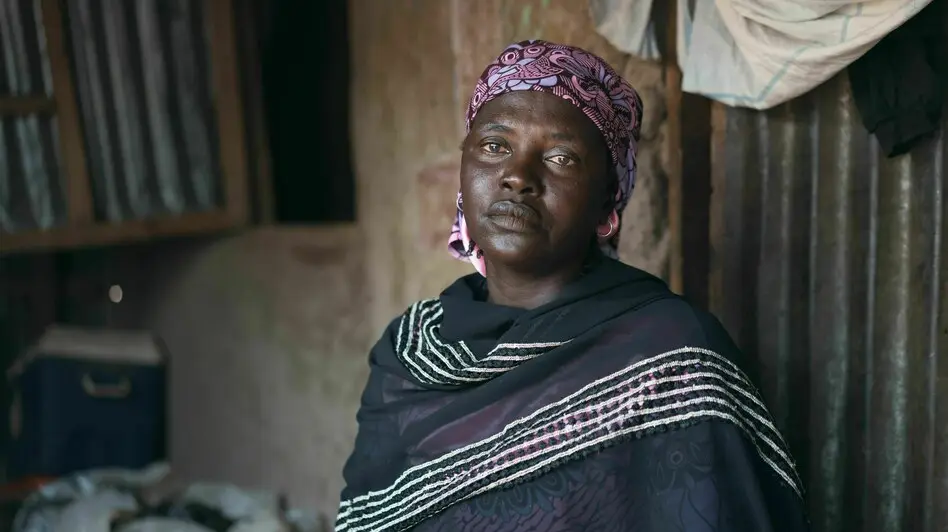
M aryamu Bitrus pulls up the hem of her purple dress slightly. A wound about five centimeters long appears under the knee. Scab only partially covers the exposed red tissue. “I can’t go to the field anymore,” says the 42-year-old in a quiet voice. She fell a week ago. For Maryamu, this is dramatic: “Agriculture is my livelihood.” Here in the village of Gurku in the central Nigerian state of Nasarawa - far away from Boko Haram, the Islamist terrorist militia - everything should actually be getting better.
Maryamu sits on a wooden bench in front of the two rooms of her corrugated iron hut. Behind her there is a crucifix painted with chalk on the wall of the house. “We have so little space – sometimes I sleep out here on the porch,” she says. She shares a room of around ten square meters with her four children. There are thin plastic mats on the floor with mosquito nets stretched over them. Some clothes hang on a line. The belongings are stowed away in buckets, bags and baskets. Maryamu doesn't own any furniture. She collects her corn harvest in the next room. But because it is now too dry most years, the room is often only sparsely filled.
Maryamu reached Gurku in April 2016. To this day, people seeking protection from Boko Haram continue to arrive here. The militia and its affiliate, the Islamic State of West Africa Province (Iswap), have killed more than 50,000 people since 2009. The Institute for Security Studies estimates that around three and a half million people fled the violence. Most of the victims are in northeast Nigeria. But parts of the neighboring countries of Niger, Chad and Cameroon are also affected.
The UN think tank Unidir is researching the causes of armed conflict in its project Managing Exits from Armed Conflict (MEAC). Based on hundreds of interviews with victims and former Boko Haram fighters, she comes to the conclusion: Climate change is fueling violence in northern Nigeria. Jessica Caus, Meac project coordinator, observes rising temperatures, irregular rainfall and shifting seasons. “Boko Haram specifically exploits this to recruit in rural communities because they have no other means of livelihood.”
Maryamu also made a living as a small farmer in her home village of Chinene, near the northeastern border with Cameroon. But then Boko Haram expanded its attacks in 2014. The kidnapping of 250 schoolgirls in Chibok, around 100 kilometers from Maryamu, made headlines around the world at the time.
This article was made possible through the financial support of the Forschungsfonds Ausland e. V. You can support the research fund through a donation or membership.
Around the same time, Maryamu's husband was hit by a motorcycle in another city as panicked people fled Boko Haram. "He was brought home and we cared for him for 28 days. We sold everything we owned to pay for his medical care, but in the end God took him."
Maryamu's gaze is fixed on the fireplace in front of the hut, tears fill her eyes. Two puppies run through the door and roll at her feet. Maryamu doesn't seem to notice her. Although she had only answered briefly up to this point, she bursts into tears at the thought of her late husband. "I had nothing left. I only had 5,000 naira with me." She set off with her four children in July 2014 with the equivalent of 22.50 euros at the time.
First they slept in the mountains, then they crossed the border into Cameroon. But how do you survive without money? “We decided to return secretly under the cover of darkness and look for anything that could help us survive,” says Maryamu. She sneaked past sleeping Boko Haram fighters into her old house. But selling a few pots only helped for a short time. In the meantime, the family of five camped penniless under a tree in the eastern Nigerian city of Yola. After almost two years without permanent residence, they reached Gurku in April 2016. Here they were safe from Islamist violence for the first time.
The farmers' desperation helps Boko Haram
Warm corn yellow is covering Gurku these days. The harvested corn kernels are laid out to dry on plastic sheets everywhere. Corn is even drying on three graves in the village center. In some places, children walk barefoot over the harvest so that the sun can reach every single grain. Women lift large buckets filled with corn over their heads and let the grains trickle down into buckets on the ground. They gradually separate the corn kernels from plant residues.
The harvest seems successful, but appearances are deceptive. The rainy season now often begins two months later and ends much more quickly, says Maryamu. "That's what happened this year, for example: A harvest was lost because of the lack of rain. We sowed corn kernels, but they didn't get enough water. The plants dried up completely."
Here in Gurku, in central Nigeria, Boko Haram is not yet recruiting new fighters. In the north, however, the farmers' desperation is helping the militia recruit new fighters. Among former fighters in Nigeria who acknowledge climate-related problems, 11 percent say they joined Boko Haram because climate change caused them problems. In Chad and Niger, where Boko Haram also recruits, 28 and 51 percent of the ex-fighters surveyed confirmed this. This is shown by the results of Unidir surveys.
A former Boko Haram fighter told Unidir: "The crops I grew died because of the lack of rain and did not produce any crops. My livestock died because there was no more grass to eat and no water in the rivers to drink. It also became dangerous for me because I no longer had enough to eat due to all these problems. That's why I joined them."
The poverty in the north has several reasons, for example historical neglect by politicians, says peace researcher Jessica Caus. But one thing is certain: poverty promotes violence, and climate change in turn exacerbates poverty. "In previous surveys, a large proportion of people said they had not had enough to eat in the last week. It is in this context that Boko Haram has established itself there." The Islamists used religion primarily as a tool for radicalization: “There are economic backgrounds and inequality dynamics that are then partly religiously charged,” says Caus.
Other people are forced to join the terrorist organization, for example because Boko Haram kidnaps them or takes over their villages. “Even among the farmers who joined of their own free will, you can ask yourself how voluntary it really was, or whether some of them had no other option.” Caus points out that Boko Haram often occupies the fertile agricultural land.
This is also confirmed by an ex-fighter from Gwoza, the neighboring town of Maryamu's home village. He said in an interview with Unidir: "When members of Boko Haram occupied my community, they set up camp on the mountain. This left me without access to good farmland. Heavy rains and floods made it impossible to cultivate the fields that were still available to us. To get good farmland, you had to join them."
Boko Haram changed over the years. The terrorist militia joined the “Islamic State” as early as 2015. When IS wanted to install a new head the following year, Boko Haram broke up into two rival factions: One part followed the old leader Abubakar Shekau. The other part followed Abu Musab al-Barnawi under the name “Islamic State of West Africa Province” (Iswap). After Shekau died, Boko Haram lost influence and fighters compared to Iswap. While Boko Haram attacks civilians more often, Iswap focuses more on military and state targets. Attacks on military posts by both groups are currently increasing. For example, a drone strike in Borno state on October 31 killed two soldiers and wounded 13 others.
Not all internally displaced people in Gurku are seeking protection from Islamist terror. Conflicts between herders, most of whom belong to the Fulani ethnic group, and farmers also claim hundreds of lives every year. Several analyzes suggest that the herder-farmer conflict is now deadlier than Islamist terrorism in Nigeria. Around half a million people have already fled the violence within Nigeria, including Rifkatu Sunday. She comes from the central Nigerian state of Plateau.
"It was Christmas Day. At that time, the Fulani invaded our entire neighborhood - everywhere, just everywhere. We stayed awake until dawn," says Rifkatu. 17 of her relatives lost their lives that night in December 2023.
The 80-year-old wears a wrinkle-free green dress with rhinestones on the hems. She also grew corn for the first two years after her arrival. But last year here in Gurku, too, the shepherds' herds ate up their entire harvest. “They ended up with me again,” Rifkatu says of the shepherds. “But here I can at least relax in my house without being afraid.” Unlike in their homeland, herdsmen in Gurku have not yet attacked residents at home. She now makes ends meet by buying vegetables and selling them on the market for a small profit.
Presidential elections: Nigeria will elect its president and parliament on January 16, 2027, and the governments and parliaments of the 36 federal states on February 6. The 74-year-old President Bola Tinubu wants to be re-elected, but the poor economic and security situation is an obstacle.
Low voter turnout: Interest is particularly low among the young generation, which is hardly represented in politics. According to the electoral commission, only around 103 million of the 240 million inhabitants of Africa's most populous country are registered as voters. In the last elections in 2023, turnout was less than 27 percent, Tinubu won with only 8.8 million votes (36.6 percent) - Nigeria does not have a runoff election, whoever is ahead in an election is elected.
Violence and terror: Large parts of Nigeria are shaken by violence. What began in 2009 as a rebellion by the Islamist sect “Boko Haram” in the northeast has expanded and encouraged the emergence of further conflicts. “Nigeria is dealing with overlapping threats on multiple fronts at once,” says the latest monthly report from US think tank SARI Global, which advises aid agencies: “the Islamist insurgency in the northeast, banditry and mass hostage-taking throughout the north and northwest, separatist violence in the southeast, conflicts between farmers and herders in the center.”
Military presence: Islamist attacks primarily target supply routes, while criminal gangs directly rob the rural population. Before the elections, the army is massively increasing its presence in the conflict areas, which could mean additional uncertainty for the population.
On November 4, just days after Rifkatu shared her daily life, residents in her home state of Plateau killed two herdsmen. The following day, herdsmen on the border between Plateau and Nasarawa shot a 14-year-old girl several times in a dispute over grazing land.
Climate change is also increasing herder-farmer conflict
While the migration routes used to lead more through the north of Nigeria, the herders now move further and longer through the central belt of Nigeria. “In recent decades, natural resources have come under increasing pressure for use,” says peace researcher Caus. This is partly due to climate change, which has led to desertification in the north. “But also partly because of population growth and the expansion of arable land – and also because of the violence and armed groups in the north,” she says. A study by the University of Lagos shows that half of the vegetated area was lost in northern Nigeria between 1984 and 2016.
In the case of the Fulani herdsmen and the farmers, not only do different ethnic groups come together, but also members of different religions. The Fulani are mostly Muslims, the farmers in the central belt belong to different, mostly Christian, ethnic groups. Ultimately, however, it is primarily a resource conflict, says Caus.
Rifkatu has also observed how her homeland, Plateau State, has become increasingly drier over the course of her life. “There isn’t as much water as there used to be.” She sits on a plastic chair in the narrow alley in front of her house. The house walls provide some coolness and shade even at lunchtime. “If you grow potatoes in Plateau today, you have to use a significant amount of fertilizer before you can even harvest anything,” says Rifkatu.
The government must find solutions to adapt agriculture to the changing climate while combating terrorism. “Security measures and climate measures should ideally intertwine and not inhibit each other,” says peace researcher Caus. "In some areas, for example, there are strong barriers to access to fertilizer because it can be used to make bombs. The lack of fertilizer, in turn, leads to even more crop losses as temperatures rise due to climate change."
Climate-adapted agriculture could also facilitate the reintegration of former Boko Haram members. “They come back and the ground is just as dry, the wells are just as empty,” explains Caus. The Unidir researchers recommend, among other things, establishing seed banks with climate-resilient crops and restoring climate-damaged soils. It is also important that there is sufficient humanitarian aid to minimize incentives to join Islamist groups.
Caus believes that it is not only the Nigerian government's responsibility to find solutions, but also the international community, for example in the form of the United Nations and the Lake Chad Basin Commission, an association of several North and Central African countries. Local actors and non-governmental organizations also need to be involved with their regional knowledge.
The Nigerian government is already deploying more than 10,000 armed so-called agro-rangers in northern Nigeria. They are intended to protect farmers from jihadist attacks and defuse conflicts between farmers and herders. According to Unidir, expanding the program could protect people and secure investments in agriculture.
In Gurku, Christians and Muslims are neighbors
An interreligious peace project was created in Gurku in response to the conflicts. "We were just sitting comfortably together and letting the evening end. It was around six or seven o'clock. Then the village leader informed me that strangers had come," remembers villager Nuhu Dawogbeyi in 2014. In the first two years, over 150 newcomers spent the night in two rooms in his house until they found their own place to stay. The 70-year-old also provided his guests with food.
Today there are knee-high piles of corn cobs in the two rooms. The courtyard of his horseshoe-shaped house is covered with drying corn kernels. Matching bright yellow sweatpants hang on the clothesline. In addition to Nuhu, many other villagers also took in newcomers. There are now around 3,000 internally displaced people living in Gurku. New people seeking protection arrive every year.
What is also unusual is that Muslims and Christians, like Maryamu, deliberately live in close proximity, instead of in separate residential areas as in most other places. The aid organization Jauro Interfaith Shades Foundation supports interreligious dialogue and helps newcomers with housing, food and sometimes microcredit.
"We share with each other - be it ingredients for a meal or food that has already been prepared. If someone cooks, a neighbor often gets a portion too. That's how we live here," says Maryamu about her neighborhood with Muslims. "We also help each other in everyday life. If I have difficulties with something, they give me advice, just as I give them advice. In this camp you don't just stay among yourself, i.e. among people of the same faith."
But even here in Gurku, the challenges for Maryamu continue. Shepherds also drove their cows into Maryamu's field. The harvest is lost. Her youngest son has just received a confirmation of a place at school.
"I had planned to harvest the corn, thresh it and sell it. I wanted to use the proceeds to pay his school fees." Maryamu still doesn't know where the money will come from. But so far she has always found a way.