
Germany · taz · · 58m
Climate crisis and hot summer: Another devastating year for Alpine glaciers
Deutsch (original) · Auto-translated to English
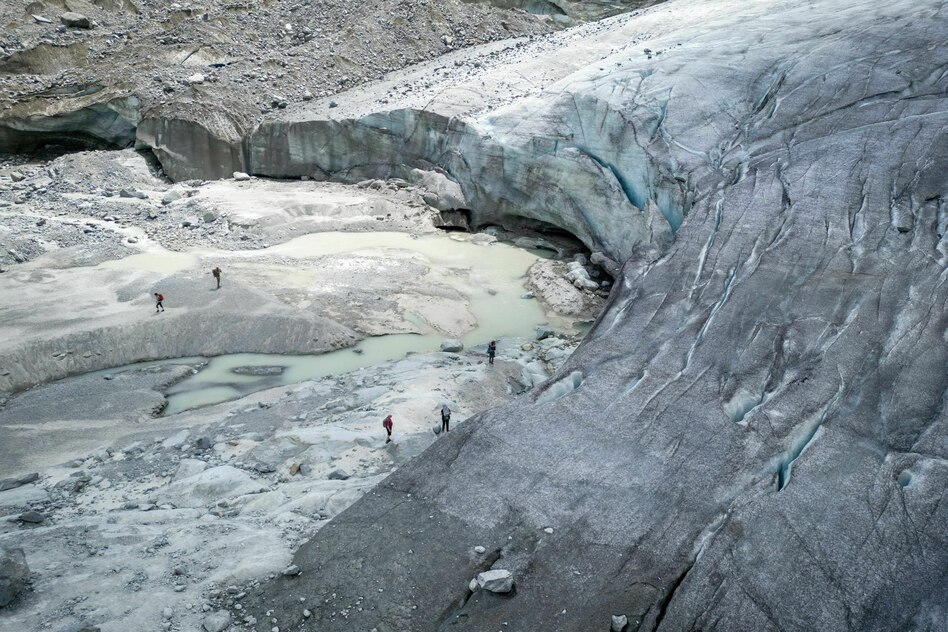
dpa | The lack of snow last winter and the extreme heat in summer have had dramatic consequences for the Alpine glaciers. In Switzerland, around 5.5 percent of the ice volume has melted this year, as reported by the Swiss Glacier Monitoring Network (Glamos). It describes the year as devastating for the glaciers. Experts also expect significant losses in Austria and Germany.
“Alpine glaciers have no chance of survival in the long term under such conditions,” says Glamos. The average ice thickness of individual Swiss glaciers has decreased by 2.5 to 4 meters. Only in the record year 2022 was the loss greater. The measuring network attributes the development to climate change. Ice loss in the past five years has been almost twice as high as in the previous five years.
According to Swiss information, Glamos is one of the oldest glacier measurement networks in the world, with a series of measurements spanning over 140 years. It regularly measures 23 of the approximately 1,400 Swiss glaciers and extrapolates this to all glaciers.
In the winter half of 2025/26, significantly less snow fell at all altitudes than the long-term average, according to Glamos. The zero degree limit was above 4,000 meters on 76 days - more often than ever before. Some of the protective snow cover on the glaciers had already disappeared in June. In September there was no more snow even at 3,500 meters.
In total, the glaciers lost around 2,200 billion liters of water from July to September, according to Glamos. That is more than four times what Swiss households need in drinking water per year. The meltwater is currently helping to alleviate summer water shortages. However, this effect decreases significantly as the ice surface shrinks.
Small glaciers have now disappeared, such as the Bella Tola glacier in Valais and the Plattalva glacier, also known as Griessfirn, in Glarus. The Allalin, Clariden, Großer Aletsch and Rhone glaciers experienced more melting this year than ever before since measurements began, reports Glamos.
In Austria, volunteers from the Alpine Association (ÖAV) are currently on the move to document the glaciers after the past summer. The teams are confronted with “massive loss of length and mass,” says ÖAV expert Andreas Kellerer-Pirklbauer of the German Press Agency. There are signs of possible record ice loss on Austria's largest glacier, the Pasterze at the foot of the Großglockner. The paster ore is not only affected by direct sunlight, but it is also being hollowed out from the inside by meltwater. “Like Swiss cheese through a mouse,” says Kellerer-Pirklbauer.
Within two decades, the ice in Austria's mountains has shrunk by 31 percent to 285 square kilometers. This emerges from the Alpine country's most recent glacier inventory, which was published in September. The data refers to the year 2023.
The heat also took its toll on the last four German glaciers. By 2025, they will have lost more than a quarter of their area in just two years. Around a million cubic meters of ice were lost in total, as a survey by the geographer Wilfried Hagg from the Munich University of Applied Sciences and the glaciologist Christoph Mayer from the Bavarian Academy of Sciences (BAdW) showed last year. A significant loss is also expected this year, according to reports from the Schneefernerhaus environmental research station on the Zugspitze, among others.
There are only pitiful remains of the Blaueis glacier and Watzmann glacier in the Berchtesgaden mountains; they could soon lose their status as glaciers. The Northern Schneeferner on the Zugspitze could be affected by the end of the decade. The Höllentalferner in the Zugspitze area is expected to last the longest. But the scientists recently only gave him a maximum of ten years. Then Germany will no longer have a single glacier.
A few days ago, a rock fall on Germany's highest mountain, Zugspitze, caused a stir. A connection with the high temperatures this summer is suspected. The demolition site was at an altitude of 2,800 meters, where the ground was partly frozen. So it's not a glacier, but so-called permafrost, which holds the rock together like glue and thaws as temperatures rise. Scientists are currently investigating the exact causes of the rockfall. Thawing permafrost also makes the work of glacier researchers more difficult: the increasingly crumbling rock increases the risk for the survey teams, as ÖAV expert Kellerer-Pirklbauer describes. There are also other factors such as increased gaps in the melting ice. “It’s definitely getting more dangerous,” he says.
Read the full story at the source
Source: taz