
Germany taz
Youth Theater at the Parkaue: The discomfort of soft hands
In her first production at Berlin's Parkaue, Zehra Sönmez lets four young people have their say. An ambivalent undertaking about theater itself. more...
Deutsch (original) ·Auto-translated to English
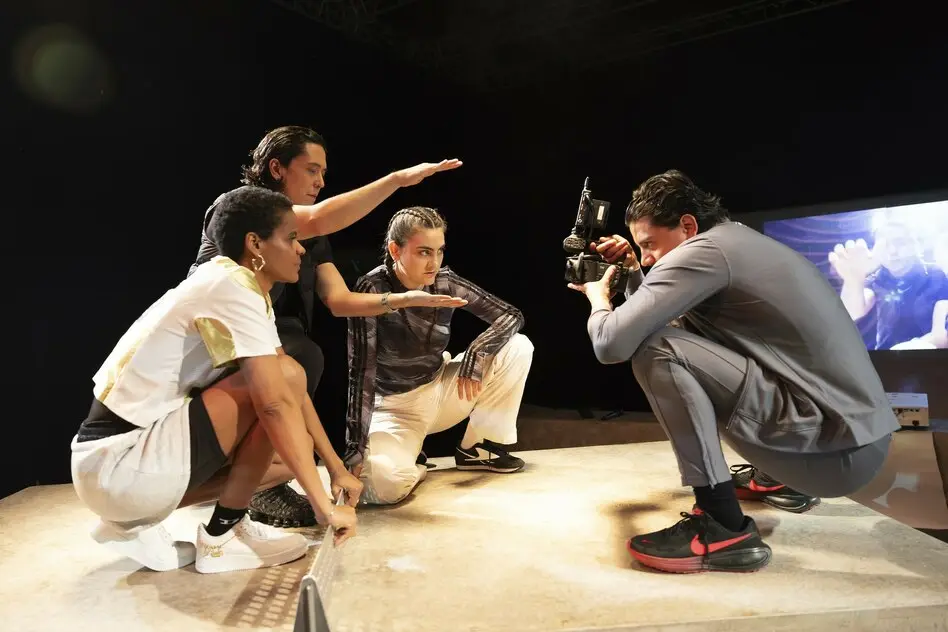
Which word is particularly German? That's what the four actors Amaru Albancando, Jan Tsien Beller, Selin Dörtkardeş, Theresa Henning (all great) ask on the stage of the Berlin Parkaue. In addition to all the nice neologisms such as financial services consulting planning or real estate transaction authorization transfer of responsibility regulations, the four agree on the not very spectacular, but still open to interpretation, word work.
After all, it is the work that inspired author Zehra Sönmez to make her debut. Her play “16GB: Table Tennis Table Politics”, which won the Berlin Play Prize for Young Audiences from the State of Berlin, has the subtitle “On the discomfort of soft hands”.
This refers to those hands who do not work “in the car repair shop, in the hospital”, who do not build and clean “the facades of single-family nuclear family houses”, who do not translate and ask questions to which they do not get answers. Because these are all rough hands, like the characters know from their parents. Those hands that are the “most valuable and at the same time the most worthless” in our society.
The starting point for the piece is a table tennis table. Because “chilling on the table tennis table” is one of the things the young people in this piece like to do most. There at the concrete slab - not the green one in the club - people meet, crack sunflower seeds, drink Uludağ and philosophize about life in their own way. The scenery is accompanied by a handheld camera whose 16 gigabyte memory card was a graduation present.
The good piece costs 7.99 euros at the checkout at Aldi; That's seven cans of tuna, that's now a kebab without ayran. These are the dimensions in which young people think, and so the hour and a half of video material for 7.99 euros is worth its weight in gold. Apart from the fact that sometimes people speak into the camera and other scribbles - #eattherich, #checkyourprivilege, #saytheirnames - are enlarged on the record, not much else happens with the device.
Instead, it's about the text, and it has it all. The audience and its educated middle class are repeatedly addressed, as well as the prejudices and clichés that young people are confronted with. The fact that most of the audience have never “chilled at the table” – and therefore cannot understand where the rough hands and crooked backs of their parents come from – is basically the conclusion of the piece.
In order to counteract the otherwise very German theater canon, Zehra Sönmez's text repeatedly includes sentences in Turkish, Korean and Spanish, languages that the young people do not necessarily speak fluently, but feel. “When places like the theater take up these languages, which are often disparaged in society, and show them to the outside world, then the self-image of the people who speak them changes,” says Sönmez, calling for more multilingualism in the theater.
In addition to the table tennis table, special attention is paid to the woodchip wallpaper (stage and costumes: Han Le Han), in which everything is initially covered. Zehra Sönmez sees this as a mirror of society. In so many homes where this relic hangs on the walls, people simply paint over it instead of looking at what's underneath. This is what often happens with events within society, she says in the booklet accompanying the piece. Maybe that's why she dedicates her piece to the victims of the attack in Hanau. The piece ends with a minute's silence for them.