
Germany taz
Island state of Naoero: Island state without opposition, but with global politics
According to its president, Naoero no longer has any opposition. The impoverished country is dependent on support and is always a plaything of major powers. more...
Deutsch (original) ·Auto-translated to English
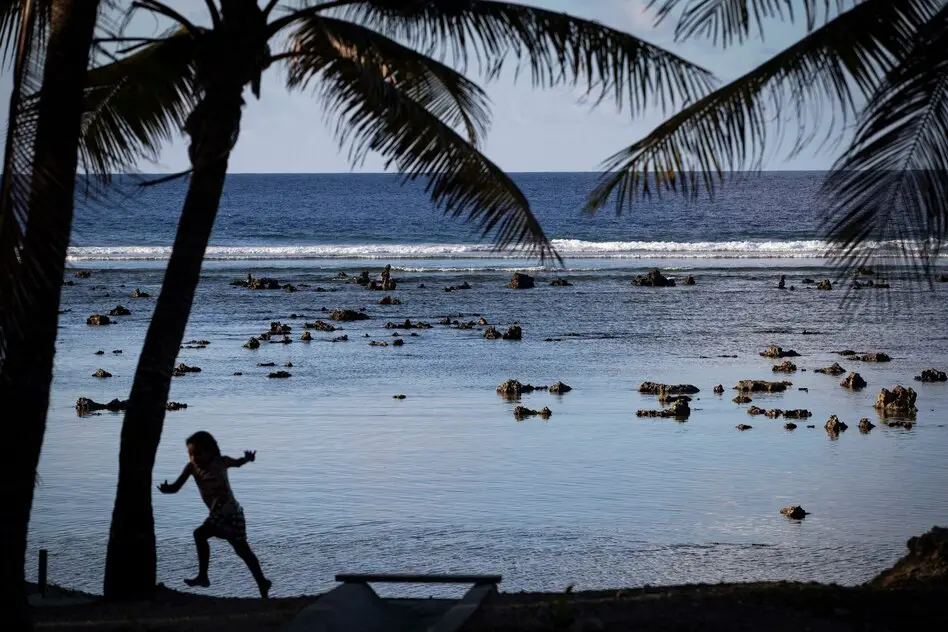
ap/kna/afp/rtr/taz | The island state of Naoero (formerly Nauru), located far away in the South Pacific Ocean, no longer has any parliamentary opposition for the first time since independence in 1968. This emerges from a Facebook post by President David Adeang. Accordingly, all opposition MPs have joined his government, it said. This is an expression of “unity, stability and common goals” in the country’s politics.
The message sounds a bit strange at first glance. Nevertheless, it seems to be related to the global political interests of major players such as China and the USA.
Naoero is one of the smallest states in the world. At around 21 square kilometers, it is hardly larger than the Berlin district of Friedrichshain-Kreuzberg.
The island was once formed by a gigantic coral stock on an extinct volcano. It is located around 3,000 kilometers northeast of Australia, almost 6,000 kilometers southeast of China and a good 8,000 southwest of the US west coast. Today almost 12,000 residents live there.
The island state was known worldwide for a long time under the name Nauru, which originated in colonial times. Only last summer the country renamed itself Naoero. It only became independent in 1968 after decades of colonial rule by Great Britain, New Zealand, Australia and Germany.
Nauru was once one of the richest countries in the world. Phosphate accumulated here due to centuries-old deposits of bird droppings. The raw material, a fertilizer sought after worldwide, enabled people to live a life of luxury. Today, the natural resources are exhausted after decades of overexploitation, and the island's residents are marked by poverty and addictions. The island is also threatened by rising sea levels caused by climate change.
When the country became completely impoverished due to a lack of raw materials, it locked up to 1,200 boat people in a camp in exchange for money from Australia as part of the so-called “Pacific Solution” from 2001 to 2008 and from 2012 to 2017 who actually wanted to apply for asylum in Australia. Most recently, Naoero has been making headlines for its deep-sea mining plans.
The name Nauru caught on outside the country because the original pronunciation was difficult for others. “But it is not the name our people have used among themselves,” President Adeang said at the UN General Assembly general debate in September. The return to “Naoero” should affirm the history, language and identity of the country. "We don't do this to erase our past. We do it because we honor it."
The renaming was apparently accompanied by a new self-confidence on the international stage. At the UN meeting, Adeang also announced that his country would no longer support the International Criminal Court (ICC) in The Hague. He justified this with the “growing insignificance” of the tribunal for his country.
He was apparently following a call from US President Donald Trump. In addition to Naoero, Washington has also convinced Chad, Venezuela, Burkina Faso, Mali and Niger to withdraw from the ICC. This means that you are no longer obliged to extradite suspects if they are wanted by the criminal court.
A missile test by China had recently caused further excitement. China fired a long-range ballistic missile in July. According to US information, the ICBM landed in the South Pacific. Taiwan's Secretary-General of the National Security Council, Joseph Wu, published a map on the online platform X that showed the landing area between the South Sea islands of Tonga and Naoero.
China has long sought to expand its sphere of influence in the Pacific - and to isolate the government of Taiwan. For a long time, Nauru was one of the fewer countries that still maintained diplomatic relations with Taiwan. In 2024 these were broken off in order to resume relations with Beijing. Nauru thereby underlined its reputation for allegedly selling diplomatic relations.
Contact with China also seems to be particularly important to the new island government. According to the AP news agency, President Adeang traveled to Beijing with two newly appointed cabinet members.
But what exactly triggered the government reshuffle in the island state remains unknown. In his Facebook post, the president explained that it was about the common will to put Naoero's interests first.
There are no sources other than the Facebook post. Foreign journalists are very rarely on site - because Naoero is far away from everything and the state charges the equivalent of around 5,000 euros for a journalist's visa.
David Adeang belongs to the Christian liberal Naero Amo party and has been the country's president since 2023. His father was briefly president there several times.
In the local parliament, all 19 MPs now support the government. Changing political alliances and defections between government and opposition camps are not uncommon in the island states of the South Pacific. However, political disputes there are traditionally lively. The fact that there are no longer any opposition MPs is also a rarity in the region.