
World · taz · · 46m
IAA in Hanover: China wants to conquer the e-truck market
Deutsch (original) · Auto-translated to English
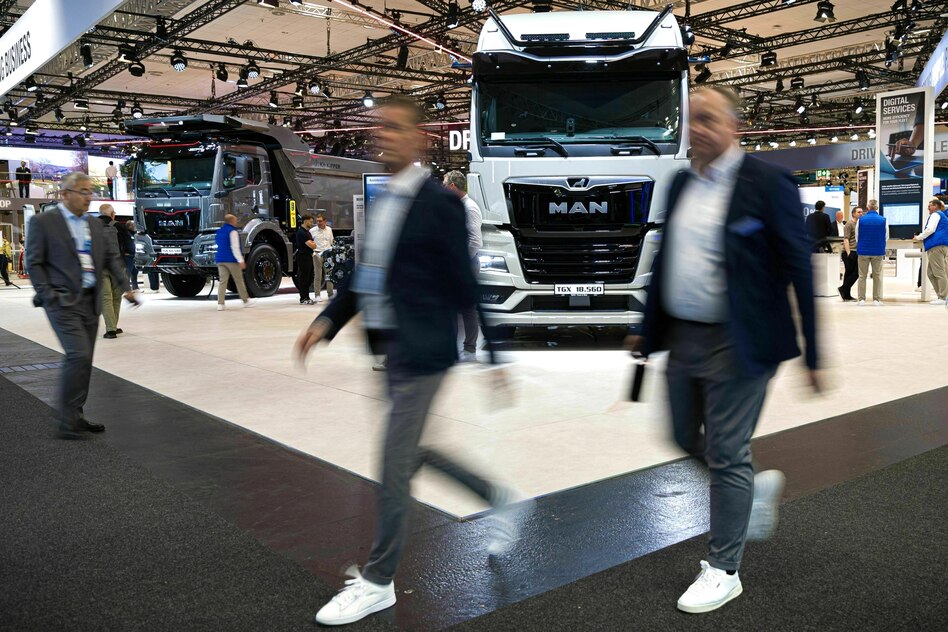
Hardly any breakdowns, easy to drive, cheap: 93 percent of the German companies surveyed by the Oeko-Institut found their new electric trucks better than the old diesel trucks. Nevertheless, the electric market share of new registrations was still relatively meager in Europe at 2.3 percent in the first half of 2026. However, it has almost doubled compared to the previous year. The transport transition is just starting in this segment. In total, there are currently only 14,000 electric trucks on Europe's roads.
The market is currently changing rapidly. Whether Europe's truck manufacturers will be overwhelmed by electric competition from China and the USA, as is the case with cars, is the big question at the IAA Transportation commercial vehicle trade fair, which opened on Tuesday in Hanover. 70 percent of the almost 1,600 exhibitors come from abroad, especially from China.
Domestic manufacturers such as Daimler Truck, the VW subsidiary Traton with its brands MAN and Scania, Volvo, DAF and Iveco still dominate Europe. But companies like Tesla, Foton, Skyworth Auto and Sitrak are pushing their e-trucks, some of which are significantly cheaper, towards Europe. This could threaten the existence of local manufacturers, according to a current study by the transport NGO Transport & Environment (T&E). The announcements by some manufacturers from the People's Republic that they will capture around a quarter of the electric truck market in Europe by 2030 should be taken very seriously. “At this critical moment, truck manufacturers should learn from the mistakes of the automotive industry,” said T&E expert Johanna Braun.
The cost advantage of competitors is clear. T&E calculates that a kilometer with a Chinese electric truck costs a total of 55 cents compared to 63 cents with a European product. Overall, this results in savings of 43,000 euros over a period of five years. When it comes to range, charging time, maximum payload and energy efficiency, the competition from abroad is “just as good” as European trucks, warns T&E. And warns: The fleet limits for trucks, which will be amended across the EU next year, must be strict. This benefits the technically experienced local manufacturers.
It seems clear: the future of the commercial vehicle market is electric. Depending on the study, the cost advantage of an e-truck in five years is between 11 and 13 percent due to the rapidly rising diesel prices, better charging infrastructure as well as toll and CO2 costs. In Germany, where electric trucks are exempt from tolls until 2031, the electric trucks are already cheaper, including operating costs, than the diesel stinkers.
More electric trucks also help the transport sector, which is lagging behind in meeting climate targets. According to the Association of the Automotive Industry (VDA), almost 30 percent of CO2 emissions in the EU come from heavy-duty transport. For VDA President Hildegard Müller, there is “enormous potential” here, as she said at the opening of the IAA.
Battery-electric trucks would have a range of up to 500 kilometers, hydrogen trucks, of which there are significantly fewer, even 700 to 800 kilometers. However, there is a lack of charging points and hydrogen filling stations across Europe: “The gap between expectations and reality is huge.”
E-trucks in long-distance transport must be able to charge at particularly powerful charging stations so that their drivers can adhere to legal driving and break times. The VDA assumes that there will be a need for around 4,000 such megawatt charging points by 2030. In July 2026, there were just 730 in the entire EU, 355 of which were in Germany. Federal Transport Minister Steffen Bilger (CDU) announced in Hanover that he would build a fast-charging network for electric trucks along the motorways. Concrete implementation is now beginning at 124 unmanaged rest areas across the country.
Because truck batteries are manufactured in China and hefty subsidies, manufacturers from the Far East have “natural competitive advantages,” warns car expert Ferdinand Dudenhöffer. However, the commercial vehicle market is significantly more complicated than the passenger car market. Chinese manufacturers are currently putting Europeans in trouble here. Among other things, the new competitors would have to offer “24-hour workshop systems along the highways, fast spare parts supply and a diverse range of semi-trailers and trailers,” said Dudenhöffer.
As with electric cars, the Chinese are currently starting to set up their own production facilities in the EU in order to avoid tariffs and import restrictions. This is how the truck manufacturer Sinotruk promotes its cooperation with Steyr Automotive.
The Austrians have been assembling a new Sinotruck model series for the European market since spring 2026. The company specifically no longer wants to be perceived as a Chinese import. The Chinese start-up SuperPanther has also set up its own European factory for its new eTopas 600. China's global e-market leader BYD, on the other hand, wants to introduce its first heavy truck "ETT 44" in Europe next year - and is also planning to produce trucks here in the long term. “In the long term, we will produce everything we sell in Europe here,” said BYD deputy boss Stella Li in Hanover.
European manufacturers like MAN are demanding that the EU take the same approach to trucks as it did against subsidized electric cars from China. Tariffs and regulations for local production shares would be instruments to compensate for unfair competitive advantages, says the Munich manufacturer.
MAN boss Alexander Vlaskamp called on the EU at the IAA to ensure fair competition. He primarily addressed production specifications. His company has to buy 60 to 70 percent of the parts locally in China and can only produce in joint ventures, Vlaskamp told the Reuters news agency. “Such conditions should also exist in Europe.”
Read the full story at the source
Source: taz