
Germany taz
Hito Steyerl on AI and art: “I work from the inside with things against things”
The artist Hito Steyerl about growing up in a Franz Josef Strauss democracy, the AI chaos and politics pushing into the arts. more...
Deutsch (original) ·Auto-translated to English
taz: Ms. Steyerl, apparently artificial intelligence will soon wipe out humanity. As a media artist, you have dealt a lot with AI - what do you think of such statements?
Steyerl: I think there are completely other ways in which humanity could exterminate itself; AI simply contributes to the general chaos. However, there is no data to be able to assess this more precisely. The algorithms are secret and will not be published.
taz: That's not exactly reassuring.
Steyerl: A large part of the hype around AI has become self-sustaining and works with circular investments. Forecasts are made that exceed actual needs and result in more and more infrastructure having to be built. This then benefits the same few companies. From my technical experience I know that some of this infrastructure is not necessary. The AI infrastructure industry is a bubble.
taz: Which parts of the infrastructure would not be necessary?
Steyerl: AI models can be trained much more modestly with less energy and data expenditure, through algorithmic optimization and with slimmed-down architectures. Then you wouldn't need new nuclear power plants, gas pipelines, fossil fuel infrastructure and God knows what to run it all.
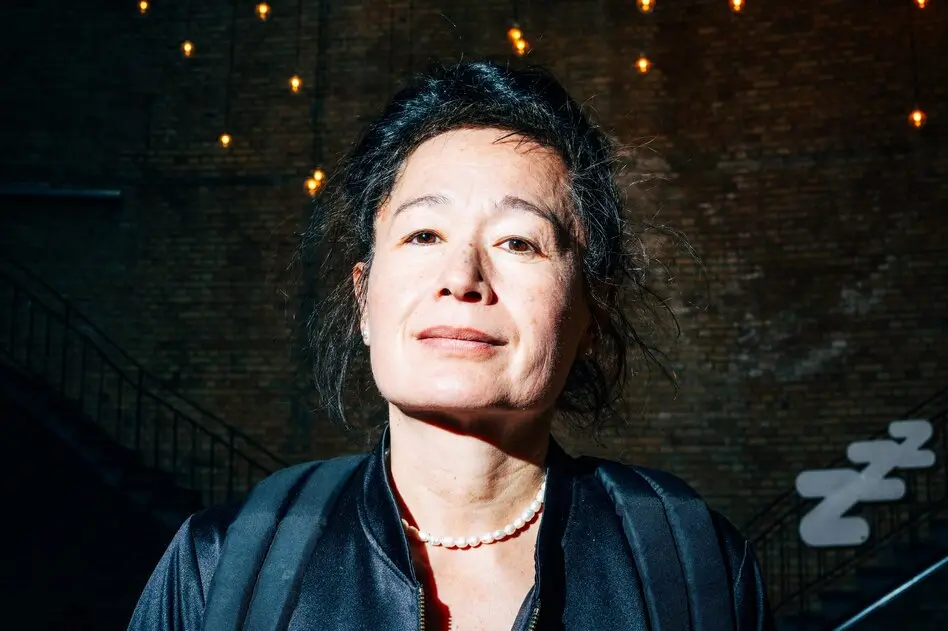
Hito Steyerl, born in Munich in 1966, is considered one of the most important artists of today, but prefers to describe herself as a filmmaker and author. In her multimedia works, Steyerl humorously brings together social and technological criticism. She has received numerous awards for her art. Hito Steyerl lives with her family in Berlin.
“Hito Steyerl – Your Mudda Makes a Show” runs from October 30, 2026 to March 29, 2027 in Hamburg’s Deichtorhallen.
taz: You started making essayistic documentaries in the 1990s, you became known in the art world with media theory essays and video installations, and in 2015 you screened the German Pavilion at the Venice Art Biennale with your immersive work “Factory of the Sun”. To this day, your film art deals with the social effects of technological change. How do you see your own role? Are you the observer who works with the material you find?
Steyerl: I work from within with things against things. Sometimes with things for things. If I only looked at AI from the outside, I wouldn't be able to understand it at all. I am a part of it from the start. This is a complicated and also compromised position.
Steyerl: The American literary scholar Michael Rothberg called it this: the implied subject. I am just as much an implied subject in these technologies. I deal with them and at the same time I am in the middle of them. Most people are, but are not aware of it.
taz: You yourself are very reserved with your data. They don’t use social media, Facebook. Where is your cell phone right now, in the refrigerator?
Steyerl: No, I have that here with me. However, many functions are switched off. Until four years ago I still had an old banana cell phone without internet. During the pandemic that became impossible because of all these QR codes that were needed. Then I gave up.
taz: So even you, who are very data-sensitive, couldn't refuse your smartphone.
Steyerl: I think you could still refuse. But it's a lot of work because everything is tailored to it.
taz: You come from Munich, squatted in houses as a young person and dropped out of school. Today you are one of the most important artists in Germany. How did you grow up?
Steyerl: In a relatively conservative, post-fascist Franz Josef Strauss democracy. For us everything was the way it was back then in Bavaria in the 70s and 80s.
Steyerl: No, not at all. My parents were scientists at MIT, the Massachusetts Institute of Technology. They had nothing to do with flower power and hippies.
This text first appeared in wochentaz, our weekly newspaper from the left!
Every week, wochentaz is about the world as it is – and as it could be. A left-wing weekly newspaper with a voice, attitude and the special taz view of the world. New every Saturday at the kiosk and of course by subscription.
taz: You were then able to study film in Tokyo without a high school diploma. How did this come about?
Steyerl: That was a funny coincidence. My mother met a Japanese person in Munich. Their daughters were both actresses and played for the well-known Japanese nouvelle vague director Shōhei Imamura. He happened to have also attended this film school and was of the opinion that school dropouts were particularly talented at making films.
Steyerl: From the age of 16 at the latest, I was always going to the cinema. I dreamed of making films myself, preferably martial arts films. Bruce Lee, sword fighting, something like that. These films still fascinate me. The elegance, the choreography, the precision. I also did martial arts back then, I trained karate six times a week.
Steyerl: No, but I just signed up for boxing. Maybe I’ll also delve deeper into Muay Thai.
taz: In your short film “Lovely Andrea” from 2007 we learn that you were working as a bondage model in Tokyo at the time, meaning that you allowed yourself to be tied up and gagged in front of the camera. Why?
Steyerl: One of my teachers made a film about Filipinas who were smuggled into Japan for sex work. I knew that this was also common in the porn scene, and I wanted to explore it from the inside in a documentary. But I quickly gave up the plan because it was too dangerous. But most of the people at my school, including the students, had part-time jobs in the sex industry, for example writing porn stories. However, this was only possible for male students. For the females, the moral boundaries were too rigid.
taz: But the part-time job as a bondage model still worked?
taz: “Lovely Andrea” is also about your childhood friend Andrea Wolf. While you were studying documentary filmmaking in Munich and later doing your doctorate in philosophy in Vienna, Wolf joined the PKK. She was killed in the occupied Kurdish territories in 1998. How important is Andrea Wolf for your work?
Steyerl: On the one hand, very important. On the other hand, she has been dead for a long time now and her memory is gradually fading. In her wake, however, several female figures have emerged. Kurdish women I met who have now taken on their role for me.
taz: The Kurdish regions have appeared repeatedly in your work for 20 years, most recently in the video installation “Mechanical Kurds” in 2025. Why do you travel there so often?
Steyerl: At the beginning I wanted to find out what had happened to Andrea Wolf. And then it took on a life of its own. In the 1900s there was a so-called peace process that made traveling around these areas easier. And there was a strong civil society Kurdish movement in Türkiye with the HDP. Then came the Battle of Kobanê, the Daesh attacks, the autonomy movement in Rojava. Every time I was there, trying to learn something.
taz: Do you feel an obligation towards your Kurdish contacts to continue telling their story?
Steyerl: Yes. I am a filmmaker, and there is a formal obligation. There's no point in telling anything if you can't work through it well. I am equally committed to this aspect.
taz: Does artistic authority trump activist appearance?
Steyerl: Yes, I come very much from a reflexive perspective, not an activist one. And Kurdistan is too important to me to be sloppy with the form.
taz: In “Mechanical Kurds” you accompany refugees in Erbil who label photos for machine learning systems, i.e. mark houses, streets and people on them. What did you see in Erbil that made you call the autonomous machine a myth?
Steyerl: This work only existed for a short time. In the early 2020s, the World Bank came up with the idea of using refugees in the Middle East for microwork because there were many young people with cell phones in the refugee camps. They knew digital, needed money, and so they could be easily exploited. We spoke to around 15 to 20 people from camps in southern Kurdistan. They were all fired again and the machines can now teach themselves how to recognize and annotate things.
taz: So the autonomous machine is no longer a myth, but a reality?
Steyerl: Yes and no. The work just described is no longer necessary. But there is a new form of microwork in the field of robotics. People wear an iPhone on their skulls and film themselves folding laundry or taking out the trash, thereby teaching the robots how to move in 3D space. In some cases, people are paid really well for this, because dentists, for example, are supposed to film themselves at work. But most people get less than minimum wage for it.
taz: One of your earliest works, which you are now showing in your exhibition in Hamburg, is the film series “Normality 1–X” from 1999 to 2001. It is about everyday anti-Semitism and racism in reunified Germany. Do the documented incidents also have something to do with your own experiences?
Steyerl: Sure, what else, I'm obviously not white. But I also feel for when someone like Pöbel MC raps about his experiences in the East.
taz: How do you observe how anti-Semitism is dealt with today, especially in the cultural scene?
Steyerl: Art was originally a place where discussions could take place beyond entrenched camps. That is not possible now. Also because politics is getting heavily involved. First of all, the autonomy of the company would have to be restored.
Steyerl: If a public discussion can only take place under the condition that any Minister of State for Culture likes what is being said, then you don't even have to start with it. He is busy with T-shirts, while the party that nominated him is presumably responsible for the beginning of the AfD's takeover of power in Saxony-Anhalt.
taz: Assuming Wolfram Weimer were to look for another job, what would then be done on the art business side?
Steyerl: It's not about any one person, but about the vibe shift towards authoritarianism, cultural dictates, militarization, all this post-Prussian stuff, reasons of state, Rheinmetall, military capability drip. Furthermore, it would be interesting to discuss things structurally, rather than just as a heated debate driven purely by social media. Now the cultural sector is partly like an appendix of social media; it submits almost seamlessly to platform attention maxxing. Gaining more autonomy again would be important.
taz: Discussing things from a formal perspective, what would that mean specifically?
Steyerl: Focus on form, infrastructure, system. Maybe you can find poetry there too.
taz: You were previously a professor at the University of the Arts in Berlin and are now a professor at the Academy of Fine Arts in Munich. What is important to you to pass on to your students?
Steyerl: I want to create a climate in which people support each other. This is the most important thing for your future career. In academies there is often an absurd pressure to do this or that in order to be successful on the market. I try to keep that out there. Nobody knows what will happen tomorrow and what will be successful tomorrow; that was not known shortly before 1933.
taz: You call yourself a filmmaker and author instead of an artist. Why?
Steyerl: I'm not sure if what I do is art. And I think art isn't sure either. We'll see how this goes. At the moment, media art is being thrown out of the concept of art and the art market again. When there is a crisis, the art market retreats back to painting. The institutions then slowly lag behind.
taz: We hear that you are strangers to the art world as a whole. Is that correct? You're good at business.
Steyerl: It's always amusing what happens there. Like a comedy with all kinds of actors and supporting actors. And everyone tries to get along somehow, class differences are magically ironed out for the duration of an opening, someone parks his yacht outside and another his bike, and everyone drinks their necks on Ruinart. Most of the time it is a very sobering operation with an incredible amount of fraud and exploitation.
taz: When do you feel like you belong to the art world?
Steyerl: I don't know. Where do I even belong? I stopped asking myself that question. A saying by the American actor Groucho Marx applies to me: “I don’t want to belong to a club that would accept me as a member.”
taz: An underexposed topic in the art world is still motherhood. You have a daughter of your own who is now 21 years old. In 2016 you had to cancel an event at the Berlin Biennale because you were – to quote the moderator – “a successful artist and mother”.
Steyerl: It's possible that my daughter was sick and I couldn't find anyone to look after her.
taz: Should the art world talk more about motherhood?
Steyerl: I don't know if it would be of any use. A lot of things are simply not accessible. Four-month residencies in remote places are not possible because the children have to be in school or kindergarten. I recommend working as a film artist. You can just send your film there and stay at home and take the child's temperature. This is a real life hack.
taz: Some of your works express a certain anger. In the video “Strike” you smash a screen with your hair down. The title of “Hell Yeah We Fuck Die” combines words that appear most often in songs. Both works also share a reproductive moment. Is this a woman's specific anger?
taz: Does your anger find expression in your artistic work?
Steyerl: I hope that my artistic work functions as a kind of sublimation, where it's not just affect that comes out. Otherwise that would be embarrassing. That is also the engine of the capitalist exploitation industry par excellence. I guess it's about playing with anger until I find a form for it and can keep it in that form.
taz: The current exhibition in Hamburg is called “Your Mudda Makes a Show”. A reminiscence of the song “Ja, Ja…Your Mudder!” the Hamburg band Five Star Deluxe? And are you the mudda?
Steyerl: My daughter says your mudda here, your mudda there. And then I think, What are you babbling about, old lady?, that's me! In general, mothers get a lot of attention from this saying, even if it's not particularly flattering. I wasn't thinking of the Five Star Deluxe, but of a line from the female rappers on SXTN: "I'll fuck your mother without a dick." This is Poetry 3000.