
Germany taz
Historian Raphael Gross: “I’m interested in how we come to historical judgments”
Are colonial crimes and the Holocaust comparable? The DHM director on continuities, family entanglements and anti-Semitism. more...
Deutsch (original) ·Auto-translated to English
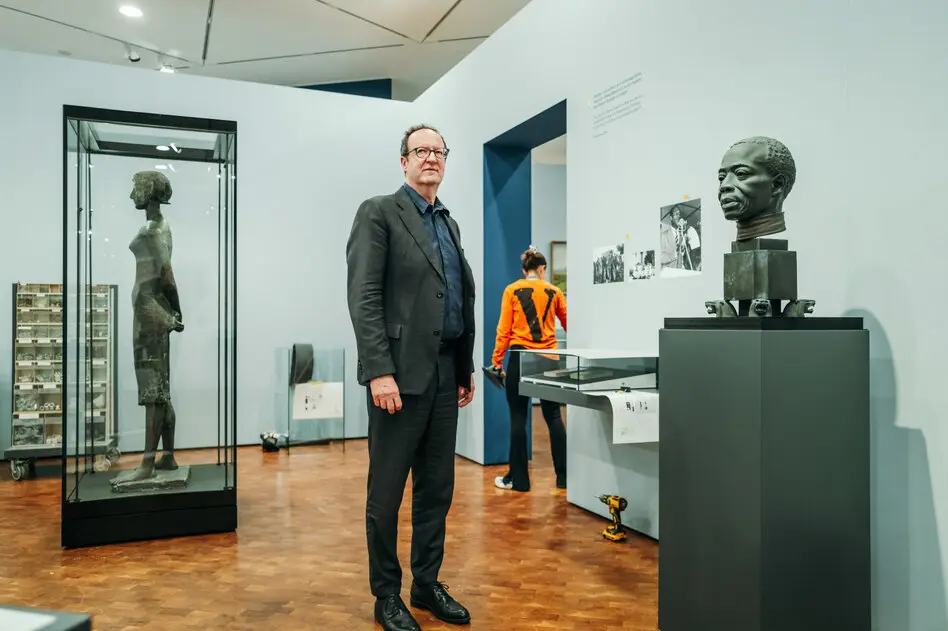
We arranged to meet a few days before the opening of the exhibition “Controversial Kinship” at the German Historical Museum (DHM) in Berlin-Mitte. Work is still going on in the exhibition rooms. Raphael Gross, director of the house, welcomes us in his room with a view of the Spree Canal in the administration wing of the museum. Books everywhere, including on the conference table where we sit.
taz: Mr. Gross, you have been responsible for historical exhibitions for more than twenty years. Are you particularly excited about this exhibition?
Raphael Gross: Yes, that's true. Even after twenty years, you never know exactly how an exhibition will be received. In this project, we are also dealing with a debate that is historically complex and politically extremely explosive on around a thousand square meters.
Raphael Gross was born in Zurich in 1966. He studied history, philosophy and literature in Zurich, Bielefeld, Berlin and Cambridge. In 1997 he received his doctorate in Essen. Gross was director of the Fritz Bauer Institute and the Jewish Museum in Frankfurt am Main until 2015. He has headed the German Historical Museum in Berlin since 2017.
“Contested Kinship: Colonial and National Socialist Violence,” curated largely by historian Stephan Malinowski. Runs until April 11, 2027.
taz: The exhibition examines the question of what connects colonial and National Socialist violence and what distinguishes them. What do you want to achieve?
Gross: I'm interested in how we come to historical judgments and what we overlook. At previous exhibitions it was sometimes assumed that I wanted to break taboos. That's never been my point. I'm interested in how you expose conflicts in a way that allows you to think about them in a new way.
taz: A political intervention in the fervent discourse about the Holocaust and colonial crimes?
Gross: Exhibitions are not suitable as daily political commentary. The current exhibition has been in preparation for many years. One way to address this highly charged topic seemed to me to be historicizing it.
taz: The debate about colonialism and stolen cultural assets has become more important in recent years.
Gross: When I started working here at the DHM in 2017, comparatively few politicians were interested in German colonialism. That changed, among other things, through the discussions about the Humboldt Forum and the colonial collections. In this respect, “Contested Kinship” is an exhibition that is shown in a political context. But it tries to place historical facts alongside the debates on memory politics.
taz: There is a growing interest among younger people in colonial history. A correction of previous failings?
Gross: Yes, German colonial history was neglected in the Federal Republic for a long time. When I offered an event on this topic at the University of Bochum about 25 years ago, there was comparatively little newer German-language research literature, mostly from the GDR. Colonial violence was already the subject of heated debates in the Reichstag during the Empire. It is understandable that younger people in particular are increasingly interested in this today. We are also seeing similar developments in other European countries with a colonial past.
taz: Dealing with the Nazi past in the post-war period has already occupied you a lot, for example in the exhibition on the history of the documenta.
Gross: When we explored the topic of “documenta. History/Art/Politics” in depth for the first time at a symposium at the DHM in 2019, we were met with strong resistance from some of the scientists gathered. The historical continuities shown between National Socialism and documenta were heavily criticized. Artists who had been popular with the Nazis continued to play a role after 1945. At the same time, persecuted or murdered Jewish artists were often given little consideration. Emil Nolde, on the other hand, was subsequently stylized as a resistance fighter, even though he was a committed National Socialist and anti-Semite.
taz: This was later discussed publicly.
Gross: But only a few years ago. The supposed new beginning after 1945 was more complicated than the reassuring stories suggest.
taz: You are now bringing together colonial crimes and the Holocaust in one exhibition.
Gross: There is heated debate about the relationship between colonialism and National Socialism. I wanted to make this debate itself the subject of the exhibition. Such comparisons are by no means new. I was familiar with the Marxist-Leninist interpretation of fascism in the GDR, which explained fascism and colonialism in the context of imperialism. And of course Hannah Arendt's reflections on the relationship between imperialism, racism and totalitarianism. What I didn't know, however, was that such comparisons had already been made in the 1930s, under very different political circumstances.
Gross: In the 1930s, anti-colonial intellectuals like George Padmore compared the violence of European fascism to the violence of European colonial powers. The Italian attack on Ethiopia in particular gave these comparisons new urgency. Their message was: You condemn the violence of the fascists, but you yourself are committing similar crimes in your colonies. Such comparisons were political interventions. Later, the National Socialists also resorted to comparisons to portray their expansion in Eastern Europe as an ordinary colonial project. They justified their policy by pointing out that other European powers had also conquered and exploited colonies.
taz: History was instrumentalized to criticize or justify political decisions.
Gross: Yes, that's why you have to ask who made such comparisons and why.
taz: Can you even meaningfully compare colonial crimes and the Holocaust?
Gross: Yes. Forced labor in particular shows how insightful such comparisons are. The National Socialists resorted to practices known from European colonial empires. However, they set up their own, racially graded forced labor system in which millions of people from all over Europe were exploited. The comparison shows both historical connections and crucial differences.
taz: Does that make colonial violence, for example in Namibia by German troops, less terrible?
Gross: No, rather it requires distinguishing precisely between which practices are similar and where historical developments diverge. In the exhibition we therefore also show examples for which no direct colonial equivalent could be found. This becomes clear when you compare Nazi anti-Semitism with colonial racism. It would be wrong to turn the desire to compare into an obligation to equate.
taz: Could it be said: The Holocaust is not suitable for comparison because it was unprecedented in its monstrosity?
Gross: Certain aspects of the National Socialist policy of extermination were unprecedented, yes. In our view, the extermination sites of Aktion Reinhardt represent a historical turning point. They cannot be explained as a mere continuation of colonial violence. Anti-Semitism is particularly important. Anti-Semitism and racism have similarities. Both can attribute characteristics to people that are supposedly unchangeable. However, there is a special tension in anti-Semitism.
Gross: Jews are portrayed as both inferior and overpowering, as people who supposedly don't belong and at the same time dominate the world. The idea behind this is that a better world could emerge if the Jews no longer existed. This anti-Semitic idea of redemption cannot simply be equated with colonial-racist violent relationships.
taz: You yourself are Jewish Swiss and you also lived in Israel for a while. How does this shape your work?
Gross: I have lived in Germany for most of my studies and professional life since 1988. I was the head of a research institute in London for 15 years. I worked in Frankfurt for ten years. To apply this to our exhibition: Without the willingness to understand the colonial injustice, the colonial violence in its incredible monstrosity and obscenity, no exhibition should be held. As a historian, I strive not only to tell my own story.
taz: Before you came to the German Historical Museum, you were, among other things, director of the Simon Dubnow Institute for Jewish History and Culture and holder of the Chair of Jewish History and Culture at the University of Leipzig. But that had something to do with your Jewishness, right?
Gross: Many German institutions for researching Jewish history are run by non-Jews. Some have converted. What does it mean when German people without Jewish family history appear as Jewish voices after the Shoah? Might non-Jews find it easier to listen? They certainly brought different questions to the research than I did - and hopefully reflected on them as critically as I did.
taz: And what role does being Jewish play in your everyday life?
Gross: I'm not Orthodox. In Germany this is often confused with the fact that being Jewish doesn't play a role. It does anyway, it has many very positive sides for me.
taz: In Germany, databases are now used intensively to search for NSDAP membership in one's own family. What does this interest tell you?
Gross: First of all, the confrontation with the Nazi past after 1945 came in waves. At the same time, there was always the desire to draw a line in the sand. The mood was already very widespread in Germany in 1949, but people had really heard more than enough about the past. However, history cannot be eliminated by deciding to stop talking about it.
taz: So you welcome the attention to the NSDAP databases?
Gross: Yes, it allows people to do more specific research using sources instead of relying on assumptions. Whether this will result in a lasting change in how we deal with the past remains to be seen.
taz: The findings from the databases can make a difference in families, right?
Gross: Of course. As long as we don't know exactly what happened, we can switch between different ideas: Maybe the grandfather was a convinced National Socialist, maybe he never really believed in it. Maybe he was involved, maybe he stayed out of it. Sources limit this openness. They don't automatically answer every question about personal responsibility, but they change the basis of the discussion. It is often easier to remain vague than to deal with concrete facts. This doesn't just apply to family stories. Societies can also establish themselves in a state in which many things are claimed but little is specified.
taz: How did your own family experience the Second World War?
Gross: I've never spoken about it publicly before. My mother's nuclear family survived in Switzerland. Many of the other relatives from Kippenheim near Freiburg were initially deported to Gurs, after which their traces were lost. But they probably all fell victim to destruction. My father and his family tried in vain to flee Czechoslovakia before the German troops invaded. The fate of his brother Jan Gross has been publicly investigated by the historian Gerd Koenen: My uncle had survived several Nazi concentration camps, Ravensbrück, Sachsenhausen and Bergen-Belsen. After the suppression of the Prague Spring in 1968, he stayed in Hamburg, where he became professor of psychiatry and director of the Hamburg-Eppendorf Psychiatric University Hospital. In the 1970s he was targeted by left-wing radical groups because of his research on the so-called camera silens.
taz: Camera silens describes a completely darkened and soundproof room. Why did he end up being targeted by left-wing radicals?
Gross: He was accused of participating in the development of methods for solitary confinement of RAF prisoners. As a result of this campaign, his front yard was destroyed with chemicals. Threats were also made against him and his family. He therefore stayed with his family for a time in Switzerland.
taz: Soon the pogrom night will be remembered again. What does November 9, 1938 mean for the German culture of remembrance?
Gross: The November pogroms were a turning point in German-Jewish history. For many Jews who still lived in Germany, it became clear that emigration was no longer about building a new life. It was about escape: How do I even get out of Germany? For me, the so-called Kindertransports are a symbol of this. Anyone who sends their child abroad alone has apparently lost hope of being able to protect them in Germany. November 9th was the catastrophe before the catastrophe for the German Jews.
taz: Has German society learned to appropriately remember the victims of the pogroms?
Gross: It was a long process. After 1945, Jewish soldiers from the Allied forces and the very small re-emerging Jewish communities often commemorated the November pogroms. On the 25th anniversary of 1963, there were also commemorative events by municipalities, districts and parliaments; However, this impulse did not last everywhere. It was only from the 1980s onwards that increased public remembrance of the November pogroms began with the history movement from below. But there are still differences between forms of remembering.
Gross: In Frankfurt, for example, a municipal memorial event takes place in the Paulskirche, followed by another in the synagogue. The events are now connected, but their separate creation is a reminder that shared remembrance cannot be taken for granted.
taz: How did October 7, 2023 change the culture of remembrance?
Gross: You can't say that conclusively yet. Consciousness has certainly changed. In the 1980s and 1990s, parts of the public could get the impression that anti-Semitism was a ghost of the past. Many people focused more on “prejudice research”. This idea is harder to maintain today.
taz: That's very conservatively worded, isn't it?
Gross: You could also say: anti-Semitism is clearly visible again. This also changes the conditions of commemoration. The discomfort of remembering the persecution and murder of Jews together could increase again if there is no sensitivity to current anti-Semitism.
taz: Have you experienced more anti-Semitism in your everyday life since October 7th?
Gross: I experience the anti-Semitism of the democratic center more than that of the extremes. I experience the latter more indirectly, for example when I go to a synagogue on a high holiday and feel like I'm in a maximum security wing.
This text first appeared in wochentaz, our weekly newspaper from the left!
Every week, wochentaz is about the world as it is – and as it could be. A left-wing weekly newspaper with a voice, attitude and the special taz view of the world. New every Saturday at the kiosk and of course by subscription.
taz: At pro-Palestinian demonstrations after October 7th, people also shouted: “Palestine free from German guilt”. The Holocaust and German reasons of state should no longer be the reason that Germany continues to support Israel. Were you surprised that it was blowing up like it did?
Gross: Less than might surprise others. I have been concerned with anti-Semitism for a long time, right up to the latest terminology used by the conservative constitutional lawyer Carl Schmitt. In previous debates it was often disputed that anti-Semitic continuities played a role.
taz: Like that of Martin Walser, the writer who spoke of an “Auschwitz club” in his 1998 Peace Prize speech.
Gross: Exactly. In the case of Martin Walser at the time, the majority of the German public was initially of the opinion that the allegations against him were unjustified. I perhaps noticed the continuity of anti-Semitism more than others. Above all, I think it is wrong to treat it exclusively as a right-wing, left-wing or Islamic phenomenon. Anti-Semitism is a problem affecting society as a whole. It is related to how societies process aggression, organize resentment and create a feeling of “we” against supposed outsiders.
taz: Both the Holocaust and the colonial period are often used as comparisons in the current debate about Israel. What do you think when you hear something like that?
Gross: Well, I hope as many people as possible will visit our exhibition. Perhaps it can help to differentiate more clearly in this heated debate. And of course everyone has to think for themselves where comparisons are really worthwhile - and where they cause confusion and perhaps even hatred.