
Germany taz
Historian about Viking legends: “The vast majority of people were not pirates”
The image that many people have of Vikings is more than strange, says Matthias Toplak. This is also due to the Nazis. So what were they really like? more...
Deutsch (original) ·Auto-translated to English
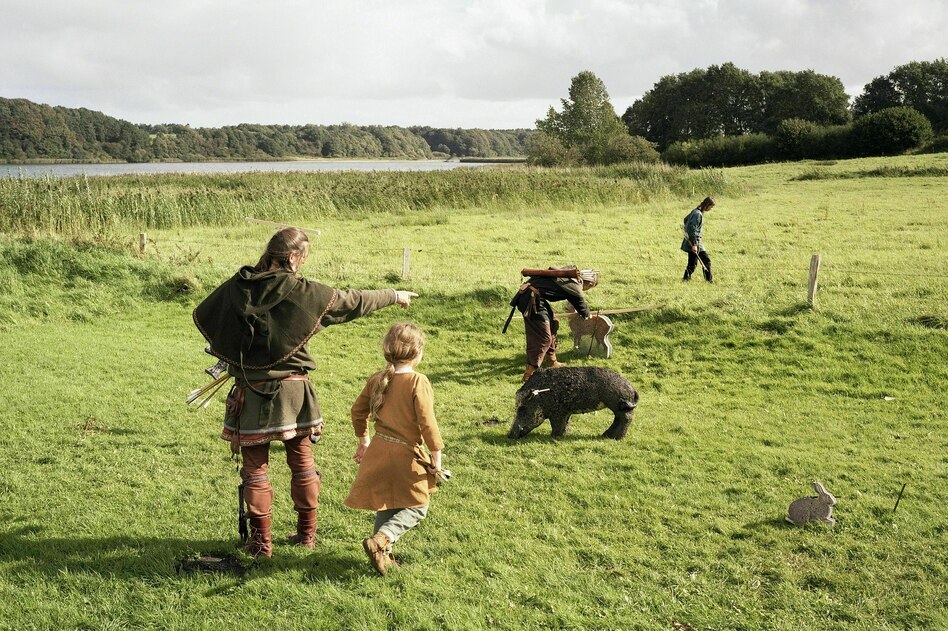
taz: Mr. Toplak, there are many myths surrounding Vikings. In series and books they often appear as combative giants with horned helmets who constantly went on raids in dragon boats. Now, during my research, I learned that Viking is not even the right term for the people of that time.
Matthias Toplak: That's right. The name “Viking” comes from the Old Norse, “fara i víking” and means something like going on a raid. However, not all of the people we now call Vikings did that. The term has become commonplace for an entire culture.
Matthias Toplak studied in Cologne, Stockholm and Tübingen and wrote his doctorate on burial rituals in the Scandinavian Viking Age. Since October 2021, the historian has been director of the Haithabu Viking Museum in Busdorf near Schleswig.
taz: What would be a more correct term?
Toplak: People from the Old Nordic cultural area are probably better off. Admittedly, that doesn't sound nearly as good as Vikings.
taz: And how did the idea arise that the people from the north liked to loot and pillage so much?
Toplak: This picture was created very early on. Most of the traditions about the Viking Age come from Christian monks. They were often the victims of the attacks. After all, the rich churches and monasteries were worthwhile targets for the Vikings. There was little resistance there, but rich loot. The reports of the brutal attacks are entirely credible, but they outshine many other facets of the Old Norse cultural area.
Toplak: The vast majority of people were not pirates, but farmers, fishermen, craftsmen or traders. It is estimated that the proportion of people who have raided at least once in their life was around five to ten percent. The vast majority of men in the Scandinavian Viking Age never ventured further than the nearest marketplace.
taz: But the part about the ships is true...
Toplak: In fact, people travel widely around the world by sea. In addition to the raids, traders made it as far as Central Asia and the Islamic world. And settlements emerge on Iceland and Greenland.
taz: The term Viking also implies a certain common culture and a common understanding as a “people”. But how much do “Vikings” from Sweden, Schleswig-Holstein or Iceland have in common?
Toplak: There is a lot of discussion in research about the similarities. But I think we can certainly speak of an Old Norse cultural area. There are some connecting elements, besides the seafaring-focused way of life. For example, a relatively uniform language is spoken, Old Norse. This meant that people could communicate from Hedeby all the way to Greenland.
taz: Haithabu was a Viking settlement in what is now Schleswig-Holstein. They run the archaeological museum there. What other connecting elements were there?
Toplak: There is also the belief in polytheism with Odin and Thor as the supreme deities, which we can prove both in Haithabu and on Iceland. Architecture and material culture are also relatively uniform; think, for example, of the characteristic longhouses, which can be found in modified form from the North Atlantic to Eastern Europe. The appearance, on the other hand, was much more varied. Slavs, Anglo-Saxons and Franks can also be found in graves that we classify as “Viking graves”. This means that the Vikings most likely included people with dark hair, dark eyes and darker skin.
taz: So we have people here who enjoy going to sea and discovering the world, but often also live a completely normal everyday life. How did the Vikings, of all people, become a projection surface for ethnic ideologies?
Toplak: Unlike ancient civilizations such as the Egyptians or Romans, there are still large gaps in knowledge in the Nordic cultural area that archeology has not been able to fill. For example, there are hardly any written sources. We know of several thousand runic inscriptions, but they are short and concise and provide little insight into everyday life. This uncertainty can easily be filled with your own narratives. The political instrumentalization of the Vikings began as early as the 17th century, when people began to stylize them as special ancestors, especially in Scandinavia.
taz: Did you want to see the Nazis as such?
Toplak: Exactly, the National Socialists also happily used the Vikings. The image of the tall, blonde, blue-eyed, noticeably clean-shaven giants, which was still used in school murals in the 1980s, dates back to the Nazi era and has remained firmly established to this day. For example, extreme right-wing extremists are still trying to take over Vikings for themselves. This goes so far that we, with the Haithabu Viking Museum, have to position ourselves very consistently against right-wing extremist appropriation, so we have strict house rules, for example about wearing symbols.
taz: What impact did Nazi instrumentalization have on research?
Toplak: Heinrich Himmler pushed forward the excavations in Haithabu in the 1930s with a lot of money and personnel. It was hoped to find evidence of the cultural heights of the Germanic “master people” here. What the excavation manager at the time, Herbert Jankuhn, achieved technically was precise and groundbreaking archeology for its time. However, the conclusions drawn from this served the racist Nazi ideology.
taz: The Vikings seemed to have been more cosmopolitans. What do the Arab traders report about the Northmen with whom they traded?
Toplak: In the tenth century, Arab scholars and diplomats wrote very detailed travel reports. The trader Ibrahim ibn Yaqub at-Tartushi came to Hedeby and reported on everyday life. And the Islamic scholar Ibn Fadlan met the Scandinavians in Eastern Europe and tells about them. These written sources are extremely valuable because they are unadulterated. Unlike the Christian sources, the Arab scholars had no interest in depicting the Northerners in a particularly diabolical manner, but rather described them in a relatively neutral manner. At most, you'll be surprised at some crazy habits.
Toplak: The devout Muslims are particularly irritated by the comparatively permissive sexual morals of the northerners. The men and women bathe together and also have sexual intercourse openly in front of others. Such insights cannot be proven using purely archaeological sources.
taz: How much can be said about gender roles among the Vikings? In 2017, for example, DNA analysis of a grave in Birka was published in which a woman with warrior outfit lay.
Toplak: The view of gender roles is again a good example of the ideologically glorified view. In the 19th century, archaeologists wanted clear gender relations, men at war, women at the stove. Today we are experiencing the opposite; we hope for as much equality and gender diversity as possible. Both are assumptions that threaten to suppress actual events. However, it can be seen from the inscriptions on rune stones or magnificent graves that free women (editor's note: women who are not slaves or maids) were quite influential. They could run a farm alone, get divorced and were entitled to inherit. That's not entirely surprising either. When the men went on raids or trading trips, someone had to keep the farm running. That was the job of women.
taz: How helpful are series like “Vikings” for your work – a blessing or a curse?
Toplak: Both at the same time. Visitors often come to Haithabu with false expectations and are sometimes disappointed when we don't deliver what they know from the series. However, “Vikings” doesn’t want to be a historical documentary, but rather entertaining as a series. At the same time, interest increases measurably when a new season is released. And if ten out of a hundred visitors who come to see the series say at the end “the real Viking Age is even more exciting,” then that is a success.