
Germany taz
Hamburg building ruins: New round of poker for the Elbtower
Negotiations about the city's involvement in the prestigious project have been dragging on for months. Now the construction company is threatening to dismantle its cranes. more...
Deutsch (original) ·Auto-translated to English
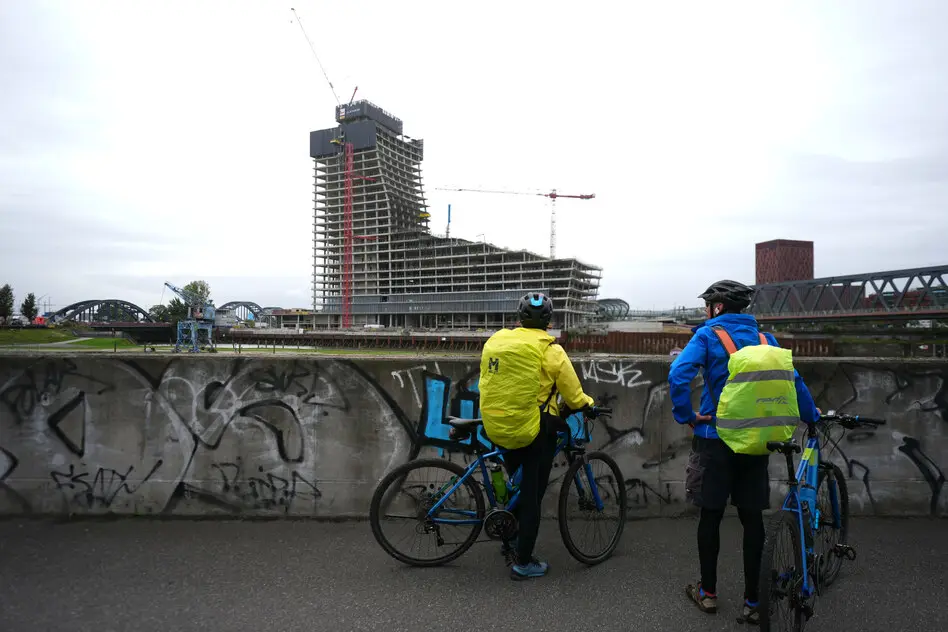
As one of the tallest buildings in Germany, the Elbtower is intended to mark the entrance to Hamburg's city center, visible from afar. But the construction site is at rest, and a few days ago the construction company Lupp put the gun on the Hamburg Senate. If negotiations with the Hamburg Senate about completing the skyscraper do not make progress, the first of several high-rise cranes that have been standing there unproductively for three years and only costing money would be dismantled. "City of Hamburg, move! Otherwise we'll be out of here," Lupp managing director Thilo Moser told the FAZ.
The construction site on the Elbbrücken is thanks to the real estate wizard René Benko, who is facing several legal proceedings in connection with his insolvency. The Elbtower was supposed to be almost 250 meters high. It has now been agreed with the architect David Chipperfield that 200 meters would also be okay. 100 meters already stand as a concrete framework.
This situation is of course a bit embarrassing, which is why the red-green Senate offered to help a consortium of investors led by the Hamburg real estate entrepreneur Dieter Becken, who offered to finish building the high-rise, just over a year ago. The Lupp construction company is part of the consortium, as are the foundation of the late entrepreneur Klaus-Michael Kühne, the Signal-Iduna insurance company and the entrepreneur Dirk Rossmann.
This text first appeared in wochentaz, our weekly newspaper from the left!
Every week, wochentaz is about the world as it is – and as it could be. A left-wing weekly newspaper with a voice, attitude and the special taz view of the world. New every Saturday at the kiosk and of course by subscription.
Although 350 million euros have already been invested in the shell, the consortium is having difficulty financing the tower. The city has therefore offered to buy the lower twelve floors for 595 million euros - but only after the building is completed. Under no circumstances does she want to take any risks.
The latter is a political issue, as the mayor of Hamburg at the time, Olaf Scholz (SPD), had promised that not a cent of public money would flow into the project. The red-green Senate justifies its offer by saying that it has committed to the state of North Rhine-Westphalia to build a natural history museum for the joint Leibniz Institute. This is possible in the Elbtower and is 230 million euros cheaper than building your own new building.
Finance Senator Dressel said the 595 million euros would be a “global flat-rate fixed price”. The city has already fallen on its face with the Elbphilharmonie, which is why it is now trying to install all possible safeguards: lawyers who will examine the transaction, a risk assessment and a detailed catalog of services.
This makes negotiations with investors difficult. Recently, representatives of the governing coalition increased the pressure by questioning the city's involvement, and a Hamburg real estate company made an offer to house a museum in one of its properties for 100 million euros less.
“We want to avoid the Elbtower failing,” Lupp managing director Matthias Kaufmann assured the FAZ. However, two months of standstill on the construction site cost almost half a million euros. And without Lupp’s special technology, the house could not continue to be built.
Hamburg's mayor Peter Tschentscher (SPD) told the television station RTL Nord that the city would not allow itself to be put under pressure: "The private investors have not really taken the city's expectations seriously, and we cannot accept that." There is a clear calculation: “We want a very good natural history museum, but we also want it at a reasonable price, and it stays that way.”