
Germany taz
Hair Transplants for Men: Brother, the time has come
The number of men going under the knife to get fuller hair has been increasing for years. Visiting a place where punching and transplanting takes place. more...
Deutsch (original) ·Auto-translated to English
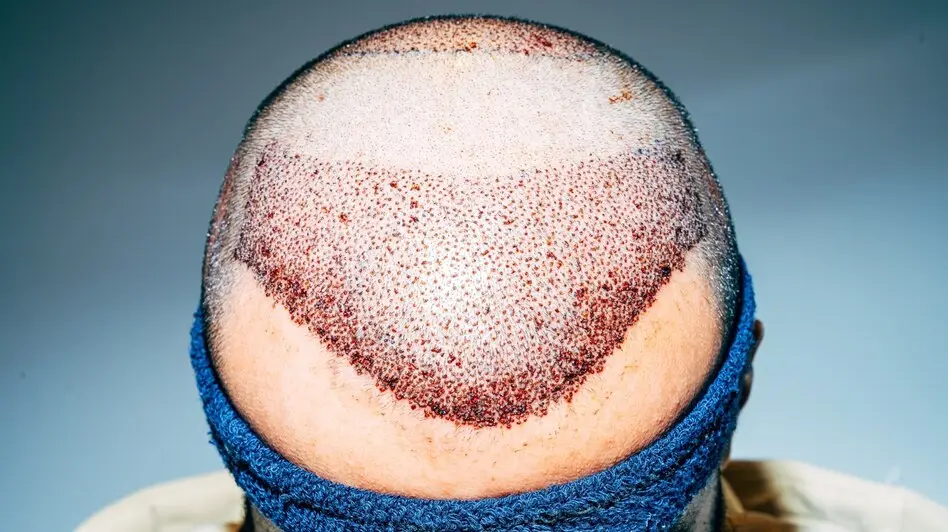
As if you were distributing flower bulbs in a bed. Just with tweezers, magnifying glass and blood. In a side street on Düsseldorf's Königsallee, between Prada and Dior, where beautiful people like to buy beautiful things, Michael undergoes an operation. Michael is a master painter, 57 years old, and he would prefer to keep his last name to himself when it comes to such a shameful topic as hair loss. Now he is dozing on the couch, his head is shaved, his scalp is numb.
Surgeon Dr. Karin Leonhardt uses her hollow drill to circle a hair root on the back of Michael's head. Then she punches a hole a few millimeters deep. Assistants help so that the doctor doesn't have to put down her tools: one picks out the hair including the root, a second collects the transplant and places it on a sterile cloth. She counts the harvested hair roots under the spotlight of her magnifying glass. The process will be repeated a few thousand more times on this rainy morning.
The principle is simple, the execution is an art in itself. Leonhardt slightly thins out the areas where hair is thick. She later puts the hair back where less growth occurs. Fine hair on the neck moves into the front hairline, while the thicker hair finds its new place further back on the scalp. It has to be more than 100 per square centimeter to make it look full. It is Michael's third operation at the hair clinic. The hair should become a little bit thicker.
Receding hairline, bald spots, semi-baldness: most men lose their hair as they get older. Having little or no hair on your head is neither unusual nor unhealthy. Nevertheless, a number of men fight against it because – yes, why? Does a man lose his dignity when he has hair on his head? The youth? Attractiveness? Where does the pressure come from, where does the self-doubt come from that leads people to pay a lot of money for a complex hair transplant?
The number of hair transplants has increased rapidly in recent years and by 2025 there were several million procedures per year worldwide. In Germany there are an estimated 4,000 procedures per year. Around 85 percent of patients are men, and they are getting younger and younger.
The cosmetic problem of hair loss is an age-old one, as are attempts to conceal, stop or even reverse it. For thousands of years, men have been smearing tinctures and ointments on their bald heads, putting foreign hair on it, and trying out new, better, more successful options. Transplants have also been around for almost 100 years. What is new, however, is acceptance in society - not for baldness, but for surgical procedures. Smoothed wrinkles, injected lips and other minimally invasive cosmetic surgeries have long been common, and so is hair transplantation.
Master painter Michael came to the hair clinic on Königsallee in the morning. Karin Leonhardt discussed everything with him there. She took photos and drew the planned hairline. Michael's head was then shaved, anesthetized and injected with saline so that no nerves were injured during the piercing. After removal, the transplants are sorted and a decision is made as to which hairs fit where and at what angle. Then they are deployed.
The procedure that Michael chose is called FUE. Follicular unit excision. “This means the removal of individual hair root groups,” explains Karin Leonhardt. “We place a hollow needle over the shortened hair and separate it, including the root, from the surrounding tissue.” The unit is then plucked out with tweezers. “The method has gradually become established over the older strip method,” says the surgeon. A whole strip of skin was cut from the neck and dissected into its individual parts under a microscope. The result: lots of hair roots to transplant into bald spots, but also a long scar.
Which technology should it be, in which practice, for what price? With just a few search terms on the Internet, you will immediately come across a number of hair clinics that outdo each other with their offers, including never-ending comment columns with reports from enthusiastic customers. Some write about how useful it is to dig a little deeper into your pockets for local experts. The others talk about what a great bargain they got abroad. Turkey is known for cheaper hair clinics. Flying there has long been men's mainstream: vacationed with Turkish Hairlines, they say with a wink.
“A lot of mistakes can happen during a transplant,” says Karin Leonhardt during her break. Prick too deep, implant too close, transplant a hairline that is too straight and too low. She gave the hollow needle and tweezers to her colleague, who continued to treat Michael. The operation takes half a day and the surgeons take turns.
Leonhardt, who is currently the president of the Association of German Hair Surgeons, opens a folder at her desk with pictures that no one actually wants to see. They are reminiscent of the shocking images on cigarette packs and show heads with bald patches, infections, wounds and necrotic crusts.
“Cases like this come here again and again when their operation has gone wrong in a cheap clinic,” says Leonhardt. “Some things can be concealed, some things can hardly be saved.” Her patients would report black market and back-alley practices in which they would lie in a room next to several other men in order to have hair implanted at the same time. Assembly line work without preliminary discussions or aftercare.
Michael also had the previous procedures carried out in Düsseldorf and paid around 20,000 euros for them. In 2016 and 2017 he had surgery using the strip method. “The scar hurt for a while afterwards,” he says in the treatment room. Afterwards, the transplanted hair follicles had to recover and relax the scalp for a few months. "It will be different this time: the skin is just a little sore from all the small holes. It will itch a little when everything heals."
His third session is intended to further improve the result. This condensation is said to have been Michael's last, probably. Up to five operations per head are not uncommon in hair surgery.
“In the eighties I had a blonde mane,” says Michael, “like all my friends.” Like the rock stars whose band shirts they wore. At the weekend we went to the metal bar with the motorcycles, headbanging and moshing to Metallica, Iron Maiden, Motörhead, “Hair down to your ass, that was mandatory.”
When the hair became thinner, Michael first had it cut short and put on a baseball cap. He wouldn't leave the house any other way. “People only knew me with a hat,” he says, and admits that he doesn’t really know what his problem was. “It kind of bothered me, isn’t that strange?”
About ten years ago I made the decision: "I saw a hair surgeon on Sat.1 and I liked him. So I went to Düsseldorf and got advice." There would be two or three sessions, the first one would cost around 7,000 euros. “As a master painter, I had to do a few more jobs – and maybe forego a vacation.” A year later, Michael had the money together.
How thin can my hair be? How high can my receding hairline be? How long can I put my guard hair over the bald spots? When is it time to just shave everything off and go bald? Or should I have the lost hair replaced via surgery? At some point you start thinking about it.
Anyone who searches for “hairloss”, “balding” or “hairline” on Insta and Tiktok will end up in a world of before-and-after videos, time-lapses from the operating table and self-appointed coaches who use the hashtag Looksmaxxing to explain how you can improve your appearance with fitness exercises, diet, clothes and of course the right hairstyle. On Reddit, men upload photos of their hairline and get answers, sometimes pastoral, sometimes painfully honest. It's okay, it's much worse for me. Or: Brother, the time has come.
You are diagnosed using the Norwood scale, a chart that divides hair loss in men into stages. Level 2 already shows the slight receding at the temples, level 3 shows a deep receding hairline, and at level 6 the remaining bridge of hair on the top of the head disappears. People exchange photos and report progress: from level 2 to level 4 in 18 months, one person writes.
In 2021, British psychologists examined what is being negotiated online. When they analyzed posts on online forums about hair loss, they found that most men described baldness as ugly and emasculating. They blamed a superficial society and wrote about fear, panic and withdrawal. The earlier hair loss occurs, the worse those affected find it, the study shows. Even when the hairline began to recede, many people asked themselves what they should do. The advice was usually brief: shave, buy a hair system, transplant. According to the study, there were no longer discussions.
But at least: the men start talking. The former secret insecurity turns into a public self-optimization project, and the stars move forward. Robbie Williams once revealed that he had a hair transplant because he was bored. He later complained that his hair was too thin for further surgery, so he would now try a hairpiece. Jürgen Klopp spoke about his hair transplant in 2013, when he was also in a Düsseldorf clinic. Robert Geiss said he was in Istanbul.
There is a kind of socially accepted agreement behind this: a full head of hair equals attractiveness. It stands for youth, energy, potency. On the other hand, if the film or advertising industry wants to portray someone as weak or at least idiotic, they are always half-bald: Homer Simpson, Bernd Stromberg, Fredo Corleone.
There are also proud and virile bald men, such as Vin Diesel, Jason Statham or Master Proper. But they have to compensate in order to be considered attractive. Maybe with a beard or a fashionable wardrobe guaranteed with a well-toned body. Then baldness is not a defect, but a statement. But it takes more than just a regular visit to the hairdresser: diet, exercise, and a lot of investment in your own body.
You really can't say that we urgently need the hair. They are a rudiment of evolution, more decoration than necessity. And in fact, we are not as hairless and naked as we think. Humans have a similar density of hair follicles to chimpanzees. The difference is that our hair is fine, short and usually barely visible. We wear fluff instead of fur. The evolutionary reason could be our thermoregulation: it cools down better naked, also because sweat can evaporate unhindered. Our ancestors probably traveled long distances in warm regions, and the thick fur became annoying. So the hair disappeared, apart from a few spots.
A head without hair is not unhealthy either. Beyond the risk of sunburn on the panel, a hairless person is hardly at a disadvantage. However, many people treat hair loss on their head as if it were a serious illness that needed to be treated. Anyone who goes to the dermatologist with a receding hairline will receive a diagnosis code: L64, androgenetic alopecia. The trigger is dihydrotestosterone, DHT for short, a derivative of testosterone.
“Normally every hair goes through a cycle,” explains Karin Leonhardt. “It grows for a few years, then goes dormant for a few months and finally is shed.” After a short break, a new hair grows from the same root. The cycle is controlled by the dermal papilla cells at the base of the follicle, which send the signal to the hair to grow. “In hereditary hair loss, these cells are hypersensitive to DHT.” Under its influence, the follicles shrink. Strong, pigmented hair turns into fine lint. They eventually fall out and no longer grow back. The same hormones that cause boys to sprout body hair during puberty later cause the hair on their heads to atrophy.
This text first appeared in wochentaz, our weekly newspaper from the left!
Every week, wochentaz is about the world as it is – and as it could be. A left-wing weekly newspaper with a voice, attitude and the special taz view of the world. New every Saturday at the kiosk and of course by subscription.
The genes decide who is affected particularly early or particularly strongly, and not in a single place that could perhaps be influenced, but in hundreds of places in the genome. Researchers at the University of Edinburgh found 287 such gene loci that influence hair loss. They attribute 80 percent responsibility to heredity. “The rest is environmental,” says Karin Leonhardt. Stress accelerates a lot, as do vitamin D deficiency and poor nutrition. As a result, there are also differences at the country level: There is probably more hair loss in Southern Europe than in Germany, but less in South America and Southeast Asia, at least according to hair clinics' own compilations. However, combing too much or too little, using the wrong shampoo or wearing hats don't play a role.
The legislator finds: You can live with hair loss - and excludes products to improve hair growth from health insurance, along with other lifestyle preparations such as sexual enhancers, weight loss pills or nicotine chewing gum. The fact that their problem is only cosmetic in nature does not really reduce the suffering of the many people affected. The Edinburgh researchers also conclude: Hair loss has a significant impact on self-perception and the perception of others. In any case, enough for many people to go under the knife for a few thousand euros.
“Hair has always been important to us,” says Roger Diederen, director of the Munich Kunsthalle. The exhibition “Hair – Power – Lust”, which Diederen conceived with the curator Juliane Au, was held in his museum for six months. “Hair has been found in ancient graves all over the world,” he says. “Not just in Egypt, also in Europe and South America, even among warriors: hair, groomed, decorated, braided.” The reason: “Hair is a means of communication, then as now.”
In the past, the message of hair was simpler: “Having a lot of hair indicated the animalistic, the wild, the warlike,” explains Diederen. On the other hand, well-groomed or no hair at all was a sign of common sense and purity. So Egyptian priests shaved their hair and eyebrows as a sign of their calling. European monks wore a tonsure and thereby said: I am not vain, I dedicate myself to God. Buddha is also said to have cut off his hair when he left home.
On the other hand, those who wear their strength in their curls, like the biblical Samson, lose it with the cut. Delila shortens Samson's hair, whereupon he is captured and blinded. Hair gives you power that you can lose without it.
Being or wanting to be powerful but not having hair was therefore a problem. “Louis XIV suffered from hereditary hair loss, as did his father,” said Diederen. It is said that the Sun King himself introduced the wig to the court as a young man to conceal his thinning hair. The nobility followed suit and the allong wig became a trendy symbol at court, a sign of belonging. The state was the king – him and his oversized hairpiece.
It took until the 20th century for someone with a lot of power to acknowledge his baldness: Benito Mussolini. “At a time when baldness stood for age and weakness, as Italian Prime Minister he turned his supposed shortcoming around and demonstrated toughness,” explains Roger Diederen. Shaved heads can also be an order: those who join the Marine Corps in the USA are shaved. The individuality, yes, the entire personality, is erased in favor of the group. In the sixties, the hippies responded to the short-haired uniformity in the barracks with long hair, unkempt, rebellious. They passed on the legacy and their nonconformity to the punks, while the skinheads responded with polished sophistication.
The relationship between power and hair fashion has changed over time: “Lush hair no longer automatically means power – and hair loss does not always mean oppression,” says Diederen. Not having hair on your head is only a sign of strength if you consciously decide to do so. The monk shaves freely, the recruit is shaved. “What matters is who wields the scissors.”
Michael has also shaved his head once. Maybe it was because a colleague with thinning hair once made a remark that was too triumphant: Oh, things are getting off to a slow start for you too! Or because a nasty gust of wind revealed a bald spot that Michael didn't yet know about. “Or in the supermarket at the checkout, when you stand under the big mirror and the bright light shines on you from above: it looks really shitty.” First it was combed and gelled a bit, laminated and bleached, then the hair came off completely. “If you're the type of person, it doesn't look so bad,” says Michael. But he wasn't the type for it, he thought. “I preferred to keep my hair.”
Anyone who wants to fight hair loss will be served one promise of salvation after another in drugstores and on websites. Tinctures and sprays with basil and rosemary, pumpkin seed oil, caffeine shampoo. There is little or no evidence as to whether this helps. “You might as well pour a cup of coffee on your head,” says Karin Leonhardt from the hair clinic in Düsseldorf.
What has been proven to help are two active ingredients. Finasteride is available as a tablet. It blocks the enzyme that converts testosterone into DHT, thus slowing down the atrophy of hair roots. Minoxidil is applied to thin areas, but exactly how it works is still not fully understood. Because finasteride interferes with the hormonal balance, the European Medicines Agency warns of depressive moods and sexual dysfunction. Minoxidil, on the other hand, is not for pet owners: just drops of it or licking it on skin and pillowcases can poison cats. But the main problem with use is: “The preparations only work as long as you use them,” says Leonhardt. If they are stopped, the hair will continue to fall out from then on. So the resources are worth your money in the long run.
Women also sit in Karin Leonhardt's waiting room, although significantly fewer. Their hair loss looks different: Hereditary hair loss affects women less often and later and almost never ends in baldness, but rather in a widening parting. More often, the hair thins diffusely and for a short time, for example after childbirth, during menopause or in cases of iron deficiency. Leonhardt transplants into women with a congenitally high forehead, after scars or accidents. Minoxidil also helps women with the hereditary form of hair loss. Finasteride seems less convincing. When it comes to circular hair loss, which occurs in both men and women, there are other remedies for severe cases.
As long as people are willing to pay money for a supposed cure, the market will of course strive for even more products. Newer ones are shampoos with dimethylglycine, which is said to promote blood circulation in the scalp. The active ingredient clascoterone is intended to block DHT directly at the receptor of the hair follicle. There are also autologous blood therapies that involve injecting plasma enriched with growth factors into the scalp.
A year ago, researchers from Taiwan made headlines when they claimed to cure hair loss within three weeks. The team discovered that fat cells under the skin can release fatty acids that awaken dormant hair follicle stem cells. A serum containing these fatty acids allowed bald laboratory mice to grow fur again. Studies on humans are still pending. Previously, researchers from Harvard had grown hairy human skin from stem cells: follicles with pigmented hair developed in the skin organoids, small spheres of cells.
Or it doesn't have to be your own hair to hide your baldness. Hair systems, as toupees are called today, are glued or linked, last about three years and cost around 3,000 euros. Done well, they are indistinguishable from real hair. However, synthetic hair can be a nuisance as a poorly ventilated foreign body on the head. Artificial hair, which is implanted individually into the scalp, is more radical. However, many experts advise against this endeavor because of the risk of infections and foreign body reactions.
After the team's short lunch break at the Düsseldorf hair clinic, the time has come: Michael's removed hair will be implanted again. Insertion requires the most concentration. Karin Leonhardt puts on her magnifying glasses, followed by a hood, face mask and gloves. “Now please don’t talk to me anymore,” she says, saying she has to count. Michael is lying under a blue blanket; he has become cold from lying there for so long. “You seem restless, do you feel anything else?” “A little,” he murmurs. “That doesn’t have to be the case, we’ll numb you out a little.”
The radio is playing quietly in the background, Antenne Düsseldorf is playing “Karma Chameleon”, Leonhardt is humming along, Michael is smiling. “We are well on time,” says the doctor. “We’ll be through in two hours and you’ll be back before rush hour.”
At 3 p.m. the operation is over and Michael can go home. He will sleep with a neck pillow for a few days because it reduces the swelling. He will have to make an effort not to scratch or rub his head after showering to avoid dislodging any grafts. Then the inserted hair falls out. That's normal. They reject the converted hair follicles in order to produce new ones.
Hair will eventually sprout again in three months. If anyone asks if that is his real hair, Michael will answer: Yes. They just moved. Until the end, Michael couldn't answer why his thinning hair bothered him so much. But it certainly has to do with the dignity of making a conscious decision about your appearance. Michael says, “I did this for myself.”