
Politics taz
Large protests in the Czech Republic: hundreds of thousands around 4:36
400,000 people protest in Prague against the government's broadcasting reform. They don't just care about fees, they fear for the future of their country. more...
Deutsch (original) ·Auto-translated to English
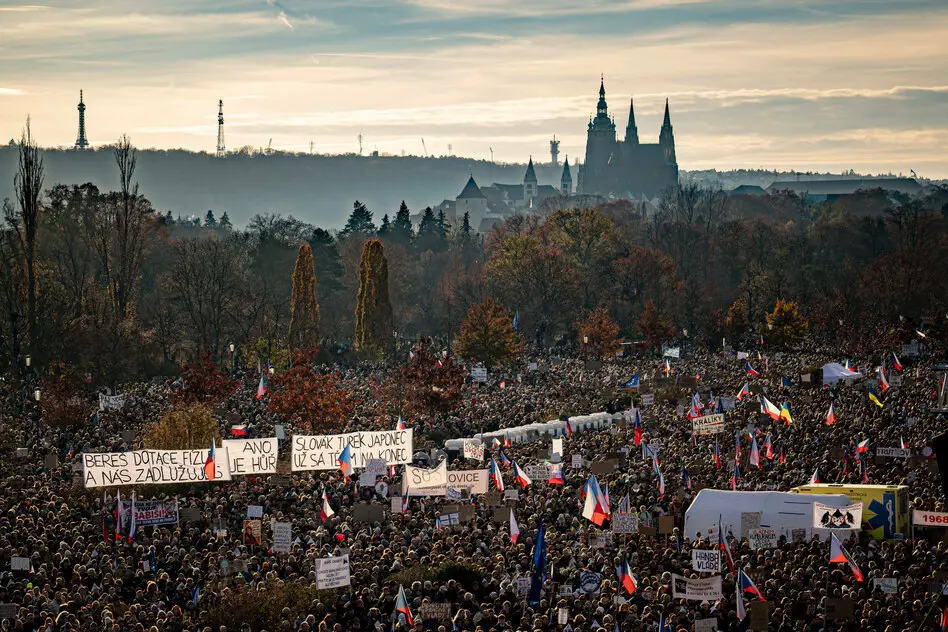
On Sunday afternoon, the Letná Hill still belongs to skaters and a few tourists. At the top of the staircase from the city center, they do their laps under the huge metronome that swings leisurely back and forth. Since 1991 it has stood as an artistic installation where a huge Stalin monument towered over Prague until 1962. The sun is shining, but it is only a few degrees above zero.
This refers to the moment when the House of Representatives pushed through the broadcasting reform in the first reading on October 24th, after a specially scheduled night meeting of the ruling right-wing coalition. At that time, the politicians decided: Instead of fees, the state budget should in future finance the public television ČT and the radio ČRo, with around 15 percent less money. Opponents, who have already held several protests in previous weeks, fear that whoever pays will make a living. For many people, what matters most is the style of government.
The initiative Milion chvilek pro demokracii (One Million Moments for Democracy) called for the largest rally to date. The donation-financed association was founded in 2017 by students led by Mikuláš Minář. Back in 2019, he brought more than a quarter of a million people to Letná to protest against Prime Minister Andrej Babiš, then in his first term in office. Today there will be up to 400,000. More than 500 volunteers are deployed and the organization is in operation. The sectors in front of the stage are already full in the early afternoon, and announcements send those behind the stage further back. It will remain peaceful all afternoon.
Almost a year after taking office, there are already many reasons to protest. “Freedom is like air,” says Maria. The mathematician experienced the regime before 1989 and came especially from Brno to set an example. You only notice their absence when freedom becomes scarcer, and that's how it feels again now. She considers the budget to be a voter buyout at the expense of the children, who would pay the debts. She also does not agree with foreign policy, for example with the fact that the Czech Republic is not taking part in the joint military maneuvers in Poland. She respects the election results, but a good government governs for the entire country and not just for its own voters.
71-year-old Pawel also came to Prague by bus. The pensioner, who came with friends, is holding a NATO flag in his hand. The government is a “disgrace”. He calls it a catastrophe that Babiš no longer wants to support Ukraine after his recent meeting with Slovak Prime Minister Robert Fico. He calls the reform “the beginning of the end,” and after the media it will soon be the turn of the judiciary. It's not about financing at all; the government wants to bring television and radio under its control. The way she treats journalists is just arrogance.
These two are no exception; people have come from all over the country. The organizers say there are at least 60 registered coaches. To the music in the opening act, people jump against the cold and tea is served from thermos flasks. The signs read “Girls just want to have free media” or “Andrej, you won’t buy us,” an allusion to the Prime Minister’s billion-dollar fortune. Protesters come from all over the country,
And there are a noticeable number of young people there. “It’s starting to smell a bit like the communism we used to have here,” says Markéta, 19. She and 18-year-old Tony have already demonstrated in their hometown of Ostrava. Many she talks to simply ask why they should pay for programs they don't use anyway. It's not about the fee, she says, but about freedom of expression and not being controlled by the government. Although Tony admits that he rarely tunes into public broadcasting, it was a part of his childhood. “I don’t want them touching what was ours.” Markéta is hopeful that the opposition has gained ground in the Senate and local elections in October and the government has been punished.
In the middle of the crowd, Sasha, 17, stands wearing a paper cap modeled after Večerníček, the character from the bedtime show on television. The hats became a symbol of the protest, and many people also put one on that day. “That’s what I grew up with,” she says. “I want the next generation to grow up with these fairy tales, like I did.” Sasha fears that the government wants to remove from the program what doesn't benefit her. Teachers are underpaid and she finds Babiš’s course towards Ukraine “simply very stupid”. She wants new elections, but is not allowed to vote until next year. “The future of this country lies with young people.”
Then it starts promptly at 2 p.m. Organizer Minář calls for non-violence, because one does not want to respond to ruthlessness with ruthlessness. He leads through the program, but the stage belongs to numerous speakers from culture, sport and media. International voices also have their say. Student Natalija Petrović from the Serbian student movement talks about the collapse of the train station canopy in Novi Sad in 2024, in which 16 people died, and the movement that grew from it. Almost a month ago, their list won the election and drove the autocratic ruler Aleksandar Vučić from office. Natalija’s appeal was: “Now it’s your turn!” Later, Maja Sever, president of the European Federation of Journalists, let the prime minister know that Europe's journalists would be following his every move. She then shouts, “Hands off the media,” which the crowd responds to with applause.
Shortly after three, Minář presented the petition “Už nikdy 4:36”, which went online during the rally. There are four demands in it. First, the government should withdraw the law from Culture Minister Oto Klempíř and only then seriously debate the future of public broadcasters. Secondly, she should seek dialogue with the public. All 16 members of the government are therefore invited to a theater in Prague on December 2nd for a public discussion with 16 experts from their departments. Thirdly, it should govern differently, without nightly votes and without bypassing rules and customs. Fourthly, Tomio Okamura should give up the chairmanship of the House of Representatives and his right-wing extremist SPD should give up the Ministry of Defense. By midday on Monday, more than 100,000 people had already signed.
Shortly before the end of his speech, Minář estimated from aerial photographs that 350,000 to 450,000 people came to the hill; later the organizers spoke of around 400,000. The police do not give their own number, but they say that they have never monitored such a large number. This may have been the largest rally since the Velvet Revolution. As dusk falls at 4:36 p.m., the cell phone lights come on and the area becomes a sea of lights for the national anthem.
The government has not yet been deterred. In response to a query from the ČTK news agency, Babiš replied on Sunday that he respected the right to demonstrate, but that the fees would still be waived; that was in the government program. Nobody wants to control the broadcasters, dictate their content or nationalize them. He did not respond to the specific demands. Okamura and Foreign Minister Petr Macinka of the Motorists dismiss the protest as an opposition matter.
Minář outlined what will happen next on stage. As early as Tuesday, the anniversary of the Velvet Revolution, a few people are supposed to meet in every community and publicly denounce their obedience to the government. In the coming week they should also ask ANO mandates, members and voters whether the alliance with the SPD and motorists really isn't going too far for them. Warnings will be posted in windows across the country at 4:36 p.m. on December 2nd. Minář ends his speech with the sentence “This is just the beginning.”