
Germany taz
Glittering world in the Botanical Garden: Nature needs sleep too
Hamburg's Nabu criticizes the commercial light spectacle in the Loki Schmidt Garden. Studies show that artificial light disrupts nature, even in winter. more...
Deutsch (original) ·Auto-translated to English
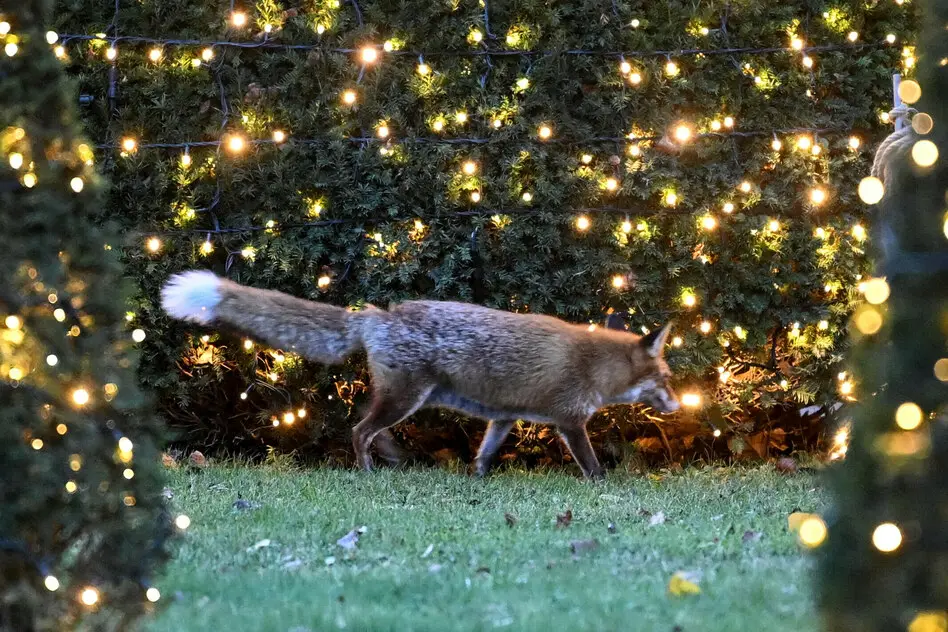
When the “Christmas Garden” opens its doors for the fourth time in Hamburg's Botanical Garden from Friday, the university campus in Klein Flottbek, which is otherwise closed in the evenings, will be transformed into a walk-in, glittering light-emitting diode world for two months. For the more than 30 light installations, around 1,000 spotlights are set up, 60 kilometers of cables are laid, there are projections on a six-meter-high water mist wall, as well as music and mulled wine.
The concept of Christmas Garden Deutschland GmbH, a subsidiary of Deutsche Entertainment AG, works nationwide, in Berlin-Dahlem, Stuttgart or Dresden. In 2023, around 1.7 million people attended the events, which also take place in other European countries.
Environmentalists such as the Nature Conservation Association (Nabu) are just as reliable in criticizing the spectacle. “Nature doesn’t need a light show,” says Hamburg’s Nabu chairman Malte Siegert. It is a contradiction that the city reduces lighting elsewhere, for example on the Outer Alster, for species protection reasons, while allowing commercial illumination in a valuable refuge like the Botanical Garden. “We humans are not completely alone in this world, but rather part of a sensitive system in which other living beings such as insects, birds and bats also have their place,” says Siegert.
The organizer and the management of the Botanical Garden counter this: The two-kilometer-long circular route was adjusted after the Nabu criticism last year, sensitive bush areas are left out and from 10 p.m. there is complete darkness again. And anyway: isn't vegetation dormant in November and December anyway? Isn't nature asleep for a long time?
Research shows that conservationists' objections to artificial light are justified, even in winter. In light ecology, the so-called photoperiod is the decisive pacesetter, explains Katharina Schmidt, urban nature consultant at Hamburg's Nabu: The temperature, but above all the decreasing length of the day, signals to plants and animals that winter is coming. If this dark phase is shortened for weeks by artificial night light, the internal clock gets thrown out of sync.
The brightening of the night sky by artificial light sources such as street lamps, facade spotlights or light shows is known as light pollution. Scattered light is particularly problematic because it blurs the natural alternation of day and night, which is the most important biological clock for humans, animals and plants.
The nights are becoming rapidly brighter in Germany and around the world. The visible sky brightness is increasing worldwide by almost ten percent per year, also fueled by bright white LEDs. In Germany there are hardly any regions with real natural darkness anymore.
To reduce light pollution, experts suggest shining light only where and when it is actually needed. The Federal Agency for Nature Conservation recommends downward-shielded lights, motion-controlled dimmers, night-time switch-off times and warm white light with a low blue content. This protects insects and the sleep-wake rhythm of vertebrates.
For example with insects, not all of which have disappeared even in winter. In November and December there are no longer any swarms of mosquitoes buzzing through the Botanical Garden, but evening artificial light is a real problem for winter butterflies or for caterpillars and pupae that overwinter in tree bark, in the ground or in bushes.
A study by a research team led by biologist Thomas Merckx in the Journal of Applied Ecology shows how sensitive the photoperiodic mechanism reacts to weak scattered light. The team studied the lattice moth, a common moth. Even a diffuse background illumination of 0.7 lux - which corresponds roughly to the shimmer of urban light bells and is much less intense than an event spotlight - prevented the caterpillars from inducing winter torpor, which is essential for their survival.
Instead of preparing for the cold, the animals evolved directly - in a season in which they have little chance of survival. Urban populations proved to be just as vulnerable as rural animals. Apparently there is no evolutionary habituation to continuous lighting.
Similar effects have also been proven for trees and birds. Trees that are illuminated in the evening shed their leaves later because they are led to believe that longer summer days are coming. This reduces their frost hardiness and depletes their energy reserves.
In songbirds, artificial light at night shifts hormone release and activity phases: They stay awake longer, use more energy, but cannot find enough food in the cold season to compensate for the deficit. Birds that overwinter here, such as tits, blackbirds and robins, need large parks such as the Botanical Garden as places to sleep and feed, especially in winter.
And empirical studies on part-time lighting, for example with bats, show that the hours after sunset are particularly crucial because in the twilight phase many species synchronize their internal clock, go in search of food or go to their sleeping places. If this time window is brightly lit for weeks, the protective effect of a later nighttime shutdown will largely be lost.
An often criticized problem of such light spectacles is their energy balance. “We have done a lot to reduce the energy consumption of the events as much as possible,” emphasizes Christmas Garden. The lighting design and path lighting consists of 90 percent LEDs, the lowest possible wattage is selected, and the lighting of the circular path is reduced to a safety-relevant minimum.
They also predominantly use green electricity and operate the mulled wine tapping systems to save energy with instantaneous water heaters. A Christmas Garden in Frankfurt used an average of around 0.56 kilowatt hours of electricity per guest - about as much as a machine washing at 40 degrees. Large locations can quickly add up to over a thousand kilowatt hours per evening.
Nabu expresses its understanding “that many people long for more light in the dark season and that public spaces should be illuminated in cozy light”. For an “event that is primarily profit-oriented and is held over two months until the new year,” the planning must be done in such a way “that the needs of the local wildlife are also taken into account.” For light installations, “there would certainly be alternative urban areas that are outside of protected areas and would be more suitable.”
“You don’t have to approve events like these that are purely for human enjoyment when weighed up against the benefit of nature,” says Nabu from Hamburg.