
Germany · taz · · 43m
Equal parenting: Dad now does something too
Deutsch (original) · Auto-translated to English
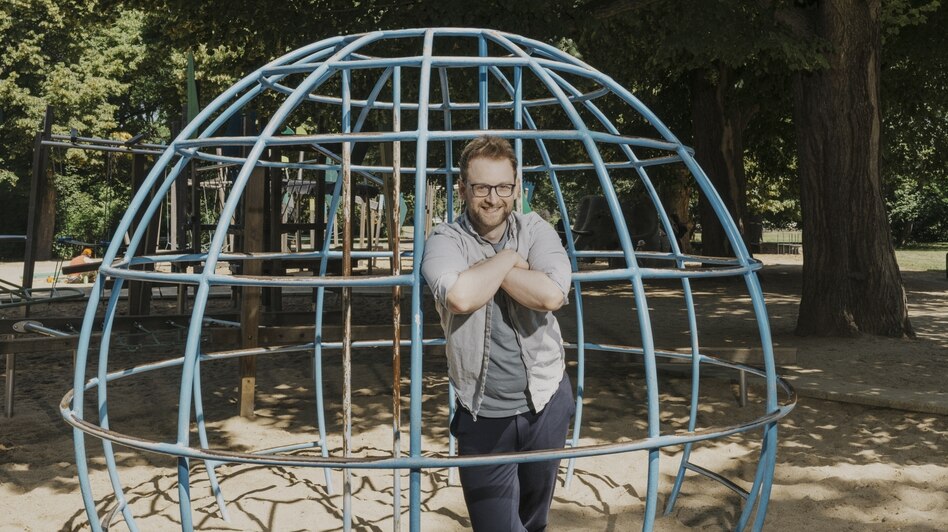
With tired eyes and slightly tousled hair, Olli greets his followers on Instagram on his "Papa.Channel": "Aah... weekend! Or as parents would say: the 48-hour challenge. Imagine you have two days to clean up a mess that has grown for five days, climb a Mount Everest of unwashed children's clothes and disassemble it into its 5,463 individual parts. We mostly spend our weekend... separately."
Olli is the father of two small children and belongs to the species of dadfluencers - men who make their fatherhood an issue on social media. Care work, mental load and fifty-fifty are the most important keywords; a lot of it revolves around how you live parenthood as equals and how you as a father are there for your children.
Olli, who does not want to reveal his last name, reaches 420,000 followers with his “Papa.Kanal”, and the reel quoted at the beginning was liked 50,000 times. His humorous imitations of everyday life with children are particularly successful, for example when he imitates how food ends up everywhere at dinner except in the mouth.
Over the last few years, more and more dadfluencers have appeared on social media and are enjoying growing popularity in the parenting bubble. The taz met four to find out: What makes them so successful? Where are the boundaries between professional and private life when the content revolves around your own children? And what is their content about?
In a story about Dadfluencer, one name cannot be missing: Sebastian Tigges. He is probably one of the most famous in Germany. The meeting will take place in Berlin-Prenzlauer Berg, where the 41-year-old father of two has lived for 14 years. It's a Friday morning in a quaint corner café on the ground floor of a renovated old building, and Tigges is on a first-name basis with the woman behind the counter. A constant stream of cyclists passes in front of the café on their way to work. Tigges is a bit distracted: "I'm sorry, my mind is still with the children, I just came from daycare." Very forgivable, parents know how demanding the morning routine can be.
Nevertheless, Tigges appeared more than presentable, in a suede jacket, blue jeans and loafers - that's how we know him from his thoughtful stories on Instagram. “I've never had a problem talking openly about my feelings and our relationship,” says Tigges. But he didn't expect so many people to be interested and listen. The great interest also came from the celebrity of his partner at the time, the actress and former “Germany’s Next Top Model” participant Marie Nasemann.
In a joint podcast, the couple discussed intimate details about life with two small children. Escalated arguments were also discussed there; Tigges reported, for example, that he had insulted his wife. In a previous life he was an insolvency lawyer in a large Berlin law firm. With the start of the podcast five years ago, he gradually transitioned to becoming a public figure.
Sebastian Tigges is no longer just a “man of”. Over the last four years, he has built his own stable presence on Instagram. 160,000 people follow him there. As a “walking dad,” he filmed himself walking with a stroller through his neighborhood and spoke to many parents’ hearts: “If we play Duplo there every day and sit there for hours – I find it really boring.” His videos shaped the image of the dadfluencer in public perception.
The relationship with Marie Nasemann, however, did not last. The couple separated a year and a half ago. Today the two of them take care of their six-year-old son and four-year-old daughter on an alternating basis. The joint podcast continued for a while after the separation until the last episode came out in November 2025.
Tigges remained an influencer and recently reached a new milestone as such with the publication of his book “Becoming Dad – What I wish I had known earlier about being a father”. The switch from digital to analogue space is probably significantly less financially attractive than advertising cooperations on Instagram. Nevertheless, the traditional commodity book has an aura about it, a symbolic value that cannot be achieved with stories on Instagram.
Immediately after its release, Tigges filmed himself strolling through the large Berlin cultural department store Dussmann and proudly recording which authors he was now displaying next to. The book didn't make it onto the Spiegel bestseller list: "Of course that would have been nice for the ego," admits Tigges, "but I'm still very happy with this project."
This text first appeared in wochentaz, our weekly newspaper from the left!
Every week, wochentaz is about the world as it is – and as it could be. A left-wing weekly newspaper with a voice, attitude and the special taz view of the world. New every Saturday at the kiosk and of course by subscription.
In the book, Tigges talks about how he found himself unprepared for the role of father. Although the child was planned, he realizes in retrospect that he had no plan at all. In contrast to his partner, he had not prepared at all at the time: "I only acted when it became concrete. When something had to be carried or a cupboard had to be assembled. It was only much later that I understood that the real problem was not a single piece of furniture, but who felt responsible. The mental responsibility for the big picture had naturally fallen on Marie's shoulders." A prime example of the typical imbalance of mental load in heterosexual relationships. Even when the father is present and participates, the mothers have an eye for the big picture.
This initial inadequacy is a central motif of fatherhood narratives on Instagram. It's about a self-critical examination of one's own masculinity; it is identified as a problem for the lack of taking on care work and mental load. The initial failure is followed by purification and a commitment to equal parenthood, usually after arguments with the partners who point out to their husbands that they are not taking responsibility.
Dadfluencer Hannes Husten also had this experience with his first child, as he explains in an interview: "At the beginning of my fatherhood, I wasn't reliable. When I was in bed, I was always away for at least half a day. Today I would say: You have to be at home, take care of yourself." Cough is one half of the podcast “Papas,” which he started with his friend Niclas Rohrwacher three years ago.
The taz meets the two at their weekly podcast recording at the Berlin Holzmarkt. Directly on the Spree, a techno club, rooms for creative people and a daycare center are gathered under the roof of a cooperative. Husten's studio is on the third floor, and the podcast is recorded in a small room with two velvet armchairs.
Husten and Rohrwacher met at their children's daycare and describe themselves as best friends. Husten is the guitarist and singer of the indie band SIND. Rohrwacher is also tried and tested on the stage. The father of two children is a trained actor; in the Neukölln mafia series “4 Blocks” he had a small appearance as a start-up founder. He also publishes the children's book series “The Mindful Tiger”.
Like all Dadfluencers, Husten and Rohrwacher also strive for a fair distribution of care work. A big topic, as it is anything but a given in Germany that fathers take part in child care and household management. According to the federal government's time use survey, women do nine hours more of this unpaid work per week than men, which corresponds to a gender care gap of 43.4 percent.
Hannes Husten and Niclas Rohrwacher both say that they are “very close to fifty-fifty if they don’t get there”. And when fathers also start to spend time with their children and take on responsibility, questions suddenly arise that only mothers would have asked themselves. For example: “New school, new friends – how do I support my child?” Or: “Is it bad that I get angry easily?” These are the titles of their section “Small Big Questions”.
“Papas” is a chat podcast by two friends who talk about their fatherhood in an inexperienced but committed way. On Instagram they make reels in which they portray exaggerated versions of themselves as “Ronny” and “Thorben”. The reactions in the comment columns are consistently positive.
It's very easy for fathers who actually just do the normal thing with their children to get applause - the norm in our society is still the working father. Does that actually bother the mothers? Asked Hannes Husten's wife Fanny. Fanny Husten is a photographer, entrepreneur – and a parenting podcaster with “Mama Leisa” since 2019. To be correct, one would also have to introduce Hannes as a “man of”.
Fanny Husten reacts calmly: "They can certainly get praise for it. It's unusual for people because it hasn't been lived like that before. But of course, in theory it's complete nonsense. Has a mother ever been asked why she's traveling somewhere alone with her children?" What she attaches importance to is that what you say as a dadfluencer is also the truth. And she would confirm this for her partner: “We have reached a point where we are very equal.”
She also took part in the podcast "Papas": "The idea for the name came from me, I shot the cover and I also did the layout. In the beginning it was a lot of free additional work. But I was happy to do it, in the end it stays in the family."
However, Fanny Husten also made an unpleasant observation: There are topics that, when discussed by men, are perceived differently or as something special by society. For example, Hannes Husten's arrival in the role of father: "It's automatically a process for fathers. It was also difficult for me as a mother to find my role." But this is generally taken for granted, normal and not worth mentioning.
Niclas Rohrwacher is aware of this: "It's easy for us as dads to receive encouragement. That's unfair because moms do everything and get none. But you have to start somewhere if you want to change something. And change can come when someone hears a thought in our podcast and thinks: Oh yeah, that's right, we could actually do that differently.'"
Is that so? Do fathers actually follow the example of dadfluencers? There are currently no surveys on this in media and family research. However, one fact speaks against it: Dadfluencer podcasts are mainly listened to by women. Cough and tube awakenings reach around 40,000 people per month, but only about 20 percent of them are men. This gender ratio is also reflected in the follower numbers of all dadfluencers surveyed for the text.
But why do women, including probably many mothers, listen to men talk about topics that they are familiar with in their everyday lives? Finally, there are a lot of much more established podcasts from mothers, such as Fanny Husten's. They let the parenting bubble on social media get so big in the first place. Maybe it's good to see that there are men who want to work on themselves.
But sometimes these men draw attention to issues that mothers know all too well but are less visible to the general public. An example of this is a reel by Sebastian Tigges that he published after his breakup. There he reported on numerous comments from separated mothers on his account. There they shared their relief at actually having half the time off since the breakup. Tigges responded to this in the video, taking fathers responsible: “What does that actually say about us fathers when our absence is perceived as a relief?”
The separation of Marie Nasemann and Sebastian Tigges also reached wide circles beyond social media. Obituaries for the couple appeared in national newspapers around this time (“No, not those two!”), along the lines of: If such equal parents can’t make it, who will? Tigges remembers: "I was completely amazed by this attention, sat in the café and received all the articles from friends. Emotionally, I was still completely consumed by the separation."
Nasemann and Tigges were a projection surface for the wishes and expectations of many people, judging by the predominantly female audience, especially mothers and women. Tigges explains the interest in his (failed) marriage as follows: “There is a social need for fathers to take more care of their children.”
The sociologist and father researcher Kim Bräuer is also observing this trend. Her research team conducted 60 interviews with fathers from very different employment backgrounds and summarizes: "The idea of equality and the desire to do things differently than your own parents was very widespread across all milieus. There is just a huge gap between this ideal and fatherhood practice."
How do dadfluencers manage to bridge this gap and take on their half of the child-rearing duties? Employment conditions are an important keyword in this question. The four men have one thing in common: they are not employed in traditional employment and, more importantly, they have partners who earn a comparable amount or even more. The decision as to who will take parental leave is based on their income right from the start. Since men earn 16 percent more on average, the mother usually takes parental leave. For Hannes Husten and Sebastian Tigges, their partners' income meant that they took on most of the parental leave after the birth; they were not yet influencers at the time.
Dadfluencers live a privileged life. Tigges and Nasemann in particular were often criticized for this: fleeing the long Berlin winter to South Africa, outsourcing care time to babysitters - the average consumer generally cannot afford that.
The fact that many parents share the hardships and worries that Tigges reports as “Walking Dad” is also due to the family model in which Nasemann and Tigges lived until their separation: as a nuclear family living in the big city. The sociologist Kim Bräuer says: "We are experiencing the peak of the de-traditionalization of family relationships, grandparents live far away and are often very old. At the same time, social demands on families have changed dramatically. There is an expectation for both partners to contribute to society in the form of paid work, but care relationships are insecure. Doing care work in the nuclear family under these conditions in the post-industrial society is a big challenge."
Tigges has no longer lived the nuclear family model since the separation and now shares little content about his fatherhood on Instagram. “I would like to move away from sharing my individual experience and personal life towards parenting as a political issue,” he says. But the reason for his new reluctance is not that he can no longer draw on the reality of life in an urban nuclear family. But, among other things, he is critical of his and Nasemann's complete openness about family life today: "We subsequently deleted an episode about our son as a small child. At the moment my children don't really understand what I do. But I don't want them to be confronted with what we revealed there in the future."
Showing your children is widely taboo on social media, even among dadfluencers - at least when it comes to their faces. When they post photos, the children are either only seen from behind or have emojis superimposed over their heads. The names are also unknown. But the example of Tigges shows that just talking about young people can cross boundaries.
While Tigges is now practicing restraint, Olli from Leipzig is at a completely different point. His star in the parental sky is just beginning to rise. A good year ago, the man with the shaggy hair and mountains of children's clothing the size of Mount Everest started his “Papa.Channel” - with growing success. In the last two months alone he has doubled his followers to 420,000. He is by far the father with the greatest reach in this text.
The meeting with the 38-year-old took place on a Wednesday morning in an abandoned playground in the west of Leipzig. His children are also in daycare. Olli is wearing trousers and a crumpled shirt over his T-shirt and has a sugar-free mate in his hand - a functional father's outfit.
He talks about his childhood as the son of separated parents who took care of him on a rotating basis. “Although it was very progressive for the time, the role clichés and stereotypes were still very much in people’s minds.” Coming to terms with one's own parental home and, in particular, distancing oneself from one's father are recurring themes among dadfluencers. Nobody who was interviewed for this text spoke badly about their father; everyone saw a certain progressiveness in their fatherhood. However, that applies to the standards at the time, today they consciously want to do it differently.
What also unites the Dadfluencers: They are urban, middle-class, white and cis heterosexual. Other perspectives, such as that of a rainbow family, also appear on Instagram, but much less often. Sociologist Kim Bräuer says: "Of course the accounts that interest the majority are successful. As a scientist, I observe that the image of fatherhood is narrowed in representation. Fatherhood and poverty, for example, is a topic that does not come up."
Like Sebastian Tigges, Olli didn't expect his success. He started posting shortly before the birth of his second child. "I wanted to record this time in a diary. Then I also have a certain affinity for the stage, so maybe I was looking for a new stage." He used to be a singer-songwriter on stages in Leipzig, where he always liked to talk a lot and entertain people with jokes. He then switched to marketing and advised companies as a self-employed person.
He gave up this job shortly before the meeting with the taz – in favor of the “Papa.Kanal”. "In order to try out Instagram, I emptied my savings account. So now I have to earn money from it to make my financial contribution to pay the rent." Dadfluencer or Creator, as Olli prefers to say, is a coherent end point of a professional life between marketing and the stage.
And how do Dadfluencers make money? With advertising - a huge market with potentially very good income, but also the risk of selling out, i.e. adapting the content to the products being advertised and not the other way around. None of the four dadfluencers wanted to name specific amounts in an interview with the taz. They just say that the range ranges from several hundred euros to the higher four-digit range for paid posts or stories. This depends, among other things, on the reach, which is not only determined by the number of followers, but also by the accounts that actually watch the content.
The other three Dadfluencers also advertise on Instagram. For example, for nutritional supplements, organic juices, e-SIMs abroad, second-hand clothing or a rental car subscription: products that are tailored to the following, i.e. left-liberal parents. When asked what was okay for them and what wasn't, all four answered the same: They only advertised products that they considered ethical and that they would buy themselves.
A few days after the meeting with the taz, Olli posted advertising on his channel for the first time: "Feel free to try out the relaxation app for babies and children with your children using the code 'OLLI' and then save 20 percent on the annual membership. I think the sound and dream journeys, audio stories and the whole space world are really nice and the kids (and I!) find it noticeably easier to wind down."
Olli says: “I also see it as companies supporting my work and the socially critical attitude on my channel through collaborations.” In his content, for example, he criticizes the savings in parental allowance (“zero child policy”) or makes the gender pay gap an issue. Can this solve the contradiction between the promise of authenticity and the foisting of an advertising message? It is the crucial question of being an influencer.
Read the full story at the source
Source: taz