
Germany · taz · · 1h
History of violence in a left-wing city: Slavery under the pavement
Deutsch (original) · Auto-translated to English
Harried businessmen rush past the inconspicuous sign on Wall Street, which appears tiny among the skyscrapers. Thousands of tourists pass by without paying the slightest attention to it.
The board shows a drawing of the city of New York as it looked when Wall Street was still right on the banks of the East River: This is where fresh wheat was once unloaded from ships and hauled to the Meal Market. Even back then, it was all about getting the best deal here on Wall Street.
What has almost been forgotten is that, in addition to the sacks full of grain, there were also people there for sale. Indigenous and especially Black children, women and men who had been kidnapped from African countries. When they were put in chains they were sold like cattle. Because the Meal Market – that was the official slave market in New York City.
It is a place of pain for the descendants of the enslaved, a place that raises questions about the right form of commemoration and compensation. And the answer to this must be answered not least by the new mayor of New York, who was himself born on the African continent and carries the hopes of many progressives on his shoulders.
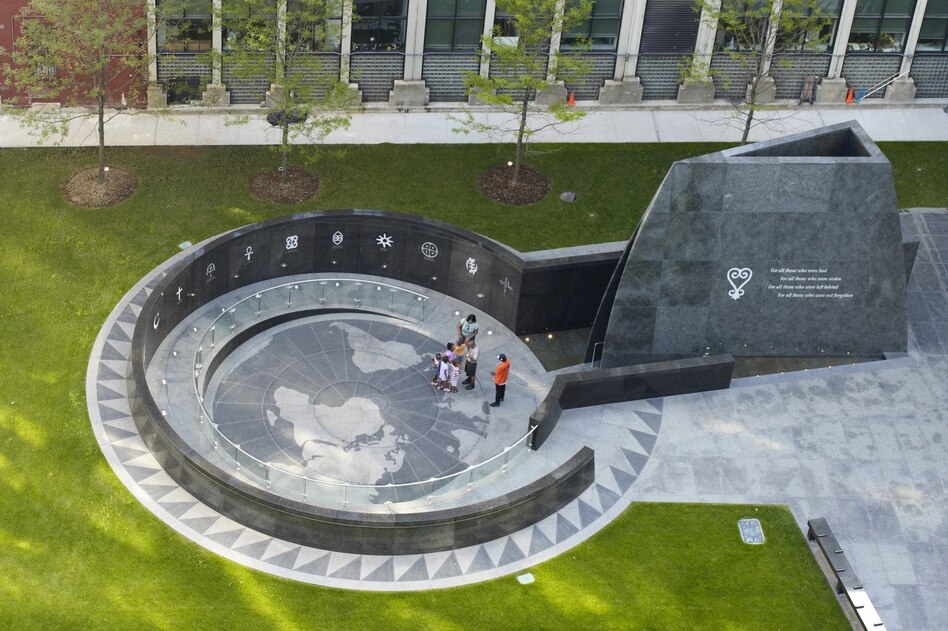
Tyrik Washington is dressed all in black, with a New York Yankees baseball cap over his round glasses. He says: "The first thing traded on Wall Street wasn't stocks, but black bodies." Washington, musician and activist, displays a granite sculpture not far from the New York Stock Exchange at the south end of Broadway. "For all those who are lost," is engraved on it, "for all those who were stolen; for all those who were left behind; for all those who were not forgotten."
Here, at the African Burial Ground, the graves of hundreds of free and enslaved Black New Yorkers were discovered in the 1990s. No wonder, because not only Broadway itself, but also the rampart, the city wall that surrounded New York in the 18th century and which gave Wall Street its name, were built by black slaves. They pulled them up along a path that indigenous Lenape people had once made.
In 1711, the New York slave market opened and the city grew rapidly. Of the approximately 6,400 residents of New York at the time, almost 1,000 were black. Almost all of them were slaves who were treated like property. They cooked, washed, sewed, carried water, emptied chamber pots, swept chimneys, and cared for children—all without a dollar's wages. Most of them worked in white people's houses. But where Queens and Brooklyn are today, they also cleared land and planted and cultivated the fields that would feed the metropolis that was just emerging.
Tyrik Washington is therefore convinced that Black New Yorkers have a right to recognition and reparation. His parents were already activists and followers of black liberation theology. “My parents fought for places of remembrance like the African Burial Ground to be created.” Apart from the small information board on Wall Street and the grave, there is hardly anything in public space that reminds us of the history of slavery in New York. “At that time, the city just wanted to quickly pave over the graves, but black people fought for us to build this place.” So that New Yorkers remember the origins of their city.
But if Tyrik Washington has his way, a lot more needs to happen. People need to understand, he says, that an extremely large number of enslaved African Americans lived in New York. The city was second only to Charleston in South Carolina. “The superpower that is New York would not exist without the work of Black people,” says Washington. They created the city itself and its wealth, but they still have no share in this wealth. “Our ancestors therefore gave us the task of fighting for reparations.”
Tyrik Washington represents Core, the Commission for Racial Equity. This independent advisory board is currently examining how and whether the City of New York is obligated to compensate its Black residents for past and ongoing injustices.
Without George Floyd, Core wouldn't exist. When the African-American man was brutally murdered by a police officer in Minneapolis in 2020, mass protests broke out across the United States. Cars burned in New York City and Molotov cocktails exploded. The anger grew. Because no population group in the USA is affected by police violence as often as black people. No one is imprisoned as often. To this day, the so-called racial wealth gap in New York between white and black people is gigantic, i.e. the unequal distribution of wealth.
According to a report from Columbia University and the Robin Hood Foundation, the Latino group has the least. These include – especially in New York – many Afro-Latinos with roots in Puerto Rico, Cuba and the Dominican Republic.
In the wake of the debate about structural racism after the murder of George Floyd, so-called Racial Justice Commissions were founded all over the USA. Tyrik Washington's Core was also created in 2022 after a referendum in which New Yorkers explicitly voted to set up such a commission.
In 2024, the city explicitly commissioned Core to examine the historical and ongoing political and economic consequences of slavery in New York - and to propose concrete forms of compensation. The commission is expected to submit its final report by next year. But whether these recommendations are implemented and how is ultimately decided by the city administration.
Tyrik Washington doesn't think that's right. “The people who caused the problem cannot be the ones who solve the problem,” he says. Washington knows that the current government is not responsible for slavery. But one senses a great deal of distrust of white-dominated institutions, which in his opinion do not protect Black New Yorkers enough. From poverty, but above all from police violence. After all: Zohran Mamdani, a mayor who wants to redistribute wealth, has been in power in New York since January. Even though the 34-year-old democratic socialist from Uganda and the son of Indian parents makes no secret of the fact that the class question is the decisive one for him - and not the question of ethnic origin.
In an interview with the black magazine The Root at the end of July, Mamdani said that although he had to wait for Core's report and recommendations, he basically wanted to stick to the promise he made during the election campaign: He would support the descendants of slaves to "eliminate historical discrimination" and "eliminate existing inequalities." Since then, the mayor has not commented publicly on this issue, not even when asked. The debate is delicate. If these reparations really come, who will pay for them with a tight city budget? What will those reparations look like? Who are they entitled to? And who is excluded?
North of the African Burial Ground, at an intersection called Cooper Square, an industrial loft with gigantic windows. Built in the 1930s for crafts and commerce, the building is home to New York University. On the fourth floor, Professor Jennifer L. Morgan clears a chair in front of her desk, family photos stand between towers of books, "Britain's Black Debt" is written on one. Jennifer L. Morgan teaches history; she knows how charged the debate about New York City's past is. Ultimately, the city enjoys the image of a progressive mecca worldwide, says Morgan. New York City as a place of slavery and white supremacy? That doesn't fit into the image.
This text first appeared in wochentaz, our weekly newspaper from the left!
Every week, wochentaz is about the world as it is – and as it could be. A left-wing weekly newspaper with a voice, attitude and the special taz view of the world. New every Saturday at the kiosk and of course by subscription.
After the end of the U.S. Civil War in 1865, Morgan says, “a certain narrative was pursued.” According to this story, the Northern states fought the Civil War to free the South from the yoke of slavery. “But in reality, of course, that’s not entirely true,” says Morgan. "There was also slavery in the North. Especially in New York, where at times as many as 40 percent of households employed black slaves." The abolition of slavery was also about the competition that white workers saw in the slaves. Because who wants to pay for work when they can force it? "It was about white interests. And even when slavery was nominally abolished in the North, it continued in other guises."
Jennifer Morgan refers to the so-called Gradual Emancipation Acts that New York and New Jersey passed at the end of the 18th century. One of the laws of 1799 promised freedom for all children that enslaved women would give birth to in the future, but only after years of further forced labor: boys had to work for their mothers' enslavers until they were 28 years old, girls until 25.
Those who were already enslaved remained so; the final release of these people in the North was not implemented until 1827. But even after that, black people were anything but equal. The New York State Constitution of 1821 abolished the requirement that white men own property in order to vote. But it required black men to own property worth at least $250 before they could vote. This allowed white wealth and white influence to continue to accumulate on the backs of Black and Indigenous people. All that was left for them was crumbs.
In 2014, Black author Ta-Nehisi Coates wrote an influential plea for reparations in The Atlantic magazine. In it he describes a historical chain of causality that leads from slavery to later racist laws and today's epidemic of violence against black people - and their poverty. A poverty that, according to Coates, must be combated with reparations.
History professor Jennifer Morgan also comes to this conclusion. "Do I believe that reparations are just and necessary? Yes. But I fully adhere to the conclusions that Coates also came to." There should be reparations that go directly and exclusively to the descendants of black slaves. "But I believe that we cannot leave it at that. Furthermore, reparations do not necessarily have to come in the form of checks. In my opinion, it must above all be institutional investments, in affordable housing but especially in schools that not only disadvantage black people, but also Brown people.”
Morgan turns and points out the window of her office. "Just a few blocks from here is Stuyvesant High School, considered the best public school in New York. The idea is that everyone has the same chance of getting in based on merit, through an entrance test. But last year only 8 blacks and 27 Latinos were accepted. Out of a new class of 778 students!"
This example shows that the conditions are not equally distributed in New York City. In order to achieve the academic achievements needed to get into such an elite school, a New York child must have a space in which he or she can study in peace. Books and access to internet. Parents who have the necessary time and money to support their child in this exam. Non-white children often don't have all of these privileges. One exception is Asian Americans, who make up the majority of non-white students at Stuyvesant High. This, in turn, is directly related to the fact that Asian Americans rank second in the racial wealth gap after New York's white residents, Morgan explains.
However, the historian believes that reparations must include all disadvantaged groups in New York. "Ultimately, almost all racial discrimination in this country can be traced back to slavery. Latinos and other minorities are indirectly affected by this. And we must not forget the indigenous people who were in New York before all of us."
Jennifer Morgan is currently conducting research in Sylvester Manor - a stately, sunny yellow mansion with green shutters that stands among boxwoods and pine trees on Shelter Island, an island in New York state. Here, the white Sylvester family once forced indigenous and black slaves to work side by side in the fields to produce food. These were then shipped to another member of the family in Barbados in the Caribbean to feed slaves there too.
“We need to think about these stories together,” says historian Jennifer Morgan. Musician and activist Tyrik Washington sees it differently. What happened to black slaves was a specific crime. “America has compensated the Japanese citizens who were sent to internment camps with reparations for this specific crime,” Washington said. “Even the so-called slave owners themselves received forms of compensation and reparation for their so-called economic loss of income after slavery was abolished,” Washington says. “But what about African Americans?” At times, freed black people were promised 40 acres of land and a mule by the authorities. “But this promise was ultimately broken too.”
It is essential to Washington that there must be reparations specifically for Black New Yorkers, regardless of what reparations go to other ethnic communities in New York City.
Parallel to Core, there is a second commission in New York that is currently dealing with reparations, the “New York State Community Commission on Reparations Remedies”. It was established by a law signed by the Democratic Governor of New York State, Kathy Hochul, in December 2023.
In May, this commission held public hearings where Black New Yorkers could voice their opinions on what possible reparations might look like for them. An attendee named Brooke Lean told the conservative television station Fox News in May: “It shouldn’t just be a check, but it should start with a check.” Not only should it come with a check, but it should start with a check. Others involved demanded $800,000 for every black establishment in New York.
Some Black New Yorkers believe that all Black people in New York should receive compensation because they are all disproportionately affected by discrimination and police violence. Even if their families only immigrated from Puerto Rico in the 1960s or from African countries in the 1990s. Still others are of the opinion that only the direct descendants of black slaves should receive money.
But how do you prove that you are descended from slaves? Jennifer Morgan says, “There is an imbalance within the African American community between those who can trace their ancestry and those who cannot.” Often those who can trace their ancestry are privileged in some way. The fact is: Not every African American can access historical archives to prove their own ancestry. Because for centuries, black lives didn't seem valuable enough to be recorded on paper.
While the Core organization has offices in upscale Manhattan, the Lenape Center has no physical location in New York City. This organization seeks to make the history of the New York area's indigenous residents visible. And she is fighting for the right to reparations for the approximately 16,000 to 20,000 members of the three federally recognized Lenape peoples. After all, the European settlers murdered the Lenape, drove them off their land and enslaved them.
According to Joe Baker, director of the Lenape Center, neither Core nor the New York State Community Commission have yet included the three federally recognized Lenape tribes in their considerations. Baker thinks that's wrong. “The suffering, exploitation and sacrifice endured by enslaved Africans and their descendants is horrific and requires serious recognition and reparation,” says the artist and activist, who comes from an ancient Lenape lineage. "Our stories are not in competition with one another; they are threads of the same unfinished reckoning that this city owes to its people."
According to Baker, the last meeting between Chief Brad KillsCrow of the Delaware Tribe and Mamdani representatives was in mid-February. The conversation was also said to have been about the topic of reparations and was said to have been cordial and constructive. The Lenape have since asked the mayor's office several times for follow-up discussions, Baker says. There has been no answer to date.
Transparency note: This research was supported by the Villa Aurora & Thomas Mann House Association, Los Angeles.
Read the full story at the source
Source: taz