
Germany taz
Planned Turkish-German Museum: A Whole Story
A new museum in Berlin wants to depict the diversity of German-Turkish connections. To achieve this, curator Gülşah Stapel collects surprising life stories. more...
Deutsch (original) ·Auto-translated to English
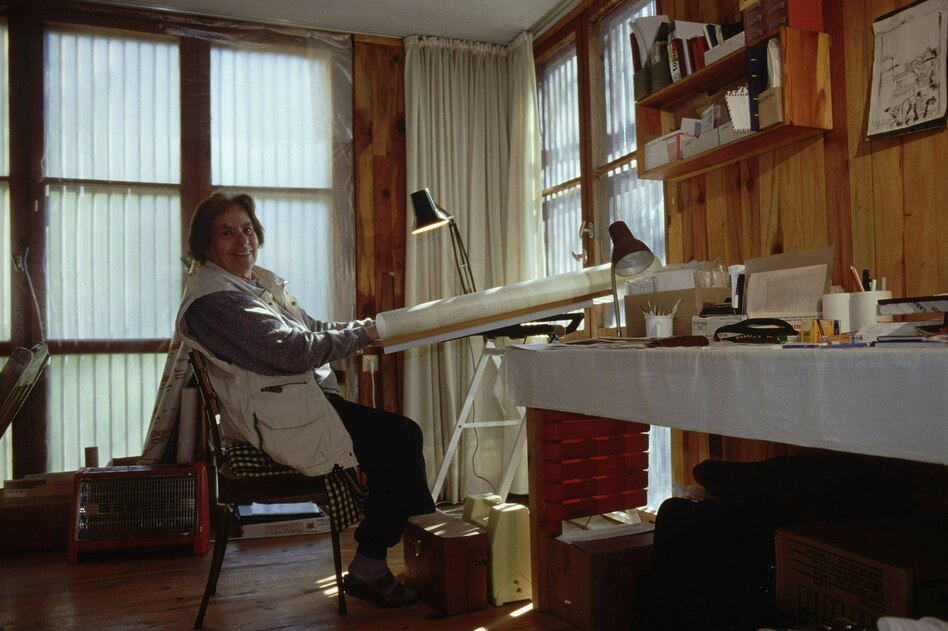
When Halet Çambel died in Istanbul in 2014, a long, eventful life lay behind her. Born in Berlin in 1916, Çambel became a pioneer of archeology in her 97 years of life and significantly advanced research into the early history of Türkiye.
She also writes sports history. She fenced and competed at the 1936 Olympic Games in Berlin – the first Muslim athlete ever to do so. When she is supposed to meet Hitler on the sidelines of the tournament, she refuses out of political conviction.
It is life stories like that of Halet Çambel that the scientist and curator Gülşah Stapel collects in Berlin. “There are an incredible number of interconnections between Germany and Turkey, some of them centuries-old, which go far beyond labor migration from the 1960s onwards,” says Stapel.
In order to represent these and take a new perspective on Turkish-German migration biographies, the 43-year-old founded the “TAM Museum” together with the scenographer Müge Avar and more than 100 supporters. “Tam” means “completely”, “just so” or “just right” in Turkish.
The museum doesn't yet exist as a location - it should be in 2028 - but Stapel and her colleagues are already researching and collecting. "We don't want to serve preconceived ideas. We want to discover stories and not just select them to explain something predetermined," says Stapel, describing their approach.
They also organize their first exhibitions. Parts from the latest, “Motherland”, can be seen in the Red Town Hall for two weeks from Friday – on the 65th anniversary of the recruitment agreement between the Federal Republic of Germany and Turkey.
The agreement, which was signed on October 30, 1961, still shapes both countries today. As a result, almost 900,000 people came to Germany from Turkey, including more than 80,000 to West Berlin. Many returned later. But many also stayed.
Today more than 200,000 people with migration ties to Türkiye live in Berlin. The parents of TAM founder Gülşah Stapel also came to Germany as so-called guest workers, the father in 1968, the mother in 1982. “I am what you call the second generation,” she says about herself. But for years she “kept anything Turkish away from her” – also out of fear of discrimination. It was only during her studies that she began to think about her migration biography.
“It became clear to me that labor migration is always preceded by a long history,” says Stapel. That's why she considers the rigid focus on the arrival of guest workers from the 1960s onwards - like now, around the anniversary - to be too narrow and speaks of a "big bang narrative": This makes it seem as if there were no connections between Germany and Turkey before the recruitment agreement, as if it were almost exclusively male, uneducated migrants who came from Turkey.
There is so much to say that breaks this reading. For example by Rebia Tevfik Başokçu. The fashion designer lived in Berlin in the 1920s, where she founded a fashion salon, was one of the city's famous seamstresses and also received orders from opera houses.
"Başokçu had a difficult time as an unmarried woman. She was defamed as a prostitute," says Stapel. But after a failed marriage, she had given up men and only had dogs. One of them, the Chow Chow “Didon”, is even said to have won dog shows in Berlin. At the beginning of the 1930s, Başokçu returned to Istanbul. “There were hardly any traces left in Berlin, hardly any memories,” complains Stapel.
Or the story of the 300 Ottoman orphans who come to Berlin in 1917, in the middle of the First World War, as part of an educational program. The Ottoman state hoped to attract qualified specialists through training based on the German model, while the German Empire, in turn, wanted to expand its influence on the Ottoman Empire.
The young people were initially accommodated at the primary school on Koppenplatz in what is now the Mitte district. They were later distributed to apprenticeships across the country. “Shouldn’t these actually be the first generation of guest workers?” asks Gülşah Stapel ironically.
According to this reading, labor migration from Turkey would not be a purely West German phenomenon. For example, one of the orphan boys, the then 16-year-old Ahmed Talib, became a master shoemaker in Fürstenwalde in Brandenburg. He experiences the Empire, the Weimar Republic, the Nazi era - and the GDR. He starts a family and raises his son to speak German in order to save him from exclusion. In 1961, after 44 years, Talib was naturalized in the GDR.
“We love stories that connect everything,” says Gülşah Stapel. Because these would challenge dominant narratives surrounding Turkey and Germany. And there would be enough of it: enough scientific and historical material to create a museum.
Stapel dreams of the TAM Museum as a “cultural center and meeting place”, in the middle of the city, not on an island, not in a villa. It should be hospitable, with a large, open kitchen in the foyer. “When it comes to encounters and stories, I need food.”
But there is a long way to go until then. Stapel and her team are looking for a private foundation to remain independent. They scraped together the capital needed to found the non-profit GmbH from their circle of friends and acquaintances. In the long term, she does not want to be dependent on government funding. "If we want to do something innovative, we can't only apply for public funding. That totally paralyzes us and throws us into structures that we actually want to change," says Stapel.
Historical and scientific work is already underway at the same time. Stapel and her colleagues are currently conducting conversations with contemporary witnesses about Turkish-German connections in Berlin - with as diverse a perspective as possible: Kurdish, Armenian, Jewish, Turkish. The interviews will ultimately be incorporated into a large oral history archive at the Free University of Berlin.
To this end, Stapel, Avar and their colleagues open the doors of their project space in Schöneberg every week. There is Çay, here they want to talk to Berliners. “It’s impossible not to have a connection to Türkiye, even if it’s just the shop on the corner,” says Stapel.
She says she has heard some surprising and touching stories. An 86-year-old woman who lives in Friedenau told her family story. Her ancestor was the watchmaker Johann Meyer, who trained in Berlin. He moved to Constantinople, now Istanbul, in 1876. There he became the official clockmaker at the Sultan's court, repairing and making clocks for the entire palace: the ruling family, generals, officials, ministers.
After two years, in 1878, he opened the “Meyer Clock Workshop” in the middle of the city. His children and grandchildren continued the business for a long time. It still exists today under the name “Meyer Objects”. Hanno Fleckenstein