
Housing taz
General strike in Spain: For affordable housing and better wages
After weeks of demonstrations for more tenant protection, the general strike follows. Strike leader Guillermo Dimarco explains what he hopes to achieve. more...
Deutsch (original) ·Auto-translated to English
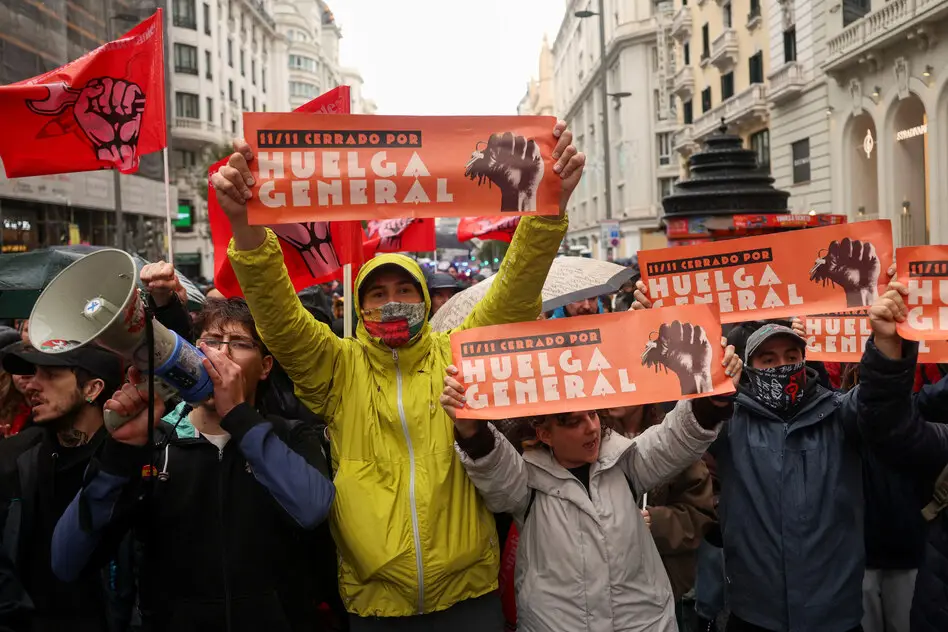
The few dozen trade unionists and activists who have gathered at the district branch of Spain's largest trade union, CCOO, in the town of Collado Villalba look tired but nevertheless satisfied. A long night lies behind them. “From zero o'clock we went around the town, sticking up posters and stickers,” says one of them, Guillermo Dimarco. The content: a call for a general strike on Wednesday.
The activists and trade unionists who came together on Wednesday night are demanding affordable housing and higher wages. The high rents mean that many people cannot make ends meet on their wages, says Dimarco, 32 years old, a museum guard by profession. His pink vest has the words “Assembly for Housing” emblazoned on it.
“The problem of high rents and housing prices no longer just affects the big cities,” he says. His town of Collado Villalba, located around forty kilometers northwest of the capital Madrid, has around 67,000 inhabitants. Month after month there is talk of new maximum prices per square meter, says Dimarco. The average is now 14.02 euros - twice as much as in 2007. More and more people are unable to keep up.
So now the reaction: the general strike in Collado Villalba, and throughout the country. It is the first in Spain in 14 years. The initiative did not come from the country's major unions, but from the tenants' union. They called for demonstrations after the eviction of an 87-year-old pensioner in Madrid, set up protest camps across the country and finally persuaded the CCOO and UGT unions to declare a general strike.
Strike committees like the one in Collado Villalba, of which Guillermo Dimarco is a member, emerged from unions and social movements - there are 1,340 across the country. They mobilized in villages and districts, distributed over four million leaflets and pasted up 600,000 posters.
The call is having an effect. In the industrial area of Collado Villalba, for example, it is much quieter than usual. In the center of the town, where the bus routes cross into the surrounding towns, there are only a few people to be found during the morning rush hour. It looks the same in Madrid. Schools and universities remained almost empty. According to the city administration, the few buses and subways that have to run as a “minimum service” only carried half as many passengers as usual. Car traffic also fell. In addition, several access roads were blocked by pickets.
The unions report high participation, especially from industry. For example, the meat processing plants in the center of Spain, as well as Seat and Volkswagen in the north of the country, were completely at a standstill, as were the ports on the Atlantic and Mediterranean. In Andalusia, southern Spain, the regional television screen remained black; other stations, with the exception of the news, broadcast emergency programs with archive material, including the state broadcaster.
For Dimarco and the others here at the Collado Villalba union hall, the day is far from over. Around midday, hundreds of them marched from the industrial area to the town center. “Tonight we’re going to Madrid for the central rally,” says Dimarco. Tens of thousands are expected there.
The issue of housing is one of the central social problems in Spain. A few weeks ago, the government tried to improve tenancy law in view of the protests that began at the time and failed because of the right-wing opposition. The left-wing head of government Pedro Sánchez then called new elections for November 29, 2026.
According to most surveys, the conservative Partido Popular and the right-wing extremist Vox have hope for a change of government. They see the government's long hand behind the protests - and insult the strikers as "mafia" and "union trash".
Dimarco firmly believes that the strike will finally bring the issue of housing to the center of the political debate. He is combative about a possible right-wing government: “No matter what happens, they should at least find us well organized.”