
World taz
General strike in France: they hope this is just the beginning
There were strikes in 207 cities in France. On the road with the teacher and chairman of the Nara Cladera education union. more...
Deutsch (original) ·Auto-translated to English
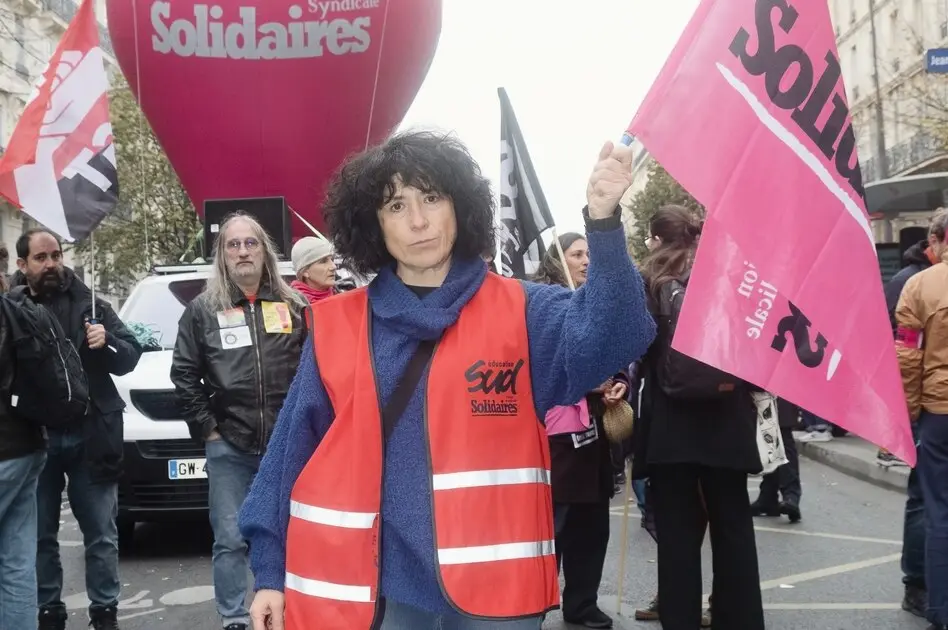
The students are at the front, of course, says Nara Cladera. Then the union bosses, of course. “And then we’ll come.” The teachers. They also want to be at the forefront of the biggest demonstration in France in years. It all started at the schools. “And then comes Planète Boum Boum.” Planet Boom Boom? “How do you explain that now?” Cladera asks her colleague, who is standing next to her on Thursday morning in the garage of the trade union building in the 10th district of Paris, loading leaflets into a van. “Techno-demo collective,” is the answer.
Cladera, 57, is a primary school teacher and one of the chairmen of the education union SUD éducation. She works south of Paris, in the Val-de-Marne department. There is the suburb of Créteil, where the major education protests began in mid-September.
Prime Minister Sébastien Lecornu wants to save around 10 percent of the government budget in 2027. 1,800 teaching positions are to be eliminated; 4,000 had already been eliminated in 2026. When the austerity plans became known, teachers at the Lycée Antoine-de-Saint-Exupéry in Créteil first protested against a lack of staff and unfilled positions. Her students joined in. “And it just kept going from there,” Cladera says. “It spread like a drop of oil falling into water.”
This text first appeared in wochentaz, our weekly newspaper from the left!
Every week, wochentaz is about the world as it is – and as it could be. A left-wing weekly newspaper with a voice, attitude and the special taz view of the world. New every Saturday at the kiosk and of course by subscription.
Since then there have been nationwide protests seven times. Virtually all unions in the country have called for a strike on November 5th.
Cladera gets into the driver's seat and a colleague sits next to her. Traffic is backed up outside. Many commuters have switched to cars, and around half of the regional trains are canceled due to the strike. “That’s something,” says Cladera. She drives the van through the north-east of Paris.
“The pressure,” says her colleague, “has upset many students.” High school students spend 37 hours a week at school and the prospects of getting a place at university are completely uncertain. Cladera's colleague says that 15 to 20 percent of her students are depressed.
Now they have arrived at Place de la République, where the demonstration is supposed to start. “They still haven’t blocked traffic, that can’t be true,” says Cladera. She parks the van in the lane.
It is also the repression that drives students onto the streets, she says. “The police attacked them right in front of the schools, firing tear gas at them.” Intimidation to stifle mobilization. "But they achieved the opposite. This is going to be big today."
On Wednesday, the National Assembly voted on Macron's draft budget: 458 MPs voted against and 0 for, although Macron's group has 90 MPs. However, the constitution allows him to draw up the budget without parliamentary approval. Macron has been doing this every year since 2022. If the unions have their way, the first day of the general strike should only be the beginning of a long wave of protests.
The union men around Cladera inflate large balloons and tie them to the roof of the transporter. The daily newspaper Le Parisien is available in the surrounding cafés. “The list of the 200 most run-down high schools in France” is the cover story. Stewards put on bandages and the street fills up. Sophie Binet, head of the CGT union, thanks everyone who took to the streets despite the police violence of the past few weeks. “The question is not whether we will win, but how much,” says Binet.
But since 1990, French industry has lost a third of its jobs. Chinese carmakers are taking over French factories that are no longer needed to build electric cars - with a fraction of the previous workforce. Only around two million French people are union members, less than eight percent of employees. Unlike in Germany, the role of the trade unions in France is primarily to put social policy pressure on the state. But today he is more in debt than ever before. It was almost 116 percent of economic output in 2025, 3.5 times as much as in 1990.
When the Social Democratic presidential candidate Raphaël Glucksmann took the lead in the demonstration, he was booed. He “doesn’t care at all whether activists don’t like my presence,” he tells reporters – but then leaves. On the other hand, the left-wing populist and EU skeptic Jean-Luc Mélenchon is applauded. There are posters everywhere for the party La France insoumise (LFI, Indomitable France), which he leads hierarchically. Young women carry signs: “LFI instead of LBD”. LBD are the rubber bullet guns the police have used to injure student demonstrators in recent weeks. The left-wing author Didier Eribon has his photo taken with Mélenchon in a street café and proudly posts the photo.
Firefighters in uniform are on the street, wrapped in French flags like a coat. Others carry the flags across their chests like mayors. An old woman holds up a sign: “Finally be 17 again.” Students hold placards: “More teachers, fewer fascists.” Palestine is omnipresent: “Fund schools, not genocide.” A man has set up a stand selling French flags, Palestinian flags and Kufijas for 10 euros. Many people refer to previous elections on their signs: Hungary, Serbia, Israel, Brazil, USA; they are hoping for the vibe shift, an anti-populist global change of mood that will also reach France and keep Marine Le Pen out of power next spring.
An anarchist bloc does not follow the marching order. He stands in front of the front row. Deep black, masked, fists up. A huge banner: “We will only have what we know how to take”. The photographers look at it as if they had discovered a rare animal. After a few minutes, hundreds of police arrive. Without warning, they storm into the block, beat the demonstrators, tear down the banner with the outrageous looting propaganda and drag some people dressed in black away.
Cladera wants to drive off, but the transporter won't move. Tens of thousands flock to Boulevard Voltaire from all directions and move like a moving carpet to the Place de la Nation. It takes more than two hours until the cars that were supposed to drive at the front of the demonstration can start moving.
It’s “about the redistribution of wealth, about social justice,” says Cladera. “The students are already saying: We see that our parents don’t have enough money until the end of the month.”
On Thursday it became clear how great the influence of the unions still is. The CGT reported in the evening that a total of 1.6 million people came to the demonstrations in 207 cities. There were 350,000 in Paris alone. The Interior Ministry speaks of 600,000 nationwide, and it remained peaceful almost everywhere. The frustration with the neoliberal and authoritarian Macron, the fear of a President Le Pen, the anger of the youth over the poor education – many hope that the interlinking of the student and social protests will trigger a new political dynamic and that the trade unions may play a key role.
In any case, the teachers at SUD éducation know what the young people want to hear. The Planète-Boum-Boum collective they invited delivers, playing their fairground techno version of the Soviet hit “Katyusha,” with “All we want is a general strike” as the refrain. With burning Bengalos, the block moves to the Place de la Nation in the evening.
“We hope that today is just the beginning,” says Cladera. “The government is nervous, we must not give in,” writes the SUD in the evening. We'll see what that means exactly, says Cladera. It is always “a mystery how such political dynamics continue.”