
Germany · taz · · 2h
General renovations on the rails: Deutsche Bahn's construction plans are delayed by years
Deutsch (original) · Auto-translated to English
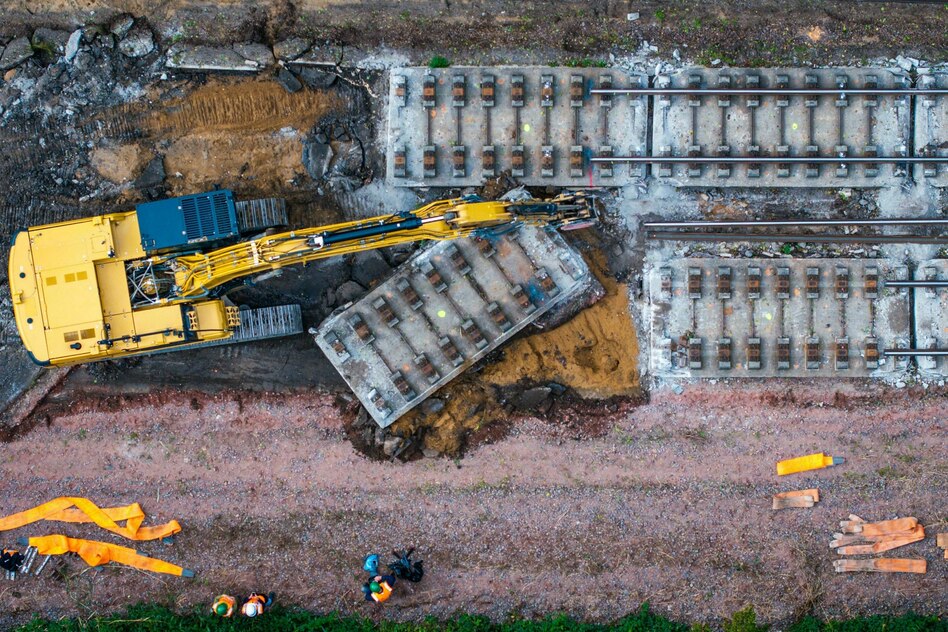
dpa | Deutsche Bahn is falling behind its punctuality targets, and the main reason for this, in the company's opinion, is the dilapidated infrastructure. Now it is clear: the network, which is dilapidated in many places, will probably slow down trains in Germany for much longer than initially thought. According to railway boss Evelyn Palla, the general renovation of important routes will take longer.
A revision of the concept showed that four such renovations per year were too many, Palla told journalists in Berlin. In the future, she expects two, or if there are special technical requirements, three general renovations per year. The revised concept is currently being coordinated with the Federal Ministry of Transport and should be presented soon. Palla did not want to give exact dates.
The railway began general renovations between Mannheim and Frankfurt (Riedbahn) in the second half of 2024. The concept essentially envisaged complete closures lasting several months so that renovations did not have to be carried out during ongoing operations.
Around 40 routes were selected for the general renovation. The original goal was to complete all of these renovations in the early 2030s. Most recently there was talk of 2036. After the concept has been revised, it may be that the renovations can no longer be completed within the 2030s.
As reasons for the adjustment, Palla cited experiences from the first major construction sites as well as the question of how much money in total the federal government's special fund will be available for all general renovations. “We will adjust the number of corridor renovations per year to the financing volume,” said Palla. In addition, it has recently become clear that four major renovations have reduced capacity across the entire network too much.
In addition to the Riedbahn, the Emmerich-Oberhausen, Hamburg-Berlin, Hagen-Wuppertal-Cologne and Nuremberg-Regensburg lines were completely renovated. Construction work is currently underway on the Obertraubling-Passau and Troisdorf-Wiesbaden connections. Work between Berlin and Hanover (Berlin–Lehrte) will also start in October.
There have been delays in previous renovations in some cases and the construction volume also had to be reduced. After the reopenings, there were sometimes a lot of disruptions. On a route in North Rhine-Westphalia it was only after renovation that it became apparent that a bridge was dilapidated and could no longer be used with full load.
There is essentially no alternative to the concept in the industry because the infrastructure has not been adequately maintained for decades and on some routes only a radical renovation with full closure will help. The problems with the first general renovations also led to a lot of criticism. The Association of Private Freight Railways is particularly annoyed by lengthy detours for freight transport, while the Allianz Pro Schiene interest group repeatedly complains about broken promises regarding construction volumes.
“The corridor renovations with full closures lasting several months must not become a permanent situation,” said Managing Director Dirk Flege about the DB’s new plans. "The renovation backlog must be resolved by the end of the next decade. In this respect, the schedule cannot be extended arbitrarily."
Palla announced that after fundamental renovations, routes will not be put back into operation at full load from one day to the next. One learned from the Hamburg-Berlin renovation, for example, “that there is no deadline on which we open the route and then everything works like clockwork.” After a fundamental renovation, a so-called ramp-up phase is required.
It is also important that the so-called diversion routes are adequately upgraded to accommodate significantly more traffic at times before a general renovation begins. An example here is the corridor renovation between Berlin and Hanover: Because a parallel route could not be electrified in time, passengers have to accept a detour with 80 minutes more travel time between Berlin and Hanover for 14 months.
“It’s also about the topic of what specific performance promise we want to make,” said Palla. "What condition rating do we want to achieve? What freedom of construction do we guarantee? That will be different because we don't always do the same thing," said the railway boss. When renovating the infrastructure, it is important overall to bring the areas of construction and driving into better balance in the future.
The South Tyrolean has been running the railway company for almost a year. In addition to renovating the infrastructure, she has identified three other key topics for the next few months: safety at stations and on trains, corporate restructuring and a new approach to long-distance transport. This should become “the flagship of Deutsche Bahn” again.
“We want to take the ICE product to a new level,” said Palla. She didn't want to reveal any details, but it wasn't about cleaner trains or a functioning interior. “It’s about the customer experience, about the ICE product itself.” They looked at many concepts in other countries and asked the question: "What could work in Germany? What do we like and what don't we like?" said Palla. The exact plan will be presented in the coming weeks.
Read the full story at the source →
Source: taz