
Politics · taz · · 1h
General debate in the Bundestag: Hyperaggressive vs. helpless
Deutsch (original) · Auto-translated to English
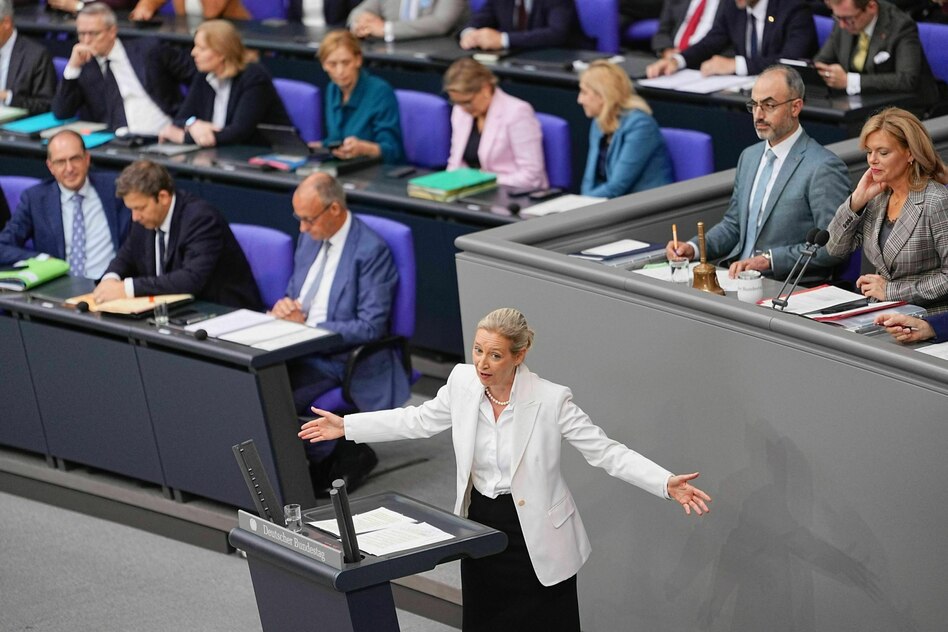
Alice Weidel often ended her speeches in the Bundestag with a rhetorical offer to the Union. The AfD is open to black and blue, to cooperation with the Union. This almost ritualistic appeal was missing on Wednesday: “Your time is up anyway,” Weidel says triumphantly to Chancellor Friedrich Merz.
The AfD faction is temporarily out of control this morning, hooting and hollering. As Merz speaks, the roaring from the right increases. Bundestag President Julia Klöckner warned the AfD twice. And then says to the AfD faction: "We're not on the football field here right now. If that happens again, I'll throw you out of here."
“I'll throw you out” is a choice of words that is more suitable for a football field than for the Bundestag presidency. And not necessarily to the referee either. If they go low, we go high? Klöckner allows himself, at least for a moment, to be infected by the AfD's insults. This moment is characteristic of this general debate. The AfD is hyper-aggressive – and determines the dramaturgy.
The national bankruptcy has already happened, the car industry is dying, only the “asylum industry” is growing, says Weidel. Migration means “sexual crimes, gang rape, violence in schools, neglect”. The federal government feeds “hatred of Germans and Christians” and squanders the money on NGOs and development aid, criminal Syrians and the EU. “We want our money back,” she shouts.
So Weidel gives her usual Germany-is-going-under speech. AfD man Ulrich Siegmund sounded positive and forward-looking during the election campaign in Saxony-Anhalt. Everything is as usual for the AfD leader.
Appearance of the Federal Chancellor. Merz attacks the AfD. With the remigration they are planning “an ethnic cleansing based on origin and skin color”, after which no restaurant, no nursing home or hospital would no longer function in Germany. We also heard “not a word” from the AfD about the Russian attack in Leipzig, and “not a word” about the forest fires caused by man-made climate change, which the AfD denies.
Fair enough. But it is unusual for the Chancellor to criticize the opposition so extensively in the general debate. This shows who is setting the pace in Saxony-Anhalt after the turning point.
56 percent, says Merz, did not vote for the AfD in Saxony-Anhalt. They missed their goal, the absolute majority. That's a pretty pink interpretation of the debacle in Magdeburg. What this note actually means remains unclear. Does Merz want the CDU in Magdeburg to set up a non-partisan Prime Minister together with the BSW and the Left Party?
Merz is the best rhetorician in the Union, perhaps in parliament. On Wednesday he appears in an unusual role - a man who, after a defeat, is slightly contrite and looks for faults in himself. The reforms in health, pensions and care are more than “economics textbooks and mathematics”. There is probably a lack of a “narrative” for these reforms. He is doing all this for the future of the younger people.
After an election defeat, publicly reflecting on the fact that you might need a convincing narrative for the government's central project is rather suboptimal in terms of communication. In Saxony-Anhalt, 42 percent of younger people voted for the AfD and 5 percent for the CDU.
In fact, the Chancellor says nothing new. He suggests that one can talk about a pension without deductions after 45 years of employment. At the exam in Neuhardenberg, Merz still sounded relentless. It remains to be seen whether the Chancellor wants longer transition periods for retirement at 63 or a generous new rule.
So far there has been a kind of unspoken consensus from the Union faction to the Left Party. The AfD's often racist provocations are only briefly discussed in order not to reward the right-wing extremists with attention.
Things are different after the election in Saxony-Anhalt. The leader of the Green Party, Katharina Dröge, accuses the right of inciting anger. Union faction leader Thorsten Frei accuses them of merely stirring up outrage and destroying jobs by leaving the EU. SPD parliamentary group leader Matthias Miersch recommends Alice Weidel to “look in the mirror” if she wants to see hatred. Then Miersch reaches into his jacket at the lectern, takes out the Basic Law with black, red and gold colors and holds it up towards the AfD faction. “The best recipe against their politics is the constitution,” he says. For her part, AfD politician Beatrix von Storch (AfD) pulls out the Basic Law and holds it towards the lectern. The more the AfD comes into focus, the more theatrical it becomes.
The Left Party is rolling out its program rather unimpressed by the AfD victory. As usual, parliamentary group leader Heidi Reichinnek attacks the Chancellor with vigor. There is money for armaments and the super-rich, but cuts are being made for parents, children and the poor.
There are also thoughtful tones. Tim Klüssendorf, SPD general secretary, warns not to return to the agenda after the AfD's success. Catalogs of measures are not a useful answer to the unleashing of feelings that the AfD is currently succeeding in. That also sounds perplexing, but it asks the right question.
Read the full story at the source →
Source: taz