
Germany · taz · · 3h
Refugees in Ceuta: the smell of urine, people as commodities and desperation
Deutsch (original) · Auto-translated to English
The angry citizens are elegantly dressed, but their language is not. A lady in a trouser suit runs out of the rally towards the convoy of Spain's Interior Minister Fernando Grande-Marlaska. “Hijo de puta,” “son of a bitch,” she yells at the window as the car drives past her. Then the whole crowd starts, cursing, insulting, whistling for minutes, even as Grande-Marlaska, protected by the Guardia Civil, has long since disappeared inside the government representation building in Ceuta.
Inside, Grande-Marlaska tells the journalists how many millions the EU should now pay to help Spain deal with the situation in the exclave, how many “processing lines” should be created for screening migrants and processing possible asylum applications. And that the feeling of insecurity among the people in Ceuta is “subjective” because crime in the Spanish exclave has been decreasing for years.
But the mood is explosive when Grande-Marlaska visits Ceuta on Tuesday, the 41st day after the big border breakthrough. 72,000 people are said to have come at the end of July, and according to official information, over 5,000 of them are still in the city. Aid organizations estimate the number to be at least 10,000, which seems realistic. Most are young Moroccans.
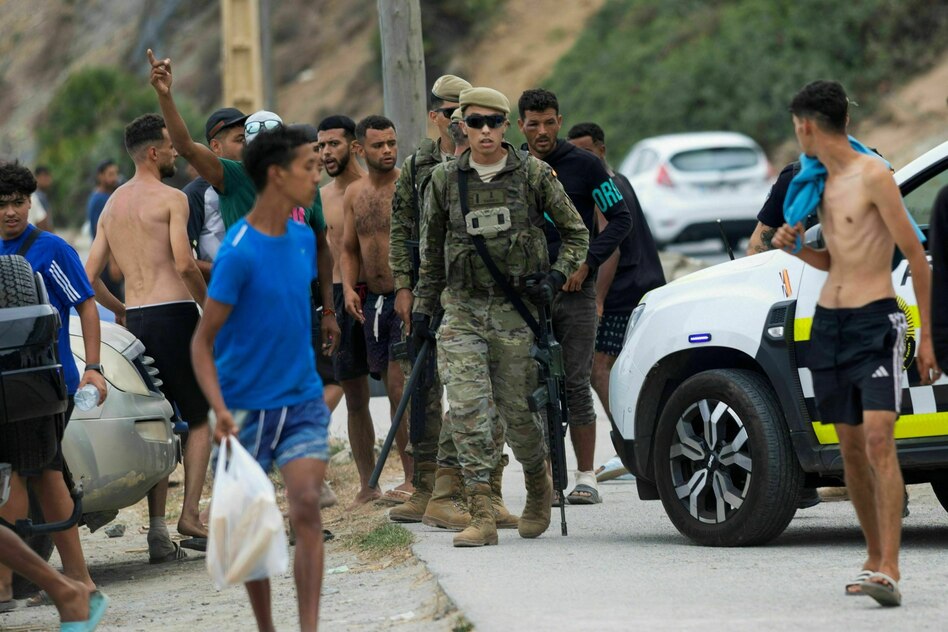
The Civil Guard and the military are everywhere in Ceuta, they keep the migrants away from the city center and are stationed in front of the supermarkets. The demonstrating locals want the government to change migration law via an “urgent application in 24 hours” so that they can deport migrants immediately, without examination. However, the government wants to first examine possible claims for protection, as legally required. But that will take time.
Many of the migrants live along the so-called trampoline beach west of the city center. Thousands of people have made makeshift arrangements on a narrow strip between the water and the road. Karim, in his mid-thirties, from Algeria, lies in front of a green igloo tent near the sidewalk. Next to him a group of men are playing cards, others are watching the soldiers walking down the street with large clubs in their hands.
“It’s all very complicated,” he says, sitting up. In Algeria he had a tobacco shop, but also had “big problems” and there was “no security” in Africa. He wanted to go to Spain via Tangier when he read on Facebook at the end of July that the border was now open. He is a good swimmer, but he can still hear the screams of the children who went into the water with the crowd that day and couldn't swim. “‘Help me, help me,’ but we couldn’t do anything,” says Karim. “We all saw them drown.” He believes there were far more deaths than the 82 officially stated.
Most people soon returned to Morocco. There was no violence from the Spanish soldiers. “Because of hunger,” says Karim. He has that too now. He has been on the beach for 41 days now, there is nothing except the plastic bags with bread, bananas and water that the Red Cross distributes every evening. He had to wait in line for three to four hours. He has his jogger phone case strapped to his upper arm, but it's empty. Locals collect cell phones on the beach and charge them. A half-charged battery costs 1 euro, a fully charged one costs 2 euros. Anyone who wants to go to the supermarket has to show the soldiers a visa at the door; anyone who doesn't have one won't be allowed in. “Apartheid like in South Africa,” says Karim.
The police would “sometimes leave them alone, sometimes attack them as they see fit,” he says. Many of the men here are now sick. “It’s a disaster.” The government has set up a reception center for minors and families in a completely run-down industrial area in the shadow of the border fence. Things don't look much better there than on the beach. People have built shelters on the streets there using blankets, old furniture and tarpaulins. The sun heats up the concrete and hot clouds of urine stench rise. Some of the migrants have set up small stands with boxes, some sell cookies.
At midday, Grande-Marlaska visits the makeshift camp inside two halls, which offers around 400 places. Here he is greeted not with curses but with applause. People hope that the government will take them to the mainland. Spanish television later cuts the images of the migrants' applause directly together with those of the demonstrating locals' outburst of anger. There is always violence in Ceuta. The rumors are running high. The school year began on Tuesday and it was said that the migrants were forcing their way into schools, occupying sports halls, there was rape and the children could not go to school. The government rejected this.
Migrants tell of attacks by soldiers and the local police, who are often of Moroccan origin. Some describe how their cell phones were confiscated and destroyed. Others report that motorcyclists often deliberately drive at high speeds through the crowds on the beach. Mayor Juan Jesús Vivas, in office since 2001, speaks in official statements of the “darkest hour in the history of the city” and an “invasion”. This is now the official language in the city. The situation is linked to the existence of the exclave as a Spanish territory.
All over the city, people wear black T-shirts with the inscription “Una caballa no se rinde”, loosely translated to mean that a Ceutí never gives up. In many restaurants, the entire staff wears these shirts. There are also banners hanging on the houses saying that Ceuta is “not being sold”. It is assumed that Morocco is sending the migrants to chaotize the situation so much that Spain will withdraw. The right-wing extremists are fueling this fear with all their might. There are posters everywhere thanking Ceuta for “uniting the Spanish people” - in the fight against migrants, Islam, the left-wing head of government Pedro Sánchez and the expansive Moroccan desire to take over the two exclaves of Ceuta and Melilla.
The tent camp on a wasteland at the harbor behind the Mercedes car dealership should be ready in the coming days. The people are to be relocated there for the duration of the asylum check. According to the government in Madrid, everything should be sorted out “in a few weeks.” The city government is strictly against the camp. But the government definitely doesn't want to bring people to the mainland. According to the new EU asylum pact Geas, she is obliged to carry out the screening in a “suitable and appropriate location” - which she has not yet considered necessary to set up.
The Algerian Karim reports on the beach that he went to the local police station three times to register for an asylum application and was sent away three times. "They don't want to register us, there are too many of us. They say I should get a lawyer." If he could get a visa, he would like to live in Spain and work as a driver there, he says. But the visa is "for the rich who can pay a lawyer. This is for the poor," he says, nodding towards the beach. He likes the fact that the government now wants to bring people into the tent camp. “It can only be better there than here.”
The people here are a business, says Karim. He believes that Morocco definitely opened the border to put pressure on Spain. “The soldiers didn’t hinder us, they helped us.” The door was opened on purpose. “We are a commodity between states, Morocco is blackmailing Spain with us.” And the Europeans gave up on them. But he won't go back. “I can’t,” he says. “I just need a lawyer.”
Read the full story at the source →
Source: taz