
Germany · taz · · 2h
Compulsory memorials in Hamburg: Prescribed anti-fascism
Deutsch (original) · Auto-translated to English
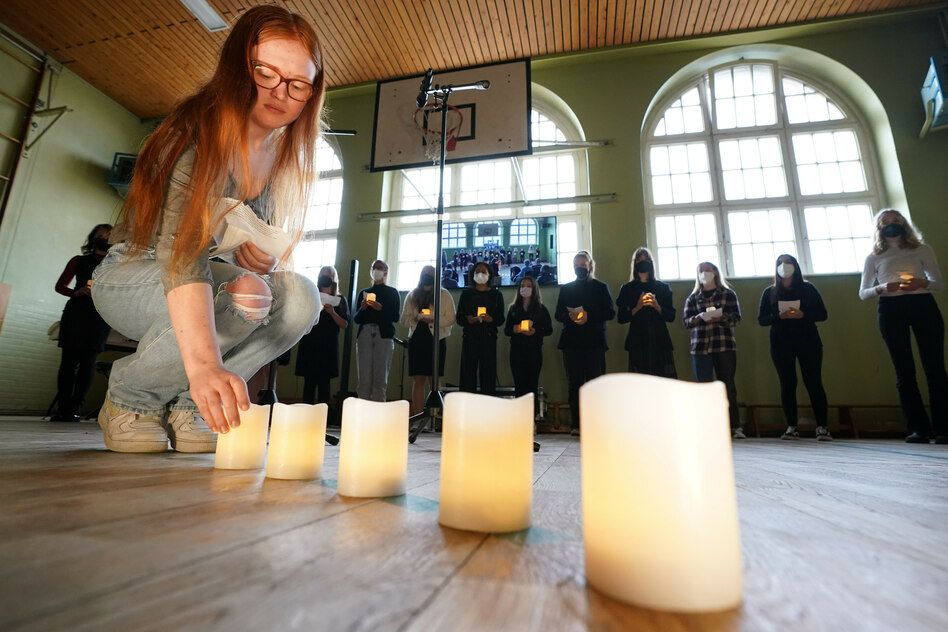
“Here you stand in silence,” it says on a central stone tablet in the memorial for the children of Bullenhuser Damm, “but when you turn, don’t be silent.” Hamburg Nazi memorials like this one, which commemorates the 20 children murdered in April 1945, are likely to receive more visitors soon. School Senator Ksenija Bekeris (SPD) is making good on her announcement to make visiting such a place compulsory for all Hamburg students.
It remains to be seen what the status of standing in silence will be like. In fact, those responsible at most German memorial sites have so far been rather skeptical when it comes to the question of mandatory visits. This is also why most federal states stick to a recommendation with varying degrees of emphasis. Only Bavaria and Saarland rely on the obligation - and now Hamburg too.
Bekeris had already announced this regulation in January 2025, on the occasion of the awarding of the Bertini Prize, which young Hamburg residents receive for particularly solidarity-based behavior. The red-green coalition agreement later incorporated this project - as well as the goal of training young people "to recognize anti-Semitic conspiracy narratives", "particularly on social media".
In addition to setting the content, there was also the prospect of more money for appropriate measures and further training for teachers. Hamburg's anti-Semitism commissioner, Anna von Villiez, who ran an educational and memorial center herself with the Israelite Girls' School, is also on board and announced more external specialists in the classroom.
You really can't blame the Hamburg initiative for the fact that this is just a matter of pushing children en masse through memorial sites and leaving it at that. It can hardly be denied that the state of remembrance policy and anti-Semitism prevention can be improved.
To give just one example: The so-called Multidimensional Memory Monitor (MEMO) at Bielefeld University shows dramatic developments. In this representative series of studies, almost 40 percent of those surveyed said that it was time to draw a line under the Nazi era. And perhaps even more dramatic: More than a quarter of those surveyed were of the opinion that Jews used the memory of the Holocaust for their personal gain.
It is precisely here, where it really counts, that the obligation to visit reaches its limits. Anyone who wants to go on a class trip to the Neuengamme concentration camp memorial as a teacher today will receive a warning in advance: the facility's capacities and didactic concept are not designed to educate right-wing extremist, racist, anti-Semitic or otherwise politically conspicuous young people. This also expressly applies to “problematic attitudes towards the current situation in the Middle East since October 7, 2023”. Anyone who works with such young people should not bring them to the memorial, but rather contact the mobile counseling teams against the right, dropout programs, the Amadeo Antonio Foundation or similar.
Again: The new compulsion is about sending a political signal, for which there is a lot to be said for it. It's about the high priority that is given to the critical communication of Nazi history and the educational work against a new fascism. But with this right approach it will soon stop again. The obvious debate about “remembrance by force”, which comes up every year when appropriate measures are discussed, confuses two very different things. Because when it comes to children, this coercion is neither new nor unusual in any way. Visiting a memorial has never been voluntary as long as it was held as a school event - no more or less than the Christmas Bazaar, the Summer Festival or the Federal Youth Games.
However, the obligation in the sense of Bekeris and the coalition agreement means something completely different: that of schools to offer such visits at all. And that's exactly where it gets exciting. Not just because an unmotivated, forced teacher probably causes a lot more damage than a whole group of unruly teenagers. What is much more problematic is that committed and informed teachers are deprived of the opportunity to assess whether a memorial excursion is the method of choice for their specific students.
And memorials are also something more than “extracurricular learning places,” as the Hamburg coalition agreement states, for example. Some are cemeteries, sacred places for survivors and posterity. The survivors themselves chose “Earth conceal not the blood shed on thee” as their inscription in Bergen-Belsen. This is Job's blatant complaint of pain, not some pedagogical device. There are also such sacred moments in Hamburg, in Neuengamme, such as on the large stele: “Your suffering, your struggle and your death should not be in vain.”
What is important in this context is that not all memorials are the same. Many of the memorial sites known today were actually created in didactic contexts in the 1980s and 1990s. And soon afterwards they began to develop concepts for the time after the contemporary witnesses, especially with children and young people in mind. And today it is finally coming to an end: According to surveys by the Jewish Claims Conference, around 196,600 Holocaust survivors with an average age of 87 years still live: a little more than half of them in Israel, around five percent in Germany.
If the obligatory visit to Hamburg leads to an upgrade and better financing of the memorial work, you can't complain about it. Even if the obligation in the chronically overloaded teaching world meant that democracy education was not the first to fall behind, that would of course be a positive effect. Just don't imagine that the problem of resurgent anti-Semitism, which has been growing for years, has been resolved. Coercion has its problems - and even where it may have something in its favor, it can only be a start.
Read the full story at the source
Source: taz