
Politics · taz · · 3h
Memorials in Saxony-Anhalt: Into the Blue
Deutsch (original) · Auto-translated to English
On the left side of the long, narrow hallway are the rooms that served as the murder site. On the wall on the right are explanations about what the Nazis did here in the Bernburg killing center, around 40 kilometers south of Magdeburg.
Judith Gebauer leads through the basement of what is now the Memorial for Victims of Nazi “Euthanasia” in Bernburg. It shows a tiled room: the gas chamber. Through a window set into the wall, the murderers were able to observe whether the killing using carbon monoxide was proceeding as planned. Behind it: the dissection room where doctors removed brains from those recently murdered. The following is the room in which there were two kilns in which the bodies were cremated. The Nazis decided whether someone was murdered based on “evaluating people based on their economic efficiency,” says Gebauer.
Margot Jungmann's prison number was 2681. Under these numbers she was initially imprisoned in the Ravensbrück concentration camp near Fürstenberg/Havel in Brandenburg from January 26, 1940. On a list of new arrivals, the Jungmanns' prison categories are “Jewish” and “racial defamation,” i.e. the relationship with an “Aryan” man.
Her 10-year-old son Manfred lived in the orphanage until he was deported and murdered in October 1942. Sometime between February and April of the same year, Margot Jungmann, née Lohmann, came from the Ravensbrück concentration camp to the Bernburg sanatorium and nursing home in Anhalt. The code word was “14f13”. The “f” stood for deaths and the “13” for the manner of death: gassing.
This is how Margot Jungmann died, her body was burned. She was 29 years old. She was one of around 4,000 to 5,000 concentration camp inmates who were killed in Bernburg - alongside almost 10,000 disabled people who the Nazis deemed "useless".
Nazi memorials like these are not mentioned in the AfD Saxony-Anhalt's election program. But there is, for example, this sentence: “By referring to the good sides of German history, we will promote a relaxed and healthy self-confident German identity.” The party also opposes “artificially maintaining a sense of guilt.” In the Bernburg constituency, the AfD received 50.2 percent of the second votes on September 6th.
The 41-year-old Gebauer says she notices the social role backwards, but less so in the memorial itself. There have hardly been any incidents during guided tours so far. Probably because Bernburg is not as well-known as the Buchenwald concentration camp, which serves as a stage for their productions for neo-Nazis and left-wing Israel haters. School classes from the 9th grade onwards and aspiring nursing staff come to Bernburg. She also says: “Anyone who comes here with a solid right-wing worldview will not change their ideas just because they have visited a memorial.”
If the party were to govern, it has announced that it will cut budgets and cut funding. The curricula in schools should also be changed and school trips to memorial sites canceled. “We’re all waiting now,” says Judith Gebauer. Everything is simply unclear. She says this in a way that is anything but presumptuous, without fear and with a will to resist. They networked with other memorial sites. There is an alliance for democracy. Of course, Bernburg is a rather conservative city, but there are committed people here, emphasizes Gebauer. “The demonstrations for diversity are perhaps a little smaller here than elsewhere. But in terms of the entire state, she says: “There is a majority that voted differently.”
The folder that Gebauer put together for the visitor contains information about the murders, but also postcards with inscriptions such as “Persecution yesterday – diversity today” or “Locked up yesterday – freedom of expression today”. The Saxony-Anhalt Memorial Foundation had material like this produced in Magdeburg. Seven such institutions operate under its roof, which not only, but mostly, commemorate the crimes of the National Socialists. Bernburg is also there.
Kai Langer, director of the foundation, takes a decidedly sober view of the situation. "Our current purpose of the foundation is to pass on knowledge of the crimes of the National Socialists and human rights violations under Soviet occupation and in the GDR. This could of course be changed if the majority in the state parliament changed," he explains. It would be entirely possible to commission the foundation to preserve so-called war memorials or to take the victims of Allied bombing into account. However, Langer sees this as a contribution to the gutting of their educational work; it would “spread historical revisionist narratives,” says the foundation director on the phone.
In the case of an AfD government, anything would be possible, even the dissolution of its organization. The board of trustees also has the opportunity to make personnel changes, said Langer. The managers receive permanent employment contracts. The director is elected for five years. "As such, I am an employee, not a civil servant. My appointment can be revoked 'for cause,'" he says.
The day after the state election, they held a video conference with all employees. Of course, fears came up.
Anett Gottschalk is not employed by the Magdeburg Foundation. She works on behalf of the Anhalt-Bitterfeld district. He explains in advance of a visit: "As a public institution, we generally do not take a position on political evaluations or assessments. We also refrain from further discussion of internal administrative and financing processes in an interview," it says. Is it already there, the ideological and political “neutrality” demanded by the right-wing extremists?
Gottschalk says she doesn't want to let her commitment be held back, especially not by any political group. The 39-year-old Judaizer runs the Gröbzig Synagogue Museum. It is a coincidence that the former Jewish church is still standing in the small town.
The once large Jewish community, explains Gottschalk, has continued to shrink as a result of rural exodus and industrialization. The ten men required to hold a Jewish service no longer met - and so the synagogue went to the local local history association in 1933 and was not burnt down in 1938, but had already been placed under monument protection as a local history museum.
The permanent exhibition in the former synagogue and its outbuildings is “their baby,” says Gottschalk, who helped design the new permanent exhibition and was able to open it in November 2024. Her team consists of only three people, including herself. Around 1,600 people visit the museum every year, around half of whom are schoolchildren.
Tours are possible here from the fourth grade onwards, although the Holocaust is left out for the children, but a lot is told about religion. “Write your name in Hebrew” is a task that is to be solved with a quill pen and causes smeared hands. The children sit on the small wooden benches in the former Jewish school in an annex to the synagogue.
Gottschalk's colleague Dorisz Macher says she hasn't noticed this at events with school classes. She tells us about a class that came to visit that morning. There was also a Muslim woman among the children: “The girl was super interested, asked how people pray and asked a lot of questions about Judaism.”
But unfortunately it is also part of everyday life that one or two children are reported sick before the school trip to the synagogue and there are certain doubts as to whether someone is really unwell. At the same time, Gottschalk observes that some teachers are becoming more active than before in view of political developments. This year the museum is already fully booked for school classes.
The exhibition presents the history of the Gröbzig Jews, as well as statistics on hatred of Jews - also in relation to today. The highlight of the show is the entry into the former synagogue, which was rebuilt in the 19th century, with the blue ceiling, chandeliers and a Torah scroll on the bimah, i.e. the place from which the Torah is read.
Gottschalk can tell a story about every piece exhibited in the house. The museum is a “matter of the heart,” says the woman, who is not Jewish herself. She moved to Gröbzig and praises her neighbors. She also takes care of a cadastre for the many orphaned Jewish cemeteries in Saxony-Anhalt.
In the Stadt Südliches Anhalt region, west of Bitterfeld, to which Gröbzig belongs, the AfD received 52.8 percent on September 6th. In the Gröbzig-Rathaus voting district there were 63.5 percent of the second votes.
When it comes to the future, Anett Gottschalk and her colleague are in a good mood. “I don’t want to be afraid,” says Gottschalk, “I want to hope.” Financially, the museum is largely dependent on the state, with additional money coming from the city and the district. If the students stopped coming, it would be a hard blow. “We will experience times that we will not like,” fears Gottschalk’s colleague Macher. But both also say: “You can change something.”
Köthen is around 15 kilometers from Gröbzig. Anett Gottschalk went with us to the Jewish cemetery far outside the city. Since the Holocaust, there is no longer a Jewish community in the small town, just as there is no longer a synagogue. All that remains are the graves in the cemetery established in 1884 and a small octagonal building. Once upon a time it was the mourning hall.
Around 25 years ago, Igor Pissetski from the State Association of Jewish Communities in Saxony-Anhalt was responsible for the 60 orphaned cemeteries that remained from the once rich life of the minority in the country. He still does this job to this day. At that time, the 68-year-old says on the way to the unusual octagonal building, he was shocked to discover that the mourning hall was on the verge of collapse. He alerted Heinfried Stuve, an architect who had moved east from Lower Saxony. This is how the initiative to restore this architectural monument, which is unique in the country, began. Now, a quarter of a century later, it is nearing completion.
Stuve raves about the funeral hall from the floor to the highest peak. The floor dates from 1884 and 1906, when the building was expanded. At that time, the Jewish community in Köthen had around 250 members. The dome, which shines silver in the sun, is made of titanium zinc sheet. Only the Star of David at the top is missing, says Stuve: “It probably fell down in 1916,” says the architect.
25 years is a long time to restore a small building. It's not like the city, district or anyone else directly put obstacles in their way, says Stuve. But money was always tight. In the end, it was primarily foundations that supported the restoration. Around 550,000 euros have flowed into the construction over the years. “We kept begging,” says Stuve. The windows are currently being made by a carpenter and the entrance door is finished. Now all that's missing is the interior work, which will cost another 50 to 60,000 euros, the architect estimates. Then the former mourning hall will become a meeting place.
Why do you do this to yourself, working on a project for decades that doesn't produce a cent of profit? Heinfried Stuve tells us that under Hitler his family was required to prove they were “Aryans” and that it turned out that his ancestors also included Jews. So there was no “Aryan proof”. But since then there has been an awareness of the constantly threatened minority.
Igor Pissetski reports that the Jewish burial ground has been devastated twice in recent years. Fortunately, he himself did not have to experience any anti-Semitic incidents in Germany. And there is no contact with the AfD. Neither with regard to the mourning hall in Köthen nor at the synagogue museum in Gröbzig, nor in the “euthanasia” memorial in Bernburg.
Nobody from the party has ever shown up at the Saxony-Anhalt Memorial Foundation office, says director Kai Langer. If the right-wing extremists want to marginalize historical memory, then they do so without those affected. In Köthen, the AfD received 50.0 percent of the vote in the state election.
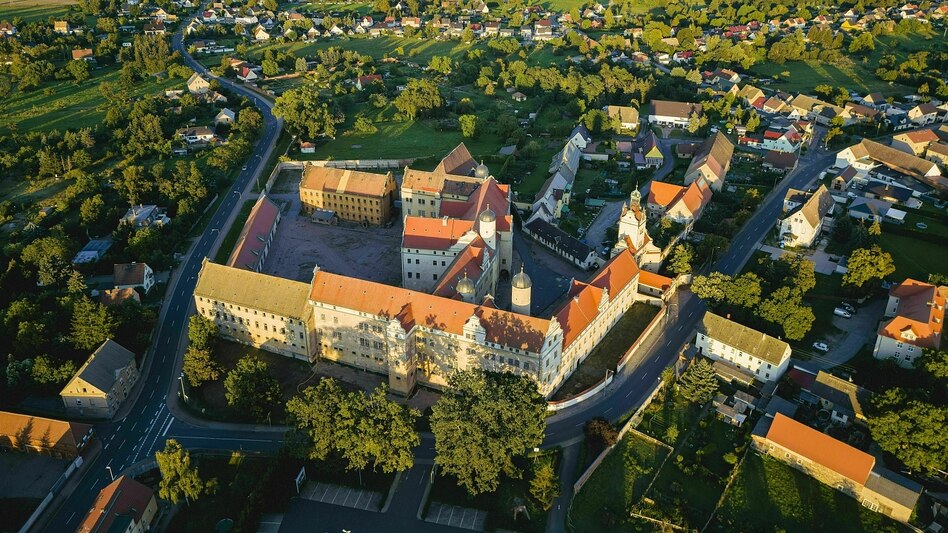
To get to another memorial site, in the northeasternmost tip of Saxony-Anhalt, it is best to take the ferry from Torgau across the Elbe. Almost 20 kilometers north is the small town of Prettin, which is almost overwhelmed by a huge Renaissance castle from the 16th century. It's called Lichtenburg Castle.
The Nazis used this castle as a concentration camp from 1933, initially for male prisoners and later also for women. More than 10,000 people were tortured there. Many Nazi victims were brought here across the Elbe. A small barge that was used for this can be seen in a photo in the memorial exhibition. This is housed in a former workshop building.
The castle itself, owned by the federal government, is empty. Every year the building deteriorates a little more. The memorial would like to integrate the former concentration camp cell building into the exhibition, says director Melanie Engler. For the time being, visitors to the castle can only enter the bunker where the prisoners' punishment cells were located. A dark vault, damp and frightening, with tiny cells - a striking contrast to the modern exhibition next door.
Unlike the other memorial management, Engler definitely has experience with right-wing extremists. She reported “disruptions to an event” so that she ultimately had to threaten to be kicked out. A reference to the evening was subsequently found on the AfD district association's website. In this context she was pilloried by name. The AfD is also disrupting its work in the district council. She feels a “great burden,” says the director.
The Lichtenburg Memorial receives around 4,000 visitors every year, around 35 percent of whom are school classes and young people on project days. Engler remembers that there were also relevant comments during tours. In the city of Annaburg, to which Prettin belongs, the AfD achieved 54.2 percent in the state election. In the two polling stations in Prettin it was 66.1 and 66.4 percent.
The extraordinary thing about the former concentration camp in Lichtenburg was its location in the middle of the town of Prettin, explains Melanie Engler. There was “great approval” in the town at the time. Nevertheless, the “myth” persists that people “didn’t know anything” about everything.
“I would like to continue my work for a diverse culture of remembrance,” says Engler despite everything. She has been running the memorial since 2012, when she was 27 years old. Melanie Engler, Anett Gottschalk from Gröbzig and Judith Gebauer from Bernburg refuse to be intimidated.
The AfD believes: “State institutions must behave in an ideologically and politically neutral manner and, moreover, commit themselves to the normative normality of society.” Is it part of “normative normality” to subordinate oneself to a right-wing extremist party?
The director of the Memorials Foundation, Kai Langer, says: “If a party is proven to be right-wing extremist, then for me it is not a party like any other, especially not if it actively fights the culture of remembrance in Germany.” Langer promises that he wants to protect his colleagues if necessary. You shouldn't duck your head now.
Read the full story at the source
Source: taz