
Germany taz
Free prison: prison without bars
Violence and control often characterize everyday life in prisons. A project in Dresden wants to better prepare people for their lives afterwards. more...
Deutsch (original) ·Auto-translated to English
One hand clings to a large suitcase with a pink bow tied around it. His other hand rises in greeting. Achim Schultze stands there for at least 20 seconds at a tram station in the Coschütz district of Dresden and waves. He likes to talk a lot, says social worker Thomas Eisenhardt, who stands opposite him on this Friday morning and waves back from across the street. But Schultze has no words right now. These are his first minutes of freedom.
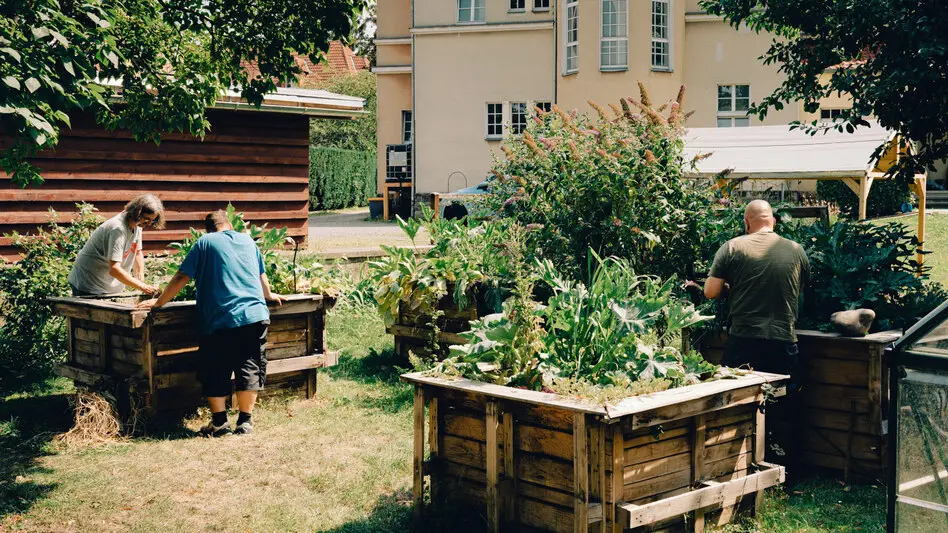
Although that is only partially true. In the past few months, Achim Schultze has been able to enjoy much more freedom than others who are in prison in Germany. He spent several years in various correctional facilities after being convicted of robbery. Then he came to Pier 36, a project of the Dresden Association for Social Justice, which is located in the south of the city in a pretty old building with a large garden.
Social justice refers to the support of people who have committed criminal offenses, are threatened with imprisonment or have been released from prison. The association also advises their relatives. Schultze's name has been changed to protect himself, as have the names of all other offenders in this text.
Pier 36 is special in Germany because it was the first project to introduce free-form detention for adults. In free-form prisons, people can spend part of their sentence outside the prison. It was included in the Youth Court Act as early as the 1950s.
In Saxony, since 2019, it has been considered the third pillar of the adult prison system, alongside the closed and open ones. But only a total of five facilities in Baden-Württemberg and Saxony have implemented it so far: three are aimed at teenagers and young adults, one at women, and Pier 36 at men.
You are reading a text from our future department. If you're interested in more positive perspectives, subscribe to TEAM FUTURE, the constructive newsletter on climate, knowledge, utopias. Every Thursday you will receive an email from us with strong thoughts for you and the planet.
🐾 Sign up now for the TEAM FUTURE newsletter – free of charge
The big goal here is rehabilitation, which is often neglected in closed prisons. As early as 1973, the Federal Constitutional Court defined resocialization, i.e. the “reintegration of the offender into society,” as an “outstanding goal” of the execution of prison sentences. At the same time, and this is also stipulated in the Penal Code, the state has the task of protecting society from further crimes.
In practice, it is not that easy to reconcile goals and tasks. Control and violence often characterize everyday life in prisons. Many prisoners have little prospect of a safe life and face the same problems after their imprisonment.
A nationwide study from 2024 shows that about one in three people with a criminal conviction will be registered again for a crime within three years. For people with prison sentences without parole, the rate is around 45 percent. Should prison sentences be thought about in a fundamentally different way in order to reintegrate people more successfully into society?
The motto at Pier 36: If you want to be able to deal with freedom, you first need the opportunity to practice freedom. In addition to a lot of personal responsibility, the men, who are called residents here, receive intensive social-educational support. They live in a residential group, cook together, are allowed to visit their relatives alone and often complete training outside of the facility. The binding guideline is a step-by-step plan consisting of five phases. The higher the phase, the more relaxation.
Anyone who ignores the limits of their freedom, for example, is repeatedly late without excuse or violates other rules, risks having to leave the project. But that almost never happens. An evaluation by the Dresden Association for Social Justice shows: The vast majority complete Pier 36 successfully, only 3 out of a total of 20 people have been returned to institutions since it was founded in 2021. 75 percent of the residents were able to be placed in companies or further training during their stay or shortly afterwards. They worked as landscapers or janitors, at bicycle dealers or in car repair shops.
The bright room on the upper floor, which was Achim Schultze's temporary home until this morning, has 13 square meters and consists of a single bed, a wardrobe, a desk, a refrigerator and a chair. His bed has been stripped and he has left a television and a guitar behind so as not to be reminded of his time in prison.
“That’s pretty much what it looks like for me,” says Mario Becker, wearing a blue T-shirt and holding a Spezi bottle in his hand, in broad Saxon. But only approximately. Because it is messy, he cannot open his room to the public at the moment: “I apologize.”
Mario Becker has been one of four residents of Pier 36 since the beginning of the year. There is no room for more in the shared apartment. At 42, Becker is in the average age. He is the father of four, and his family, to whom he wants to return after his imprisonment, lives not far from Dresden.
In 2023, Becker was sentenced to four years and six months in prison for failing to pay fines and repeatedly driving in a traffic violation, including without a driver's license. He spent almost half of his sentence in the Waldheim and Dresden correctional facilities.
Like the other residents, Becker can now spend the last part of his sentence in Pier 36. The last day of the project is usually the day of dismissal. However, there are also cases in which the responsible prison arranges for an early release and prisoners can move into the project at an earlier point in their imprisonment.
Anyone who is released early no longer has to serve the rest of their sentence in prison, but is under probation support for the duration of the probation period. During this time, the court's requirements must be adhered to and no crimes may be committed.
This morning, like every working day, resident Mario Becker has to appear for internal work instructions. That's the name of the practical work, i.e. repairing, building, painting, gardening and cleaning at Pier 36. The residents leave their mark everywhere on the site. In 2024, they renovated the attic and built fall protection so that their children can stay there safely when they visit. One resident learned to crochet and sew and made curtains.
In the past few weeks, the participants have primarily taken care of the dilapidated wooden fence. Today the formwork for the new fence posts is being done. Mario Becker takes a sip from his friend, points to the greenhouse where tomatoes grow and says: “I did that!” A few meters away there are covered bicycle racks: “And those too!”
Anja Rücker, government councilor and press spokeswoman for the JVA Dresden, explains on the phone why Becker is suitable for prison in a free form. Like all prisoners transferred to Pier 36, he “behaved without complaint” in the correctional facility and was given the prospect of easing prison sentences. He will also most likely stay in Dresden and the surrounding area in the future because he has family there. Living nearby after prison is one of the basic requirements for the project.
Whether a prisoner is a good fit for the project is also checked in discussions and a psychological report in the prison. People incarcerated for terrorist offenses or organized crime are excluded, as Pier 36 residents have a lot of free time and cannot be negatively influenced by structures or people outside the facility. Anyone who has a positive drug test or a psychiatric illness requiring treatment is also not eligible for the project. The Pier 36 building is also not barrier-free.
The most important thing for admission is that people need help and can communicate this, explains Thomas Eisenhardt, social worker and team leader of the project. “Not all prisoners have the motivation to face the challenges that await them on the way back to work and social life.”
This is tiring and often involves a lot of effort and time: having conversations, looking for a room in the tense housing market, and even thinking about how the crime could have happened, what you actually want to do in life and where you want to go. Many residents are overwhelmed by debt, addiction problems and other problems faced by authorities and need a lot of support.
You get them around the clock. Every week there is an educational cooking evening as well as individual and group discussions about topics such as masculinity, fatherhood or dealing with stress.
Joint excursions are also planned here. Sometimes we go to the Banksy exhibition in Dresden, sometimes we go to a Dynamo football match. In the evening at 10 p.m. and in the morning at 7 a.m. the men have to report to the night service, which is on the same floor as the shared apartment. There are exceptions for a cigarette in the garden or movie nights together.
In order to be able to do all of this, four social workers are responsible for four residents at Pier 36, who alternate in teams of two. A staffing ratio that the regular prison system is worlds away from: in Hessian prisons, for example, there were an average of 24 prisoners for every social service specialist at the end of 2024. In the JVA Frankfurt am Main I there were up to 79. Many prisons lack money and staff.
This text first appeared in wochentaz, our weekly newspaper from the left!
Every week, wochentaz is about the world as it is – and as it could be. A left-wing weekly newspaper with a voice, attitude and the special taz view of the world. New every Saturday at the kiosk and of course by subscription.
Due to the high level of care required, enforcement in free forms is sometimes co-financed by foundations or other providers. Pier 36 says it receives its funds mainly from the Saxon Ministry of Justice. Only in special situations, for example if the residents do not receive unemployment benefit or social assistance shortly after moving in, would funding from a Dresden foundation be used to pay for public transport tickets or medication.
The fact that the project still exists today may also be due to the fact that the Association for Social Justice has been committed to helping people who have committed criminal offenses since 1991. "It would be much more difficult to create a project like this today. I can imagine that there would be great prejudice in many places," says Eisenhardt. He believes it is unlikely that the concept will be expanded across the board, “that must be politically desired.”
To ensure that people have fewer difficulties continuing their life of impunity after their imprisonment or building a new one, greater use could also be made of open prison systems. In open prisons, people are housed in correctional facilities, although with significantly fewer security precautions than in closed prisons. They are allowed to leave the facility at agreed times, for example to work.
Berlin and North Rhine-Westphalia are pioneers nationwide. In Berlin, people with short crimes of up to two years are sometimes even summoned to open prison when they begin their sentence. Nationwide, however, the proportion of people in open prisons has been declining for years. While in 1996 around 20.8 percent of prisoners were housed in open prisons, in 2025 their proportion was only around 13 percent.
What is only granted to a few people in Germany has long been part of everyday life in Finland. For a long time, crimes in the country did not decrease despite the high prison rate. Until the 1970s, many prisons were overcrowded and had a bad reputation. The government at the time then decided on a comprehensive criminal justice reform. Alternatives to prison and forms of enforcement that rely on trust and self-control were used significantly more.
Today almost half of all prisons in Finland are open. Sex offenders and those convicted of homicide are also housed there. The accommodations are located on islands, away from villages and increasingly in the middle of cities. Many are more reminiscent of country school homes than prisons; there are no walls or fences.
Outside of agreed curfews, residents can work and pursue hobbies, but are sometimes monitored. Those who are suitable for an open prison are examined individually. The basic requirement is that people do not consume alcohol or drugs.
The statistics suggest that the approach is having an impact: since the prison reform, the prison rate in Finland has fallen significantly. In 2024, there were 57 prisoners per 100,000 inhabitants – the lowest figure in the EU. But what about the people whose relatives were seriously injured or murdered? Who have been victims of sexual crimes and are traumatized for the rest of their lives? Aren't you angry that perpetrators are allowed to enjoy a supposedly lenient prison sentence? Don't they feel safer knowing they're behind bars?
From today's perspective, it seems fair and understandable to punish people who commit serious crimes by depriving them of their freedom. But that wasn't always the case. In the Middle Ages, serious crimes were punished with execution or banishment - this is still practiced in some parts of the world today. At that time, dungeons were seen as more of a means of pressure, for example for people who had not paid fines. In colonial contexts, however, prisons were used early on for oppression and control.
The idea that prisons could be places of correction emerged about 500 years ago. In the Netherlands and England, people without a permanent address began to be put in prisons and workhouses in order to get them used to regular work - such as beggars and prostitutes, and later also criminals. Reports show that the working conditions there were extremely harsh. It was not uncommon for rule violations to be punished with physical punishment. These places are considered the basis of today's prisons.
In principle, work is not a bad idea. Prisoners generally do not do this in their cell and are in contact with other people. In order to increase the chances of a life without further crimes, activities should be perceived as meaningful and, in the best case, also increase the chances on the job market, say experts. Instead of washing dishes or sorting clothes, people could take part in educational programs or complete training in in-house carpentry or car workshops.
Equally useful is gradual reintegration, which many penal institutions provide for but in practice implements with varying consistency depending on the institution and federal state. The principle: Instead of releasing prisoners from the strictly regulated, closed prison into free life, they should gradually get used to it.
The first relaxation could be to first leave the building accompanied and then alone and to see more and more family members and friends. Depending on how they deal with the relaxations, they could be released earlier into more open forms of enforcement.
“The goal is gradual reintegration,” says Anja Rücker, who has a lot of contact with serious criminal offenders in her work at the Dresden prison. However, from their point of view, the majority of prisoners at the Dresden JVA are not suitable for an open form of prison - also because there are a disproportionately large number of people here who have already been imprisoned several times. In addition, a large proportion of prisoners who do not have German citizenship have no real prospect of remaining, which makes reintegration complicated. And drug consumption is high: an absolute exclusion criterion.
It's 12:30 p.m. at Pier 36 and work is finished for the day. For lunch there are grilled sausages, a tradition when large projects are being completed. Vegetarian sausages have also recently been grilled because Wolf Biedermann loves animals and therefore doesn't want to eat them.
From 2011 until he moved into Pier 36, the 38-year-old was in a closed prison in Waldheim for violent crimes. He is a trained metal worker, but would rather work as a salesman at Fressnapf in the future. He doesn't want to talk about what he did. Just this much: He had a big problem with drugs. He originally comes from Leipzig. He doesn't have a place to return to after his imprisonment.
What is currently the biggest challenge for him? “Dealing with so much humanity,” he says without hesitation. “For example, at the beginning of my time here, I was really upset while riding my bike,” he points to deep wounds on his legs, “and everyone came and asked me if everything was okay.” In prisons he would have experienced “completely different things,” he says. “You arrive here and you realize that you are a human being, not just a prisoner, a human being.”