
Politics · taz · · 3h
Questions and answers about the fuel discount: 10 to 11 cents cheaper
Deutsch (original) · Auto-translated to English
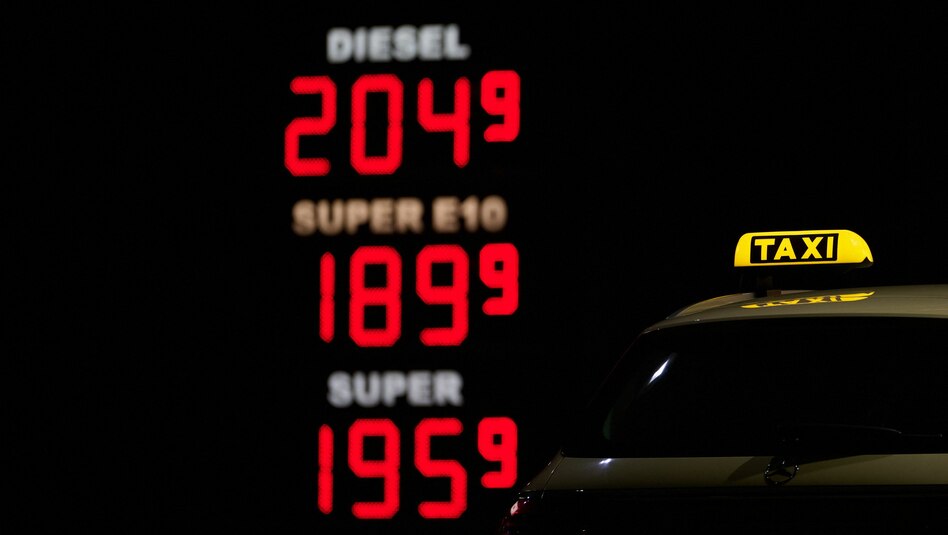
dpa | At the start, the fuel discount caused fuel prices to fall sharply in many places. Petrol and diesel suddenly became cheaper around midnight. On the fuel price portal Tankerkönig, the Germany-wide average prices fell by around 10 to 11 cents between 11:41 p.m. and 12:41 a.m. This same price difference also occurred early in the morning at the same time on Wednesday.
In many places, premium gasoline of the cheaper E10 variety was offered for less than 2 euros, as can be seen from the ADAC portal. However, there are regional differences here. There were many such offers in Munich, Stuttgart and Leipzig. There were numerous in Berlin, but only a few in Hamburg, and in Cologne there were no petrol stations listed for less than 2 euros in the morning. However, the nationwide average prices at Tankerkönig were well over 2 euros.
The fuel discount has been in effect since midnight and is already having an effect. What drivers need to know now.
Not necessarily. The price cannot rise until midday because of the 12 o'clock rule. The cheapest time to fill up is usually late morning. However, you shouldn't calculate anything too close to 12 p.m. if there is a big crowd, because prices usually jump significantly at 12 p.m.
If you can't make it to the gas station before noon on Thursday or want to avoid waiting times, you should wait until Friday morning. Following the current patterns, fuel should then be as cheap as on Thursday morning. It is generally advisable to compare prices.
Demand on Thursday morning is likely to be high because many drivers waited for the discount to fill up. It also made sense for gas stations not to have their warehouses too full before the discount started, as the tax advantage of 16.7 cents per liter only applies to fuel that leaves tank depots or refineries after midnight. The ADAC fuel price expert, Christian Laberer, does not expect any relevant bottlenecks. “That wasn’t the case last time in May either and back then there was the additional problem that May 1st is a public holiday,” says fuel market expert Laberer.
How long is the discount valid and how much does it cost?
The measure lasts until the end of the year. The federal government expects that 2.485 billion euros less taxes will flow into the state treasury. This time, however, the states should bear half of it. In return, the federal government gives them slightly less sales tax revenue than normal. The approach is quite unusual, because the states often only co-finance federal decisions with great pain in the ass.
The gas stations do not have to pass on the tax cut one-to-one. However, prices fell sharply on Thursday morning. Since they had already fallen quite a bit in the previous days - possibly in anticipation of the fuel discount - it is difficult to assess exactly how high its effect is currently.
The fact that prices are already falling sharply is mainly due to customer expectations, because it can take a few days until tax-reduced fuel is in stock everywhere.
Will fuel be as cheap as it was before the war?
Barely. On the last day before the outbreak of war at the end of February, according to ADAC data, a liter of Super E10 cost a national daily average of 1.78 euros and a liter of diesel 1.75 euros - the gap to current prices is therefore much greater than the planned tax discount.
How much does the discount benefit the average driver?
According to figures from the Federal Motor Transport Authority, the average car in Germany is driven around 900 kilometers per month. Assuming consumption of 7 to 8 liters per 100 kilometers, the average combustion engine driver saves roughly 32 to 36 euros through the discount over the full three months. However, depending on the mileage, consumption and skillful refueling after the start and before the end of the discount, the value can vary significantly.
The vast majority of experts think little or nothing of the measure. The most important points of criticism that were raised in the last edition:
The discount is relatively expensive and not targeted. It also supports people who don't need the help - especially frequent drivers with large cars. However, it is of no use to people who don't have a car but suffer from high fuel prices due to heating costs or other things. It dampens the price signal: Normally, scarce goods become more expensive, which dampens consumption. However, this mechanism, which makes sense in itself, is slowed down by an artificial reduction in the price of fuel. There is no guarantee that it will reach the consumer completely.
Two renowned economic institutes in Germany criticize the fuel discount as wrong. “It is understandable that many drivers find the high fuel prices a great burden,” said the head of the Ifo Institute in Munich, Clemens Fuest, when asked. “However, the fuel discount is not the right answer.” It brings about a redistribution in favor of frequent drivers with large cars.
“There are many of them who can afford the high prices and for whom it is unjustifiable that burdens are redistributed in their favor,” emphasized Fuest. If politicians want to relieve the burden on certain groups, such as commuters with long commutes, they should do so with more targeted instruments, such as increasing the commuter allowance.
"In addition, the fuel discount only has a limited effect. With 1,000 kilometers per month and 6 liters of consumption, you save 10 euros per month." However, there would be noticeable costs for the economy as a whole, amounting to 2.5 billion euros. This money could be put to better use, Fuest said.
Expert Tomaso Duso from the German Institute for Economic Research (DIW) also expressed a similar opinion: “Those who drive a lot and drive large cars – usually households with higher incomes – benefit the most,” he said. “Households without a car will not receive any relief and will have to help finance the measure.” In times of scarcity, high prices also serve a function, added Duso. They signaled to consumers to drive more economically and to refineries to produce more. “If you want to provide relief, then do it directly and precisely, not through the price.”
However, there are other voices too. Manuel Frondel from the RWI Institute recently told “Spiegel”: “It would of course be better if the state would provide targeted help to needy households. Since it still cannot easily implement such direct payments, I consider the fuel discount to be a pragmatic and fair solution.”
The ADAC also sees the fuel discount as a “suitable means of relieving the burden on drivers in the short term,” even if direct payments would have made more sense.
Read the full story at the source
Source: taz