
Germany taz
Forsa survey on youth protests: 83 percent understand the protests
The nationwide demonstrations by young people have met with great understanding among the population. At the same time, Dobrindt's statement about a “migrant milieu” is causing criticism. more...
Deutsch (original) ·Auto-translated to English
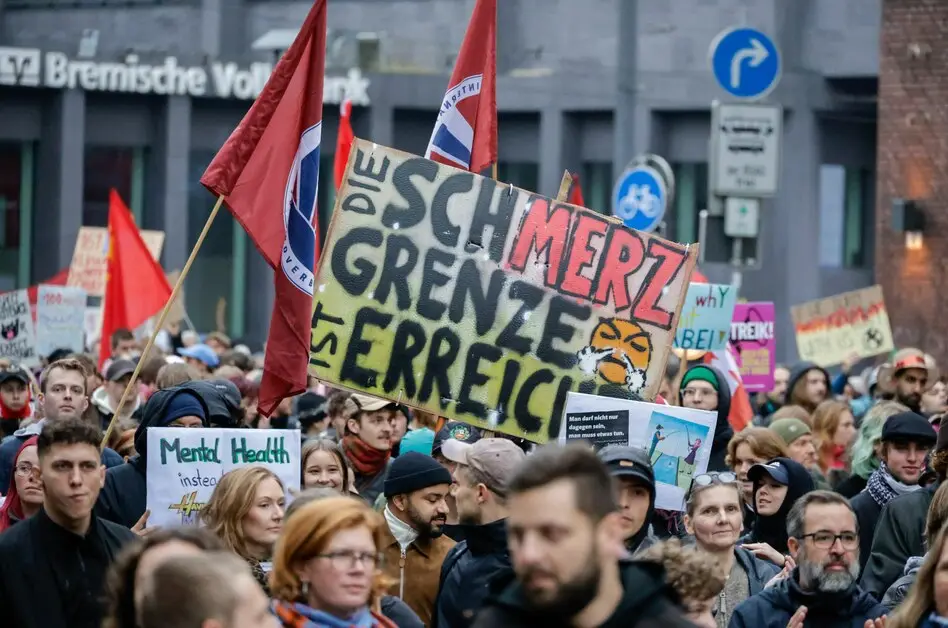
kna/afp | According to a survey, the nationwide demonstrations by young people on Saturday apparently have great support among the population. A majority of 83 percent across all age groups generally understand the protests, as shown by a Forsa survey commissioned by Stern and RTL. Only 16 percent of those surveyed had no understanding of it. The latter view was particularly widespread among supporters of the CDU/CSU (28 percent) and AfD (33 percent).
According to information, a total of around 100,000 mainly young people took to the streets in over 30 cities during the Germany-wide protests, which were organized by the “Gen Z regulates” movement, among others. They demonstrated for better education, more social justice and climate protection as well as against compulsory military service. Despite increased security precautions, there were riots and looting in some cities on the fringes of the demonstrations.
According to the report, the opinion research institute Forsa interviewed 1,006 German citizens for the survey last Thursday and Friday - before the demonstrations took place. New protests have already been called for November 20th.
Chancellor Friedrich Merz (CDU) has shown understanding for the demands of protesting young people in Germany, but at the same time sharply criticized the violence on the sidelines of the rallies. The young people represent “legitimate concerns” that he takes “very seriously,” Merz said on Monday through his spokesman Stefan Kornelius. His government's reform policy aims to open up "new opportunities" for the young generation - for example by stabilizing state finances and reforming the pension system.
At the same time, however, the following applies: “Excesses of violence have no place in our country,” said Kornelius. The police “rightly” reacted harshly. The spokesman emphasized that the Chancellor had “noted that a lot of young people demonstrated peacefully.” However, this peacefulness then “changed over the course of the evening,” which should be condemned “in the strongest possible terms.”
In terms of content, the Chancellor sees his reform course confirmed by the demands of the young demonstrators: the “message of the young people” corresponds to the reform message that the Chancellor has “been repeating for months,” said Kornelius.
The formulation by Federal Interior Minister Alexander Dobrindt (CSU) caused discussion, according to which “violent left-wing groups and chaotic people from the migrant milieu” were responsible for the violence on Sunday night. Critics complained that people with foreign roots were being blamed across the board. Left leader Luigi Pantisano, for example, criticized this as a “cheap attempt to attribute something to a group in order to agitate against migrants in this country again”.
Chancellor Merz expressly supported Dobrindt's statement. His assessment of the perpetrator's environment is “based on the observations of the investigative authorities and the emergency services on site,” said his spokesman Kornelius. It also corresponds “with the images that many have seen”. The spokeswoman for the Federal Ministry of the Interior admitted that there were still “no valid nationwide figures” on the suspects and their background. The reference to the “migrant milieu” generally means “people with a migrant background” – regardless of the question of how many generations their families have lived in Germany.
The CDU foreign politician Norbert Röttgen contradicted Interior Minister Dobrindt in his classification of violent perpetrators. “They are lone perpetrators, always lone perpetrators,” said Röttgen on Monday evening on the ntv program “Pinar Atalay”. There were many of the violent perpetrators “who were either foreigners or Germans of foreign descent.” However, no common milieu can be derived from this. “There is no one milieu of migrants in Germany,” said Röttgen.
At the same time, Röttgen emphasized that a clear distinction must be made between peaceful demonstrators and violent criminals. “If people take to the streets and demonstrate, then that is their right,” he said. That is “the perception of our democracy”. Violence, on the other hand, cannot be justified by anything and requires “the rigor of the rule of law”. Violent perpetrators should not be allowed to exploit the right of peaceful participants to demonstrate for their actions.
Green Party leader Felix Banaszak has also accused the federal government of not addressing the concerns of the protesting young people. It was “a recognizable maneuver” by Chancellor Friedrich Merz (CDU) and Interior Minister Alexander Dobrindt (CSU) “not to continue to deal with these demands,” said Banaszak in Berlin on Monday. “And this essentially signals to people: no matter how peaceful these demonstrations end up being, your concerns will not be heard anyway.”
The Federal Minister for Family Affairs announced that Minister Karin Prien (CDU) had arranged to meet this week with representatives of the Federal Student Conference and the Education and Science Union (GEW) for an exchange. Prien himself called for the interests of younger people to be given greater consideration. “These are exactly the debates that we need to have now, which young people are rightly demanding,” she said on RBB.