
Germany taz
Consequences of mining in the Ruhr area: Staying afloat
Without the work of pumps, large parts of the Ruhr area would sink into water. But how long should these pumps continue to run? more...
Deutsch (original) ·Auto-translated to English
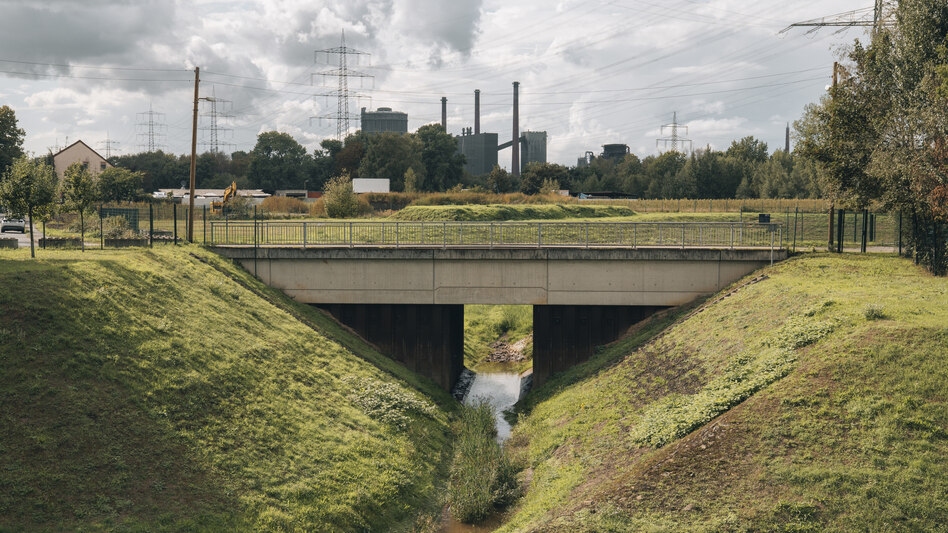
"It's over 50 years old and is still running," says Carsten Meybohm, pointing from the gallery of the pumping station down to a large pump painted light green a good ten meters below him. The green giant is just one of ten machines that pump the water from the Boye and its tributaries into the Emscher, which flows just a few hundred meters to the south.
The Boye is a small river. It takes just 13 kilometers from its source in the north of Bottrop to the Emscher. But it would never achieve this naturally: Before the Prosper-Haniel mine in Bottrop was closed in 2018 as the last hard coal mine in Germany, mining had shaped the northern Ruhr area for almost 150 years and ensured that today the surface between Duisburg and Dortmund is up to 25 meters lower than it was before coal mining began.
The miners got coal and even more rock from seams up to 1,000 meters deep, fields full of hard coal. And once it was dismantled, the ground gradually sank. Polders, i.e. low-lying areas from which water can no longer drain away on its own, have formed. "When the river flows in there," says Meybohm with stoic composure, "it doesn't flow uphill. The Boye simply no longer reaches the Emscher in the normal way."
The 59-year-old operations engineer has all the numbers ready: the water from the Boye has to be pumped 18 meters high so that it can flow into the Emscher. The system creates 46,000 liters per second. If the Boye and its tributaries carry a lot of water after heavy rain, the pumps run at full capacity. If, like this summer, it hasn't rained for weeks, most of them stand still. When heavy rain sets in, the pumping station in the no-man's land between Essen, Gladbeck and Bottrop is very busy.
The Emschergenossenschaft's systems are able to cope with heavy rain, which theoretically only falls every 250 years. That was enough for a long time. But in the summer of 2021, an amount of rain fell in Hagen on the southeastern edge of the Ruhr area - outside the Emscher catchment area - that only occurs every 10,000 years. Facilities are being expanded and dikes are being raised, but in the cooperative's opinion, the technical limits are being reached as to what is still possible to deal with the consequences of climate change.
There are three operating areas along the Emscher, which rises in Holzwickede east of Dortmund and flows into the Rhine in Dinslaken. At the Bottrop-Boye pumping station, Meybohm and his team are responsible for the middle course of the river.
The Emscher is the river that shapes the Ruhr area. It flows through the middle of the region of five million people, while the Ruhr, which gives it its name, flows on the southern edge of the Pott. The third formative river, the Lippe, an important transport route for Roman legions in their attempts to civilize Germanic tribes 2,000 years ago, lies in the north.
Of the three rivers, the Emscher had the hardest fate: While the Ruhr provided the Ruhr area's drinking water, the once 109-kilometer-long river, which meandered through the Emscherbruch, a floodplain landscape, and repeatedly changed its riverbed, became an 83-kilometer-long sewer: The wastewater from millions of people and countless industrial companies such as mines, steelworks and chemical plants flowed into the Emscher and from over 30 streams and small rivers existing river system. A smelly broth full of poison and pathogens that no longer found its way into the Rhine from the late 19th century onwards: lakes formed in more and more places, flooded entire parts of the city and caused epidemics such as typhoid and cholera to break out.
This text first appeared in wochentaz, our weekly newspaper from the left!
Every week, wochentaz is about the world as it is – and as it could be. A left-wing weekly newspaper with a voice, attitude and the special taz view of the world. New every Saturday at the kiosk and of course by subscription.
“From the 1870s onwards,” explains Hattingen historian Dietmar Bleidick, “it became apparent that there was a sewage catastrophe.” In the Emscher area alone there were hundreds of square kilometers of polder area. Today it is 780 square kilometers, almost half of the entire Emscher region, which includes Gelsenkirchen, Bottrop, Herne, but also Duisburg and the north of Essen and Dortmund.
The cities and companies in the Ruhr area responded to the challenge in the way that is still common today: they began to argue with each other about costs for 20 years and were meticulously careful to only keep the interests of their own city or company in mind. The church tower policy that is still typical of the Ruhr area today can look back on a tradition going back to imperial times. “When the situation became so dramatic at the end of the 19th century that we had to act together,” says Bleidick, “they got together and, in a concerted effort, decided to found a wastewater association.”
Because the association also needed special rights such as the expropriation of land for its own construction work, the Prussian state parliament created the Emschergenossenschaftsgesetz in 1904. The Emschergenossenschaft, which was founded in 1899 and still exists today and is responsible for keeping the pumps running, was given its legal framework. All cities and districts in the Emscher catchment area, the mines and all companies with high water consumption now had to become members. Canals and pumps were created, the time when entire districts sank into dirt and epidemics broke out came to an end. “People are not aware that around 40 percent of the central Ruhr area would be under water today if the pumps weren’t running around the clock,” Bleidick believes.
As well as? Only in a few places in the Ruhr area do you notice that it is a polder area: you can see dikes between forests and meadows far away from the nearest river. And the fact that many of the ponds in the area are not only intended to make ducks and walkers happy, but are also rain retention basins, cannot be seen even at second glance. The ground has sunk 28 meters in Essen-Katernberg near the world heritage site Zeche Zollverein and in Dortmund near the Zeche Hansa in Huckarde. Borrowed land that wouldn't exist without the pumps for well over a hundred years.
The Ruhr area owes its existence to the mining and steel industries. At the end of the 19th century, its population exploded from 1 to 3 million in fifty years, rising to 5.2 million by 1970. Even today, the region between Hamm and Wesel is still the largest urban center in the republic with 5 million people. The price for the area being the industrial center of Germany for a time was high: contaminated streams, rivers and lakes and land subsidence that is unique in the Federal Republic.
Keeping the pumps running so that entire parts of the city don't flood costs money. A lot of money: 288 million euros flowed into the Ruhr area in 2025 and smaller sums also went into the former mining regions in Saarland and Ibbenbüren in Westphalia. The RAG Foundation, founded in 2007, provides the money. It has to generate it with the profits from shareholdings and investments. The foundation brings together the ownership of the former mines, a 40 percent stake in the housing construction company Vivawest and a 44 percent stake in the specialty chemicals group Evonik. Over the past almost 20 years, the RAG Foundation has invested in numerous companies through its investment subsidiary RSBG. Not always with success: the RAG Foundation invested 269 million euros in the Signa Group of the Austrian fraudster René Benko. When his empire collapsed like a house of cards, 189 million euros had to be written off.
But the foundation doesn't run pumps, it lets them pump. In the Ruhr area these are the Emschergenossenschaft, the Lippeverband and the Left Lower Rhine Drainage Cooperative, with the Emschergenossenschaft and the Lippeverband forming an administrative community since 1926.
The cooperatives should ensure that the northern Ruhr area does not sink into water for all time. It is a task for eternity. Dietmar Bleidick doesn't want to take the term eternity too literally: "From the perspective of a human life, periods of time that extend over three or four generations are already eternal." The aim is to express: “As long as the Ruhr area is used for settlement purposes, you have to keep the system running.” But if that is no longer the case, you could of course let everything fill up.
The Ruhr area is not one of Germany's growth regions. The shrinking of its population over the past ten years has been slowed primarily by the influx of refugees, but the prospects are particularly poor in the northern Ruhr area, the Emscher zone, where pumping is being carried out to combat flooding.
According to almost all relevant social and economic indicators, Gelsenkirchen is one of the poorest cities in Germany. With Essen, Dortmund, Duisburg, Oberhausen and Herne, other cities that are wholly or partly located in the Emscher area are among the leaders nationwide in terms of unemployment and receipt of transfer benefits. When it comes to income, however, they are far behind. And in some cases the population here has fallen massively: 270,000 people still live in Gelsenkirchen, once a city with 400,000 inhabitants. In many of these cities, houses are empty and decaying. The cities and the state are spending millions to buy them up. Some are being renovated, but many are being demolished.
The economic prospects of the northern Ruhr area are poor, as are its demographics. As early as 2010, Günter Tebbe from the Bertelsmann Foundation called on cities in the Ruhr area to enter into dialogue with their citizens and to look for common solutions in the dismantling of cities. In addition, the running of the pumps depends on the political and economic conditions remaining stable in the long term. An uncertain bet on the future: Germany has repeatedly experienced phases of wars, civil wars and economic catastrophes over the past centuries. You may wish for stability in the long term, but no one can guarantee it.
Uli Paetzel knows that too. Paetzel has been chairman of the board of the Emschergenossenschaft and the Lippeverband for ten years: “We estimate that it will take between one and two years until lakes are created in the polder areas after the pumps are switched off.” It is about increasing resilience, also with a view to the Russian warfare in Ukraine, where the infrastructure is being deliberately destroyed. The Emschergenossenschaft, says Paetzel, has begun to compile the hydrological basis in order to be able to decide where new lakes could be created. The deepest polder areas are usually the places where the large housing associations have their largest holdings. “You could talk to the housing associations and offer them these improved or other locations if they would help turn off the pumps and create a lake.” It is important that something like this happens in a planned manner and not as the result of a catastrophic development.
You can see such a planned lake in Dortmund since 2011: The Phoenix Lake was created on the site of the former Phoenix steelworks in the Hörde district. What was once a no-go area behind factory walls has become a popular excursion destination and sought-after residential area.
It remains to be seen whether there will be several Phoenix lakes in the Ruhr area in the future. Turning off the pumps in a targeted manner has so far been a taboo, Paetzel's idea is as logical as it is new. But it could open up a perspective beyond an alleged eternity, which could actually be narrowly limited in time.