
Germany taz
Liquefied natural gas terminal in Mexico: Are whales legal subjects?
In the Mexican state of Sonora, activists and scientists are suing against an LNG project to protect whales in the sea. more...
Deutsch (original) ·Auto-translated to English
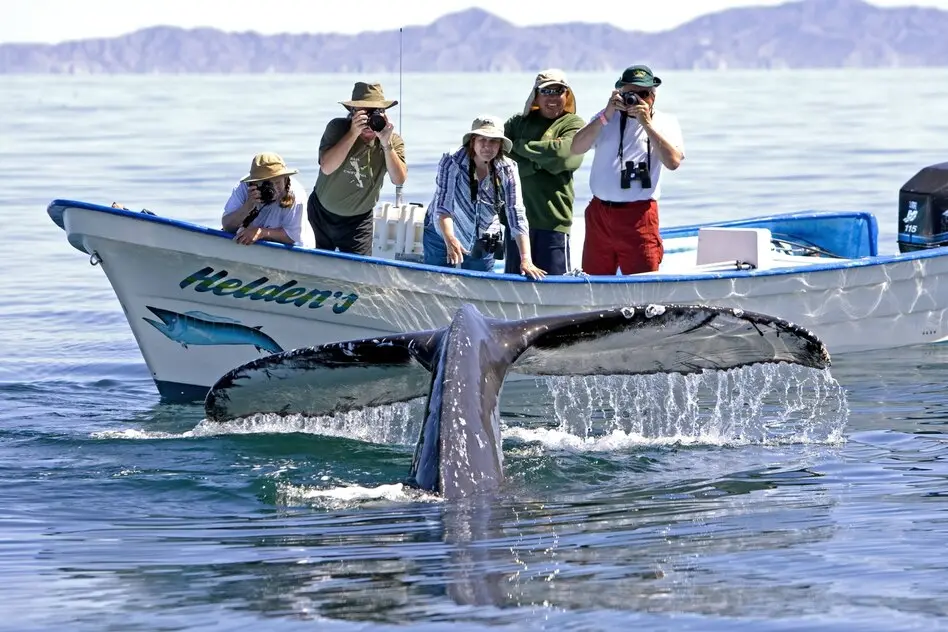
The first thing Nora Cabrera asks on the phone is whether I think the whales would approve of an LNG tanker passing through their habitat? The instinctive answer is: no. The answer becomes more complicated when you consider that large companies and governments are also involved in the decision and millions of US dollars are at stake.
A whale cannot appear in court. He also cannot hire lawyers. Cabrera, a young lawyer, wants this impossibility to no longer be a disadvantage.
15 journalists from 12 Latin American countries are taking part in the “Euromérica” workshop organized by the taz panter foundation. It's about the opportunities and challenges of the EU-Mercosur agreement and Latin American-European relations. A supplement will appear in the taz on December 5th, and there will be a public talk in the taz canteen on December 9th. All texts can be found here.
It's about the Saguaro Project. The US company Mexico Pacific plans to build a terminal for the export of liquefied natural gas (LNG) in Puerto Libertad in the state of Sonora, near the border with the US. The plant would take gas from Texas and liquefy it, then ship it and transport it to Asia. The investment is estimated at $15 billion. The project was originally intended to be realized in California in the USA, but strict environmental laws and social resistance prevented its implementation.
Texas has a gas surplus and Asians need that gas. Between the deposits and the buyers lies Mexican territory: the land through which a gas pipeline would run and the sea over which the fuel would be transported. This location has an economic advantage because it shortens the journey to Asia by eleven days compared to projects in the Gulf of Mexico and avoids the Panama Canal. Eleven days less is a reason to invest.
But the Gulf of California is more than just a quick transport route: almost 40 percent of the world's whales live there.
Attorney Cabrera is also the head of the Nuestro Futuro organization and part of a coalition that filed a lawsuit in September 2025 to have Mexico recognize the whales as legal subjects. She demands that animals be protected for their mere existence. The organization has managed to halt construction of the project for now. So far, however, it is only a temporary suspension that only applies until the case is decided in the main hearing.
We are used to defending a house because it has an owner, a car because it has a license plate, an investment because it is based on contracts. With animals, on the other hand, we usually look for a benefit that underpins their right to exist. That they attract tourists or secure jobs. As if mere existence were an insufficient argument that needed to be backed up with a calculation.
In any case, the whales' livelihood would be at risk due to the increasing tanker traffic in the region: A study commissioned by the organization “Equal Routes” fears an increase in emissions, underwater noise and collisions with ships. Collisions with these are the most common cause of death in whales, says Cabrera.
Support the taz panter foundation and its international projects with a donation. Learn more
Afterwards, around a hundred Mexican and international scientists wrote an open letter calling the production and transportation of LNG in the Gulf a “direct, existential and unacceptable” risk. In addition to Saguaro, they also pointed to AMIGO GNL, another LNG project in Guaymas, also in Sonora. They called on the governments of Mexico and the United States not to implement these plans.
At AMIGO GNL in Guaymas, European companies would also be affected. The raw materials giant Gunvor, based in Geneva, has signed a long-term purchase agreement to purchase 0.85 million tons of LNG from there annually.
If implemented, the ecological consequences of the LNG projects would be significant: Saguaro alone would produce more than 73 million tons of carbon dioxide annually. That's more than the annual emissions of Sweden and Portugal combined, says Cabrera.
For an investor, the delay in a project can be measured in monetary terms. For a fishing community, its implementation could endanger their entire livelihood. Saguaro is therefore part of a larger debate: about the fact that Latin American countries largely bear the environmental costs of large-scale projects, but whose profits are then distributed beyond their borders by the companies involved.
It's easy to announce investments with a number that fills headlines. But what about the costs and risks for the people living on site and the animals affected? Who keeps this account? And how important do these aspects weigh in the implementation of a project?
Mexico Pacific presents Saguaro as a contribution to Asia's energy security and energy transition. The company argues that the project's location and design would reduce emissions compared to other U.S. export routes. But what harms are considered acceptable in the name of relative improvement? And who has the authority to decide that?
The lawsuit against the project seeks to introduce an obligation into this imbalance: before the whales' habitat is changed, there must be someone to defend them and be heard in court. But the lawsuit filed against Saguaro is only a first step: now the lawsuit must be won.
Diana Nava is a freelance business journalist from Mexico. She works, among other things, for the digital financial medium REDD Intelligence.
Translated from Spanish by Ole Schulz