
World · taz · · 1h
Venice Film Festival: Love in times of revolution
Deutsch (original) · Auto-translated to English
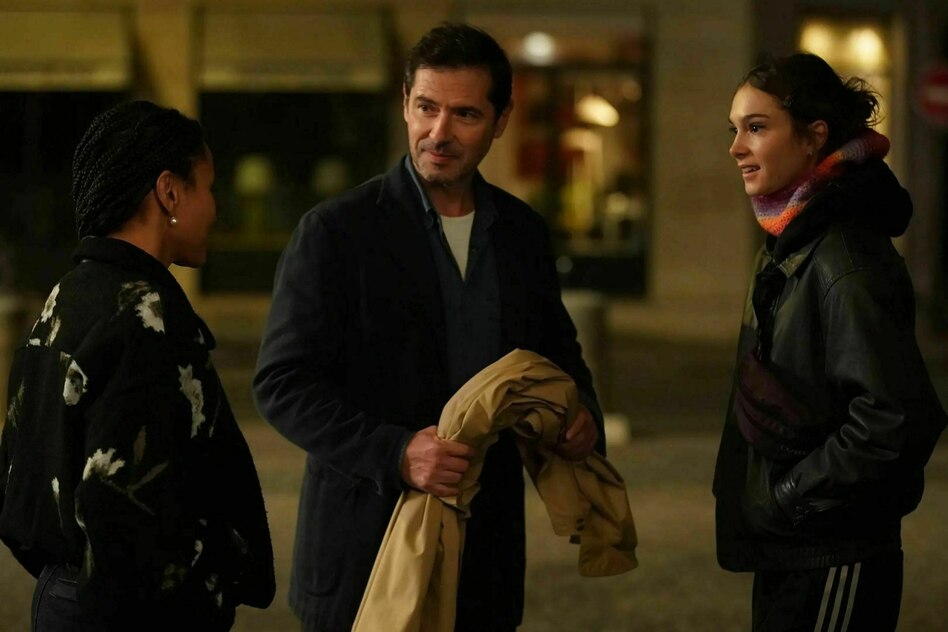
A number of films in competition in Venice this year are about families and relationships. Quite a few of them played primarily in closed rooms: “The Echo Chamber” by Andrea Pallaoro, Florian Zeller’s “Bunker” or Edoardo De Angelis’ “Il fuoco che ti porti dentro,” for example. Nicolas Pariser also talks about relationships in “Un peu avant minuit”, although in his case the nuclear family merely forms a loose framework around which the main characters arrange themselves. In contrast to the films mentioned, the protagonists in Pariser never stay within their four walls for long. They prefer to stroll on the street. Or they run when circumstances dictate.
At the beginning of the film you see a billboard with newspaper headlines. There is talk of “battles in the banlieue” and even though the action takes place in the more central regions of Paris, the sounds of sirens, flashing lights and police patrols are a constant background backdrop to the action. France appears to be on the verge of civil war.
Léo, a classic anti-hero, is at the center of the film's cast of characters. Melvil Poupaud portrays the university assistant in his late 40s with a slightly neglected elegance; an old-fashioned raincoat is just as much a part of his basic equipment as the plate on the back of his head that is emerging from the daylight. We learn right at the beginning that he has to go to Italy for a lawyer's appointment regarding his late father's will. We also learn that he doesn't actually live in Paris, but in Nancy, where he also has a girlfriend. Although he doesn't really know whether they are really still together.
With every new character Léo meets, he begins a conversation about love or similar forms of human interaction. His daughter Emma (Clara Pacini), with whom he takes his first walk, is stunned when she learns that her grandfather saw her grandmother as the great love of his life, even though the two were only together for a short time. Love, according to her angry plea, is not just a bourgeois construction, but a male fiction in which the woman is reduced to an object of the man's fantasy.
From there, Léo strolls on to his old friends, with whom he ran a magazine shortly after completing his studies. There is a lot of talk about the female interns, who were not allowed to do much journalistic work, but always aroused desire among men. Éléonore (Léonie Simaga), the wife of a former colleague, is just as bored by this macho nostalgia as Léo, so they decide to take a few steps. In doing so, Éléonore elicits a few uncomfortable insights from her interlocutor, which reveal that his image of women at the time was not much better than that of his friends.
At the end of their encounter, Éléonore seems to send Léo to hell, but advises him to seek out two of the women he once admired. One, Armelle (Anaïs Demoustier), has now gone into politics and involves Léo in a conversation about the disastrous state of the left in France. The other, Tina, whom Léo particularly remembers as her supernatural beauty, remains untraceable.
Léo not only meets women from back then, but also other former colleagues. One has become a television producer and is making a series about their time together, in which Léo even has a small part. Instead of talking to his old friend, he's always on the phone. The other, once a film critic whom Léo never liked, has said goodbye to journalism and film nerdism to lead an Orthodox Jewish life. Apparently it's just his wife who works for him. He thinks even less of romantic love than Léo's daughter, although for different reasons.
Love, as Nicolas Pariser demonstrates in extensive dialogues, changes with changing society. Whether there will be a civil war in the end remains an open question. Léo learns how his mother, who died early, thought about love.
Read the full story at the source →
Source: taz