
Germany taz
Film “La bola negra”: From fragment to epic
The film “La bola negra” weaves together three gay life stories surrounding Federico García Lorca. Past and present intertwine. more...
Deutsch (original) ·Auto-translated to English
Even in a somewhat sluggish year for cinema like this one, they still exist: the truly great films that create something genuinely new. “La bola negra” is one of them, even if its opening initially leads on the wrong track and promises a cinema that relies entirely on spectacle. Planes roar in as the residents of a remote village in the barren Andalusian countryside gather in the middle.
“Welcome Mussolini!” stands on a flag, musicians have positioned themselves on a pedestal. The camera repeatedly focuses on a young trumpeter who spots his mother in the crowd and encourages her to raise her right arm, just as the farmers, women and children around her have already done.
Then there is a hiss and a crash and the first bombs hit. People are hit and knocked to the ground, dust and debris fly through the air. Within seconds, the strange gathering turns into a deafening inferno.
“La bola negra”. Directed by Javier Calvo and Javier Ambrossi. With Guitarricadelafuente, Miguel Bernardeau and others Spain/France 2026, 155 min.
The fact that Spain was embroiled in a civil war in 1937, in which the Second Republic was fighting against the putschists gathered under Franco, and that Mussolini's Italy was on the side of those same nationalists, meaning that allies were being bombed in spirit: you have to figure that out either from your own historical knowledge or from marginal comments later on.
This is one of the great peculiarities of “La bola negra”, in the quiet sophistication of its details and the art of their interweaving. As he flees through a destroyed church, the trumpeter, who a little later reveals himself to be Sebastián (Guitarricadelafuente), climbs the rubble of an oversized statue of Saint Sebastian.
This is a nice allusion not only because of his name, but also because the martyr, pierced by arrows and known for his beauty, is considered the patron saint of gays. Anyone who knows his importance already suspects what longings Sebastián will discover on his way.
As in an alchemical process, however, it only gradually becomes clear what a story that ultimately spans almost a century is aiming for. Before Javier Calvo and Javier Ambrossi delve deeper into Sebastián's story, the film changes time level for the first time, to another of its three storylines - in a flowing movement, as occurs again and again in "La bola negra": Moments before, a change in the music begins, causing the scenes to bleed into one another and respond to one another.
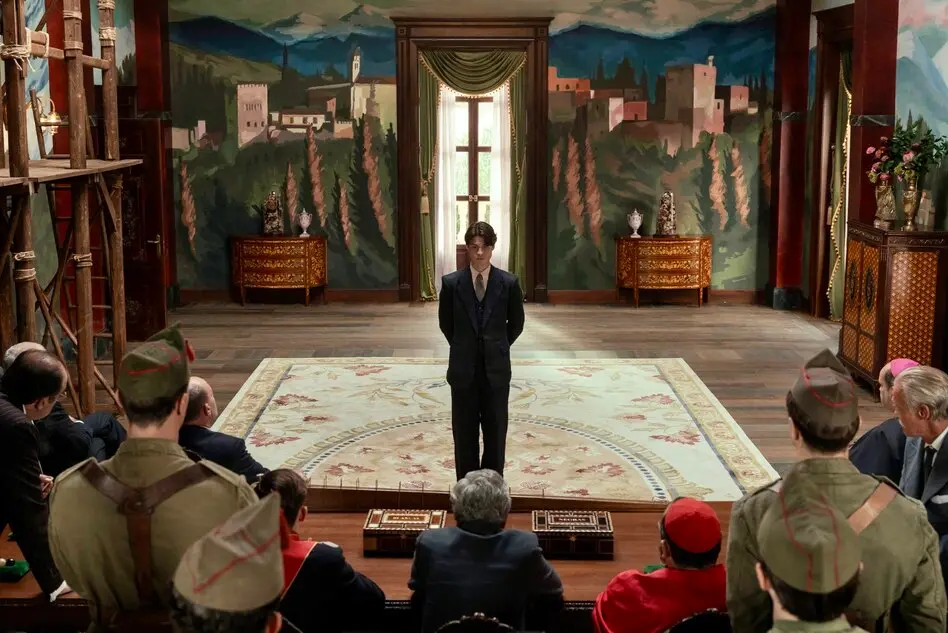
The focus of the second chapter is twenty-year-old Carlos (Milo Quifes), who in 1932 Granada applies to join the local casino, an exclusive social club where high-ranking military officers, clergy and the wealthy representatives of the urban upper class decide whether he belongs.
The film owes its title, at least indirectly, to the special procedure used to vote on it: Carlos' fate is judged with white and black balls, or bolas negras, while construction workers work on the impressive hall dome above the heads of the assembled dignitaries.
After all, the will for restoration is unbroken among them too: the Second Spanish Republic, which is focused on culture and the aesthetic, in which gay men could also hope for greater freedom, has only just been proclaimed, and the reactionary forces are already working on its dismantling again. When the black balls finally multiply, it is clear that Carlos has been rejected. The reason is rumors about his homosexuality.
What costs Carlos his belonging, the young historian Alberto (Carlos González), protagonist of the third time level, lives with a matter-of-factness that no longer needs any explanation. In Athens in 2017, he is looking for traces of a bygone queer culture, scours markets for music recordings from 1920s Constantinople for his doctorate in Spain, and is captivated by old melodies and the intricate stories of their performers.
Meanwhile, his own desires are far less complicated: he arranges a quick sex date with a muscular stranger via the “Grindr” app. Naked bodies lie on top of each other, intertwined.
Just a moment later, back in Spain in 1937, there are again bodies lying on top of each other, now dead or seriously wounded, reduced to a whimpering heap of flesh and limbs. It is a cut of such precision that the montage in “La bola negra” itself begins to tell the story: of the violence that lies between these bodies, of eight decades of Spanish and gay history and the different degrees of freedom that open up between them in this picture.
Among them is Rafael Rodríguez Rapún (Miguel Bernardeau), half naked, more dead than alive. Sebastián, who is now serving at a nationalist military base, is supposed to guard him and listen to the wounded fighter from the opposing Republican side. Instead, the two soon become entangled in tentative conversations about theater and poetry. And the way Sebastián looks at him reveals that he is also developing romantic feelings for Rafael.
What Sebastián doesn't know at this point: The man he's supposed to guard was once Federico García Lorca's lover. The playwright, who is now one of the most important in the country, had been arrested and murdered by the fascists the year before. He previously worked on “La bola negra,” his first play with an explicitly gay protagonist. It should remain unfinished. Saving what is left of him from oblivion now becomes Rafael's final concern.
The extent to which the lives of these men intertwine, how carefully Javier Calvo and Javier Ambrossi have woven them together over the decades and how artfully everything ultimately comes together, is one of the great charms of “La bola negra”. Therefore, nothing more should be anticipated at this point. Just this much: What gradually becomes apparent is not just the connection between individual destinies, but also how inextricably linked the experiences of gay men are to the history of Spain.
“La bola negra” does not tell of a story alongside history, of a queer parallel world that developed apart from major historical events. Without even coming close to well-intentioned but ungallant gestures of representation, Javier Calvo and Javier Ambrossi demonstrate that gay men have always been part of everything, of Spain itself, of its political upheavals and social upheavals - even if their stories have been erased from collective memory. The fact that two Hollywood stars, Glenn Close as a “Lorca” researcher and Penélope Cruz as a vaudeville dancer, also fit into this large panorama is almost a nice bonus given what the duo, who won the directing award in Cannes, tell and achieve here.
Because more than anything else, “La bola negra” is a gay epic – possibly the first that does justice to this title in all its meaning. With a magnitude that continues to be rare for queer narratives, those of the past who found the courage to live, name and describe their desires are honored. Javier Calvo and Javier Ambrossi leave no doubt that it is their courage on which the freedom of today's gay, lesbian and trans people is based.
But even this freedom in “La bola negra” is ultimately not a finished story. In the last movement of the film, the three time levels come together again. A sonnet from Federico García Lorca's “Sonetos del amor oscuro,” which Rafael carries with him and passes on to Sebastián, wafts through the final scenes. His last verse also becomes the last sentence of “La bola negra”: “¡Mira que nos acechan todavía!”