
World · taz · · 60m
Opening of the Strait of Hormuz: Trump rejects Iran's proposal
Deutsch (original) · Auto-translated to English
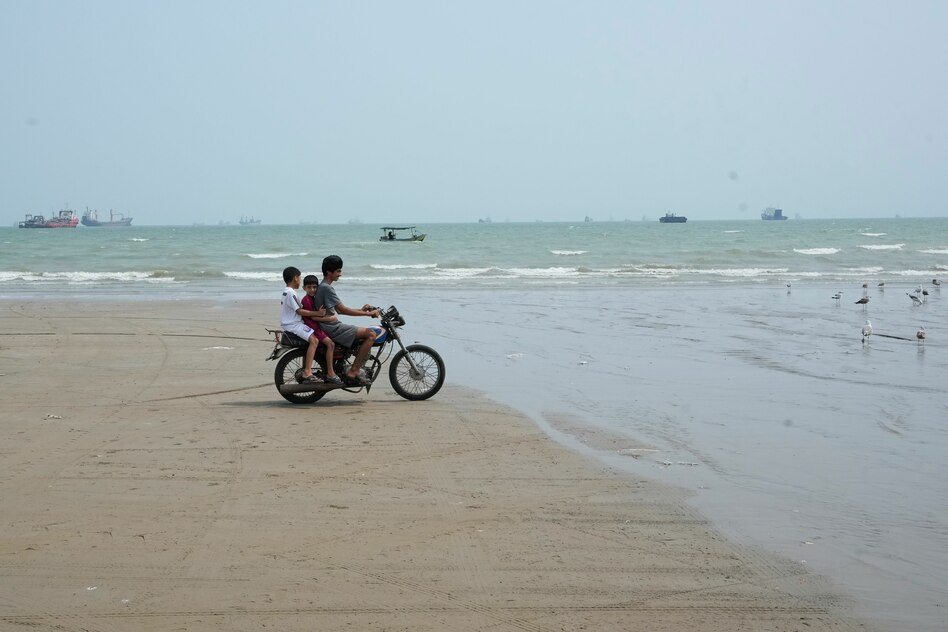
afp | A public response from the US government to an Iranian proposal to reopen the Strait of Hormuz within seven days is still pending - but according to a media report, US President Donald Trump has rejected it. As the Wall Street Journal reported on Friday (local time), Trump doubts that Tehran will meet the conditions set by Washington. Meanwhile, Iranian President Massoud Peseschkian said that Supreme Leader Moschtaba Khamenei also supported the new plan. Saudi Arabia reported new attacks by the Iran-backed Houthi militia on Saturday.
The Wall Street Journal, citing US government officials, wrote that Trump was considering resuming attacks on Iran after the congressional midterm elections in November. On Truth Social on Friday evening, Trump posted a map of the Strait of Hormuz labeled “Trump Strait.”
During a joint visit with Chinese President Xi Jinping to the National Archives in Washington, Trump was fundamentally confident about the reopening of the Strait of Hormuz. “I think we’ll do a great job,” he said in response to a question from journalists. Trump also confirmed that he had spoken to Xi about the Iran war.
"The seven-day period begins as soon as the United States accepts this plan," Iran's Foreign Minister Abbas Araghchi said earlier at the UN in New York. The decision now rests with Washington. The steps that the USA must take to achieve this are “not new,” emphasized Araghtschi. “They are all already included in the framework agreement signed with Washington in June.”
On Tuesday, Araghchi had already sent US envoy Steve Witkoff seven conditions for an end to the war and the reopening of the strait. According to Iranian information, this includes a seven-day cessation of hostilities in the region, including Lebanon, as well as the release of frozen Iranian assets, the lifting of sanctions against Iranian oil and an end to the US naval blockade of Iranian ports.
Iranian President Massoud Peseschkian also called for a return to the framework agreement agreed in June. “If the United States agrees to act in this way, everything will go back to the way it was before,” he told CBS. The trial could begin on the day Washington agrees. The plan had been “coordinated” with Khamenei, he emphasized on Saturday.
The June agreement between Washington and Tehran was intended to end the fighting, reopen the Strait of Hormuz and allow talks on Iran's nuclear program. However, she collapsed shortly afterwards. The war began at the end of February with US-Israeli attacks on Iran. Tehran has largely blocked the Strait of Hormuz, which is important for world trade, since the beginning of the war, and the USA, for its part, imposed a naval blockade of Iranian ports.
According to Iranian state media, Peseschkian made his way back to Tehran after taking part in the UN general debate in New York. According to the Iranian presidency, Peseschkian spoke with UN Secretary-General António Guterres there and said: "Iran has not withdrawn from the negotiating table, but given past experiences, it no longer trusts the United States."
Meanwhile, the Saudi-led military coalition said on Saturday that its air defenses had destroyed two drones launched by Yemen's Houthis en route to the capital region of Riyadh. In addition, a ballistic missile was intercepted that was aimed at the city of Khamis Mushait. There is an air force base there.
A member of the Houthis' political office, Hesam al-Assad, threatened further escalation. Despite the strength, scope and impact of the recent attacks, the militia sees them as just a “small exercise” for a full-scale escalation, he explained.
The Gulf Cooperation Council (GCC) strongly condemned the Houthis' attacks. “This dangerous escalation represents a blatant violation of the Kingdom’s sovereignty and poses a direct threat to the security of civilians and the stability of the region,” said GCC Secretary General Jazem Mohamed Albudaiwi.
The Iran-backed Houthis have imposed a naval blockade on Saudi Arabia, attacked Saudi tankers and taken control of large parts of Yemen's Red Sea coast. The coast is important for Saudi Arabian oil exports. According to the UN, 138,000 people have been displaced within Yemen since fighting resumed in July, including 70,000 children. The UN Security Council on Friday “strongly condemned” the Houthi attacks on Saudi Arabia.
Read the full story at the source
Source: taz