
Germany · taz · 1d
Festival Kirill & Friends Berlin: A rarely experienced serious lightness
Deutsch (original) · Auto-translated to English
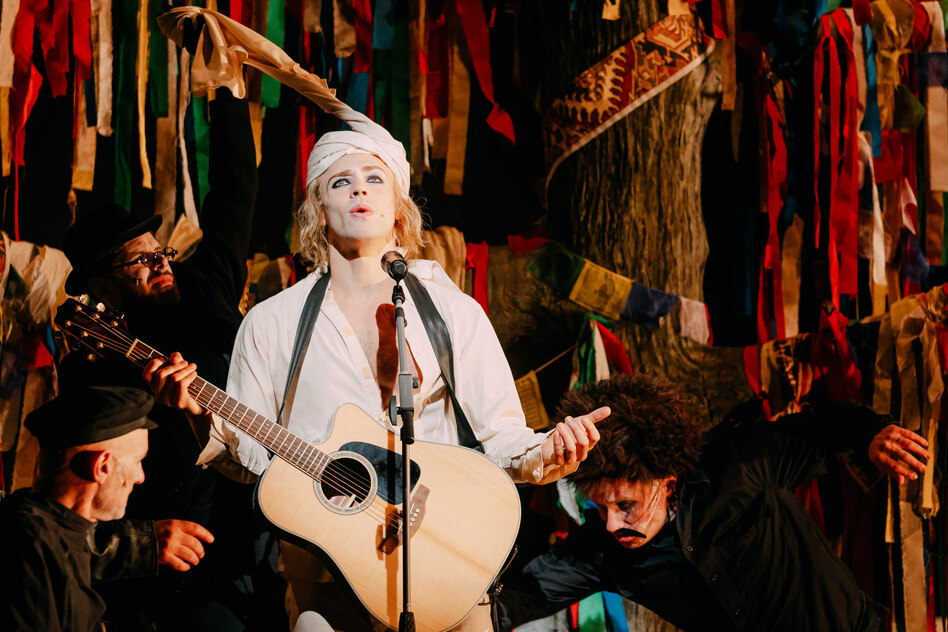
Kirill Serebrennikov has powerful enemies. A few years ago, the theater maker in Russia was charged with criminal charges and placed under house arrest. But he continued to stage anyway – via Zoom. His theater, the “Gogol Center” in Moscow, is a thing of the past in an autocratic state that sanctions independence at all levels.
Serebrennikov, who was well connected in the European theater scene even before his persecution by the Russian state authorities, now lives in exile in Berlin. He is in great demand as a director of opera and plays at major German-speaking theaters. His films regularly screen in Cannes. For three years he has been putting his excess energy into the “Kirill & Friends” project. A theater company that consciously brings together artists from different disciplines and cultural contexts.
The “Kirill & Friends Berlin Festival” now brings together the works created at various locations into a compact showcase. The opening was Kirill Serebrennikov's Hamburg production “Legend”, a declaration of love to the Soviet filmmaker Sergei Parajanov. “I watched his films over and over again when I was young, so they became part of my identity,” he confesses. Along with Andrei Tarkovsky, Parajanov probably has the most unique style in Soviet cinema when it comes to cinematic means and themes. Beguiling color tableaus that burn into the visual memory are characteristic of the Armenian cinema art.
Kirill & Friends Berlin Festival, various locations. Until September 13th
Red, the full red from Parajanov's films, repeatedly dominates the stage of Berlin's Schiller Theater. For four short hours you are in another world that arises from zero to a hundred, when in the first rank a Georgian choir soloist brings forth sounds from the depths of his body that flood the hall and penetrate all layers of skin. Ten legends are told and a small language Babylon is established, as Kirill's company members come from many corners of the world.
It is an overwhelming work of art that is musically characterized by an intense carpet of sound, created live by Daniil Orlov on the keyboard, the Georgian male choir Schavnabada and the soprano Svetlana Mamrescheva. In the game, Filipp Avdeev and Nikita Kukushkin, both of whom were in Serebrennikov's Moscow acting class, jump through the waist-high grass like large beetles. In general, a serious lightness is established that is rarely experienced on German stages, as it is about life and death, but with the option that existence continues after death in any case. Only the perspective has shifted slightly.
In the first legend, Karin Neuhäuser plays a dead mother whose whole sorrow is for the fur coat she left behind. From the beginning she is the secret center of gravity of the production. If some pathos builds up, she nonchalantly intervenes. And then she makes her really big appearance as an aging diva who is reminiscent of Marlene Dietrich.
Even as a young man immediately after the Second World War, Parajanov was convinced that he was a genius. The red neon sign “I’m genius” reminds us of this. Serbrennikov puts the last words of the evening into his alter ego's mouth: "After us, all that remains is the beauty that we have achieved. I have achieved a lot of beauty. And that's a good thing."
Nikita Efimov accompanied Kirill & Friends on their search for clues and during rehearsals for “Legend”. “Making Legende” is one of five films that accompany the theater program. Also included is Serebrennikov's sensitive portrait “Tchaikovsky's Wife”. The feature film debuted in competition at Cannes four years ago, but was never released in German cinemas. The heart of the festival is the “Ampersand (&) Grant” initiative. On the last day of the festival, five artists working in exile in Germany will be awarded a scholarship and accepted into the “Circle of Friends” of Kirill & Friends.
Serebrennikov sits relaxed with August Diehl in St. Matthew's Church. Diehl can be seen at the festival in “Blizzard”. When asked about the peculiarities of German acting, he says: “In Germany there are as many acting schools as there are churches.” What remains in your mind is definitely the charming miniature copy of the Treptow Soviet soldier in the foyer of the Schiller Theater. In contrast to the original statue, it appears to be floating.
Read the full story at the source →
Source: taz