
Germany taz
Festival “Female-Fronted Is Not A Genre”: It remains complicated, even in the 50th year of punk
How diverse is subculture? In Berlin, the “Female-Fronted Is Not A Genre” festival focused on female voices in punk and hardcore. more...
Deutsch (original) ·Auto-translated to English
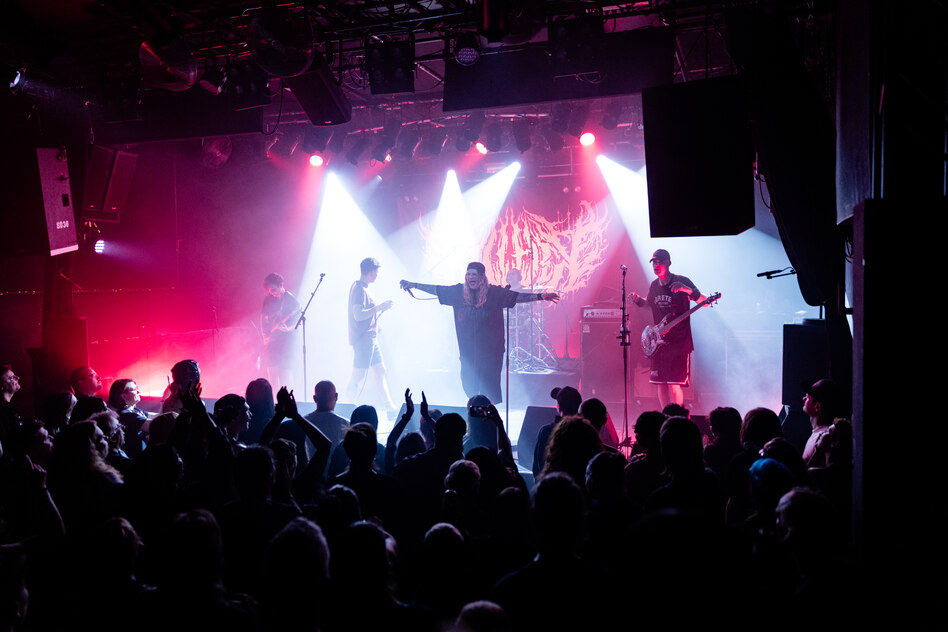
It is a mild autumn evening on Kreuzberg's Oranienstrasse and a sizeable crowd of people has already gathered in front of the entrance to SO36. For the fifth time, the “Female-Fronted Is Not A Genre” festival is inviting people to the club for two evenings to focus on the alleged equal treatment of the genders in subcultures.
Because punk and hardcore are still dominated by men, only “female voices” and “female-female bands” are on the program, as the announcement states. The somewhat unwieldy vocabulary suggests how attempts to make marginalized positions visible can result in an emphasis that says nothing about the artistic work.
The festival name comments on this effect by negating the prefix “female fronted” as a meaningless description of bands, regardless of the fact that the announcement of non-male people on stage can also be understood as supportive. It remains complicated, but in the 50s of punk it is a remarkable feature of this infinitely small-scale genre that the demands and realities within the scene are constantly reflected and updated.
The opening evening begins on time and in the well-filled hall, the Dutch singer and guitarist Wick Bambix takes on the role of the charming opener. Two acoustic guitars and smoky vocals define their folk punk with a rebellious attitude and occasional country touch. The audience is as attentive as they are ready to sing along – not for the last time on this young evening.
In keeping with the musical range the organizers are aiming for, the alternative metal quintet Never Obey Again takes the stage next. Presence, songwriting and sound make it clear that the band is striving for greater things and is not afraid of a mainstream interpretation of metal. They drove twelve hours from Italy to play here, says singer Carolina Bertelegni and seems honestly overwhelmed that her band has been so enthusiastically received by the Berlin audience. A popular explanation for the absence of women in the line-ups of major rock and metal festivals is the claim that there aren't enough bands with women playing at a professional level - here is one.
During the subsequent set by the queer-feminist hardcore band Kill Her First, the music is more straightforward again. In front of a classic instrumentation of drums, bass and guitar, Gero Crocianelli and Giulia Campagna sing and growl their way through a mixture of powerful breakdowns and melodic parts. Audibly trained in punk and old school hardcore, the band sprinkles in gentle passages here and there before anger and energy push the whole thing back into the Kreuzberg underground.
“You are the best audience,” says singer and co-organizer Gero Crocianelli happily about the enthusiastic crowd and emphasizes the vision of her festival as an inclusive place. The event on this opening evening lives up to the aim of making non-male people visible in a subculture that often appears masculine and uninviting to outsiders, even if most of the instruments in the line-up are still played by men. Beyond pure numerical ratios, the organizers are concerned with an atmosphere of solidarity without bias and with sovereignty over who can feel at home in subcultural spaces.
The American punk band The Iron Roses also repeatedly points out the utopia of an inclusive scene during their final concert. Their melodic punk with characteristic two-part singing and well-dosed ska elements rounds off a varied concert evening, which here once again experiences an explicit focus on the visibility of queer positions in the scene.