
World · taz · · 2h
FAQ: What is anti-Semitism?: “Kill all Jews” is not the only problem
Deutsch (original) · Auto-translated to English
On October 7, 2023, the Islamist Hamas and its allies murdered almost 1,200 people, most of them Jewish, but also Arab Israelis and foreigners. More than 5,000 people were injured and around 250 were taken hostage. This terrorist attack was the largest massacre of Jews since the Shoah. Anti-Semitism has also increased again in Germany since 2023, and it often refers to Israel. When criticism of Israel is anti-Semitic and when it is not is highly controversial. But all definitions agree on some points. An overview – without any claim to completeness.
Scientists have been trying to give a definition to the phenomenon since 1945 - and are writing entire shelves full of it. Even among Jews there is no agreement about the one correct understanding. It also depends heavily on the context and there are many shades of gray. Various sides also repeatedly exploit definitions for their political purposes.
One of the oldest forms is Christian anti-Judaism, which rejects Judaism for religious reasons and justifies this with accusations that it was the Jews who killed Jesus. Secondary anti-Semitism, which often occurs in the German political center, consists of the defense of guilt for National Socialist crimes. For example, the Shoah is trivialized or Nazi crimes are denied. An example of this is the “final line” demand first raised by the FDP in 1949, which has since been adopted by the AfD. In addition, there is Islamist, national, annihilation or redemption anti-Semitism. In addition, anti-Semitism often occurs together with other forms of discrimination - from racism to anti-queer sentiment.
"Anti-Semitism is a certain perception of Jews, which can be expressed as hatred towards Jews. Anti-Semitism is directed in word or deed against Jewish or non-Jewish individuals and/or their property, as well as against Jewish community institutions or religious institutions." This is a working definition from the International Holocaust Remembrance Alliance, or IHRA for short. The organization, which has 35 member states, was founded in Stockholm in 1998 and aims to promote education, research and remembrance of the Holocaust. Its definition was announced in 2015 and includes 11 specific examples, including Israel-related anti-Semitism. Most German authorities and anti-Semitism officers use this definition.
“Anti-Semitism is discrimination, prejudice, hostility or violence against Jews as Jews (or Jewish institutions as Jewish),” says the Jerusalem Declaration on Anti-Semitism (JDA), published in 2021 as an explicit alternative to the IHRA. Among the authors are the historian Aleida Assmann, the Jewish Holocaust researcher Amos Goldberg and the head of the Berlin Center for Anti-Semitism Research, Stefanie Student-Springorum. The Left Party also adopted this definition at its party conference in Chemnitz, but it remains controversial within the party. Some criticized this decision, but other organizations such as the left-wing Israeli party alliance Hadash support it.
The most important difference concerns Israel-related anti-Semitism. The JDA emphasizes that “criticism or rejection of Zionism as a form of nationalism” or “comparing Israel to historical examples including settler colonialism or apartheid are not inherently anti-Semitic.”
For example, when Jewish people, individually or as a group, are held responsible for the policies of the Israeli government, for example a German Jew with no connection to Israel. If criticism of Israel contains anti-Jewish clichés, it is anti-Semitic.
No. Even under the “stricter” IHRA definition, “criticism of Israel that is comparable to that of other countries cannot be considered anti-Semitic.”
The 3D rule can be an instrument to put your own thinking to the test. This is not a definition and if one point is met you are an anti-Semite, but it simply serves as a tool to take a look at the motives behind statements.
The first “D” stands for “demonization.” What this means is that Israel is portrayed as absolute evil. For example, when Israel is equated with Nazi Germany, Palestinian refugee camps with concentration camps, or Gaza with the Warsaw Ghetto.
The second “D” stands for double standards. These occur when Israel is required to behave differently than other states, for example when Israel is denied the right to defend itself but Ukraine or Iran is granted the same. Or when human rights violations by the Israeli state are problematized, but those by countries like China or Russia are not. Unlike the IHRA, the JDA does not consider excessive criticism and even double standards to be anti-Semitic per se.
The third “D” stands for “delegitimization”: This denies the state its right to exist. For example, when it is claimed that the state itself is racist. The sentence that is currently being heard more often is: “People have a right to exist, states don’t.” The aim of this argument can be to deny the country the right to self-defense and the people there a safe life in their own state.
Thinking and talking about future models such as a “one-state solution” for the territory of Israel/Palestine, which would mean the destruction of the State of Israel in its current form, is not inherently anti-Semitic from the perspective of the JDA definition. Due to the current crimes of the Israeli army in Gaza, through which Israel is delegitimizing itself, the 3D rule is of only limited use today, some believe. Others, however, find it more important than ever due to the hostile climate against Israel around the world.
BDS stands for “Boycott, Divestment and Sanctions” and is the name of an international campaign. This calls for an end to the occupation of Palestinian territories, equal rights for Arab Israelis and an unrestricted right of return for refugees. To this end, BDS calls for an academic, cultural and economic boycott of the Jewish state of Israel. According to the JDA definition, these are “common, non-violent forms of political protest against states” and “not anti-Semitic per se.” From the perspective of the IHRA definition, the BDS campaign is anti-Semitic because it demonizes and delegitimizes Israel. It is reminiscent of National Socialist calls such as "Germans! Defend yourself! Don't buy from Jews!" and is supported by anti-Semitic terrorist groups such as Hamas, the Palestinian Islamic Jihad (PIJ) and the Popular Front for the Liberation of Palestine (PFLP).
Only very few people who have anti-Semitic thought patterns actually take action, but they live in a climate in which even anti-Semitic statements often go unchallenged. According to police statistics, which use questionable categories and never record all crimes, anti-Semitic crimes increased by 5 percent in 2025 compared to the previous year. The absolute majority, namely 3,056 acts, were committed by right-wing extremists, followed by 2,239 acts behind which the police see a “foreign ideology” and which they include, for example, Islamists. “Leftists” are the smallest group of all suspects, who are associated with only 129 crimes. Overall, the police see almost half of all crimes in connection with the Middle East conflict. Alternative counts are available from the Research and Information Center (RIAS), which is based on the IHRA definition and registered a total of 8,725 cases of anti-Semitism for 2025.
Conservatives or right-wingers often exploit the accusation of anti-Semitism in order to weaken left-wing causes and actors. Only rarely do leftists currently commit anti-Semitic crimes. But although people who identify as left-wing are less likely to share anti-Semitic assumptions, it is not impossible. These often shape people's worldview unconsciously and/or unintentionally.
But left-wing arguments can also lead to anti-Semitism, for example through a shortened criticism of capitalism: when people do not (want to) understand complex social structures - such as exploitation mechanisms and system constraints - but instead (want to) blame specific people for the unreasonable demands in this world. A typical distinction is made between (good) “creating” capital and (bad) “absorbing” (financial) capital. Phrases like “The Rothschilds control the world” are hidden anti-Semitic narratives about the supposed power of “Jews” over banks and international finance. These thought patterns became visible again and again through symbols such as “octopuses” during protests critical of globalization.
This is highly controversial among leftists. Some authors such as Gerhard Hanloser see this primarily as a “fighting concept” for conservatives. Others consider a blanket rejection to be an attempt to deflect guilt. Authors such as Olaf Kistemacher do not consider anti-Semitism on the left to be a slip-up, but rather a fundamental problem in communist theoretical traditions, which he traced to the present day in a study of the KPD in the Weimar Republic. The topic is repeatedly discussed using writings such as Karl Marx’s “On the Jewish Question” (1844). Currently, anti-Semitism from the left is most evident in the Middle East issue.
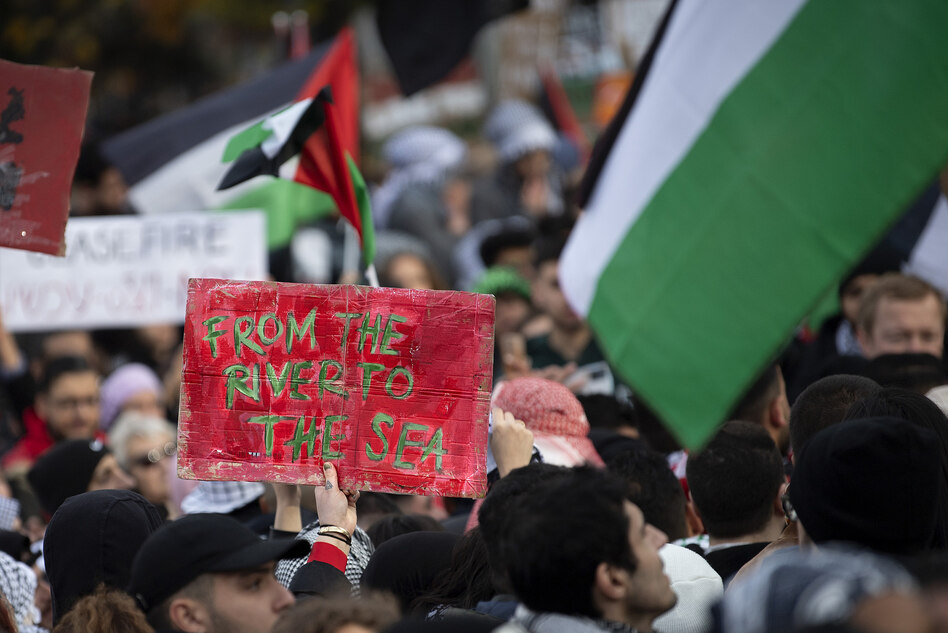
Calls such as “Free Palestine” or “From the River to the Sea…” are often heard at pro-Palestinian protests. Whether this is viewed as anti-Semitic depends on how you understand it: If it is said that Israel should disappear from the map - without there being a safe space for Jews or that they should even be eliminated together with the state - that is viewed as anti-Semitic. German Jews who would like to demonstrate against the war in Gaza and for the freedom of Palestinians also feel threatened by such slogans and are partly staying away from these demonstrations. But if this means that regulations are needed that should bring equality to all people between “the river”, i.e. the Jordan, and the sea, that is not anti-Semitic. This is roughly how the JDA definition sees it. The IHRA does not take an explicit position on geopolitical issues, but emphasizes the population's right to self-determination.
What is important is that the composition of these demonstrations is very mixed. Not everyone there is left-wing. And not all, but some of the (anti-imperialist) leftists there sympathize or even collaborate with groups like the Popular Front for the Liberation of Palestine (PFLP) or with Islamists - who are also present at these demos. Some of those who attend these demonstrations are themselves suffering from the war in Gaza, for example because they have lost relatives as a result. Still others simply feel sorry for the Palestinians and are not aware that some of them are demonstrating there with anti-Semites.
In this context, October 7th is repeatedly celebrated as the day of “liberation” or the Hamas massacre is described as “legitimate resistance” – thereby relativizing the anti-Semitic violence. For example, in the demonstration registered for this Wednesday in Berlin under the title “Until total Liberation”, in which the call praises October 7th as a “beacon of steadfastness” and quotes its mastermind, the former Hamas boss.
Anti-Semitism is not just a 'wrong' image of Jews that can be corrected by a 'correct' one, as experts Tom Uhlig and Katharina Rein write in their 2019 essay "Antisemitism: Connecting People". According to them, anti-Semitism is “an emotionally motivated form of thought” that is difficult to dispel through rational arguments. It is an “anti-democratic impulse” that attempts to resolve political conflicts through one-sided blame.
The common hatred of the artificially created enemy image unites people who otherwise cannot stand death. From a psychoanalytic perspective, anti-Semitism fulfills the same function for all people: Anti-Semitism fulfills a longing for simplification in a complex world. It makes it possible to project contradictions and undesirable characteristics onto someone else, namely the figure of the Jew, so that you don't have to deal with them (critically) yourself. This leads to Jews being attributed completely contradictory characteristics at the same time: instinctive and uptight, capitalist and Bolshevik, effeminate and patriarchal. Science therefore also speaks of a chameleon function: Depending on the political orientation, anti-Semitism fulfills different goals (see types of anti-Semitism).
For example, on house walls – and not just in the much-discussed Berlin district of Neukölln, but nationwide. One example of many: In the Hamburg subway, the war crimes committed by the Israeli army in Gaza were described as the “Holocaust”. This puts the Shoah into perspective and is anti-Semitic according to both the JDA and IHRA definitions. The same applies to marking Jewish front doors with red Hamas triangles or calls for violence against Jews - even if these are packaged in codes such as "Kill all Juice", as in a scribble at the University of Cologne.
But. Anti-Semitic violence occurs again and again. In addition to shoving and attacks, for example on people with yarmulkes, there are also repeated calls for murder or bloody attacks. Last year, an IS member injured a Spanish tourist, whom he mistook for a Jew, at the Holocaust memorial in Berlin. The year before, a Berlin student beat up his Jewish fellow student Lahaf Shapira after an argument about Israel, causing him to suffer broken bones and a cerebral hemorrhage. Although the regional court did not consider the act to be anti-Semitic, the district court, experts and the person affected did.
Read the full story at the source
Source: taz