
World taz
Expert on prediction markets: “These markets can drive disinformation”
Betting on so-called prediction markets easily created artificial election campaign momentum in the US midterms. The Trump family also earns money. more...
Deutsch (original) ·Auto-translated to English
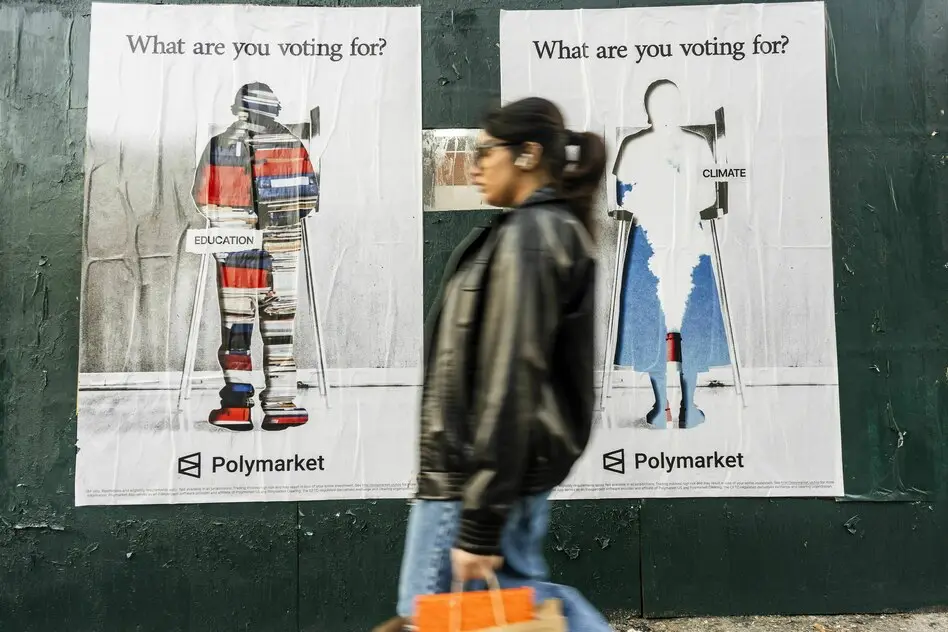
taz: Mr. Hornsby, so-called prediction markets played a big role in the US midterms. Their data was used by CNN and other media for their forecasts. What is this even about?
Michael Hornsby: Prediction markets are prediction platforms where people trade contracts on how likely a particular event is. Providers like Polymarket or Kalshi seem like betting sites at first glance, but they work differently. There are no bookmakers who set the odds, but people trade directly with each other: one side is actually betting on “Yes, that will happen”, the other on “No, that won't happen”. Both enter into a contract for one price. When the event is over, the correct contract will be paid out.
Michael Hornsby is co-director of the Anti-Corruption Data Collective (ACDC). The non-profit organization studies how technologies such as cryptocurrencies and prediction markets influence anti-corruption and democracy.
taz: Why do many people bet money on such platforms and not with classic betting providers?
Hornsby: In the USA, prediction markets are treated more as financial instruments than as gambling and, in addition to sports, can also offer markets on elections, politics or culture. And Polymarket, based offshore in Panama, even offers markets on military issues. Many people find this exciting because they can use information from the media, from other people, or from their professional expertise to try to monetize their perceived information advantage over the rest of the market.
taz: Your collective has now observed and analyzed how the US midterm elections were mapped on prediction markets. With what result?
Hornsby: We were able to see about 28,000 different markets for the congressional elections in our analysis. According to our rather conservative calculation, a total of over 440 million US dollars flowed into prediction markets during the midterms. Other estimates put it at over a billion.
taz: Which events could you bet on?
Hornsby: The questions in these markets can be quite simple, for example: “How likely is it that candidate X will win the election?” But there are also very detailed bets, for example on whether a news agency will announce the election results by a certain time, whether Obama will support a candidate in the election campaign or who Trump will support by a certain date.
taz: What dangers do prediction markets have for elections?
Hornsby: We first looked at Prediction Markets primarily with an eye on insider trading. The danger of people with confidential information betting on these markets, like with the Maduro arrest. When we saw how many individual markets opened during the midterms, it became clear: many of these markets have very little volume, meaning little has been invested in them. These markets are vulnerable to individuals with a lot of money being able to shift the price and displayed probability of an event. Our concern is that targeted disinformation can be carried out around elections.
Hornsby: In 96 percent of the midterm markets we examined, the price could be moved by five percentage points with less than $3,500. If one side of the campaign or the media picks up on that and says, "Look, there's momentum here, this person is ahead," that influences the entire information landscape surrounding the election and possibly even how people end up voting.
taz: Were there any such incidents in the run-up to the midterms?
Hornsby: The problem is that it's difficult for us to attribute price movements to clear intent. A concrete example is the mayoral election in Los Angeles with candidate Spencer Pratt, a reality TV star. There was a kind of fan base on Prediction Markets that quickly bought up his crashed forecast after poor surveys. Such dynamics show that markets not only reflect information, but could also highlight deliberate attempts to visibly keep a candidate's chances high.
taz: In the presidential elections in Brazil, the platforms' forecasts were quite wrong. They were pretty accurate in the midterms. Polymarket and Kalshi celebrate themselves for announcing correct results particularly quickly.
Hornsby: Prediction markets were right quite often in the midterms, but that also applies to many polls. What you can clearly see is an acceleration effect. Prediction markets pick up on election night sentiments and trends earlier and sometimes more strongly. If it seems like this is a huge win for the Democrats, a lot of people are quick to invest. The real question is therefore whether prediction markets really provided additional knowledge or, above all, reflected what was already known.
taz: Who will win in the end at Prediction Markets?
Hornsby: A small percentage of users make the majority of the money. Numerous studies show that the top one percent skims off the majority of the profits. What does it cost society if we accept that many people will lose money on these platforms in order to make election predictions a little faster, perhaps a little more accurate?
taz: Donald Trump Jr. is an advisor to Kalshi, holds shares in the company and sits on the advisory board of Polymarket. What role does he play?
Hornsby: The presidential family's political backing for these markets must be viewed primarily with a view to regulation: the chairman of the responsible regulatory authority, a Trump appointee, is pursuing a very industry-friendly course. At the same time, an investment company in which Donald Trump Jr. has a stake led a large round of financing for Polymarket.
taz: What could the new majorities in Congress change in terms of regulation for the platforms?
Hornsby: There are already numerous legislative proposals with support from both parties, but they have made little progress. Some want to give responsibility back to the states. Others aim to limit the involvement of military and political insiders. With Democrats in control of key oversight bodies, the role of the national regulator is expected to come under greater scrutiny.
The research was made possible by the Daniel Haufler scholarship from the taz panter foundation.